
State vs. Federal Unclaimed Property Programs: Understanding the Difference
Unclaimed money is managed at multiple levels of government. Learn how state and federal programs differ in scope, rules, and how to search each one.
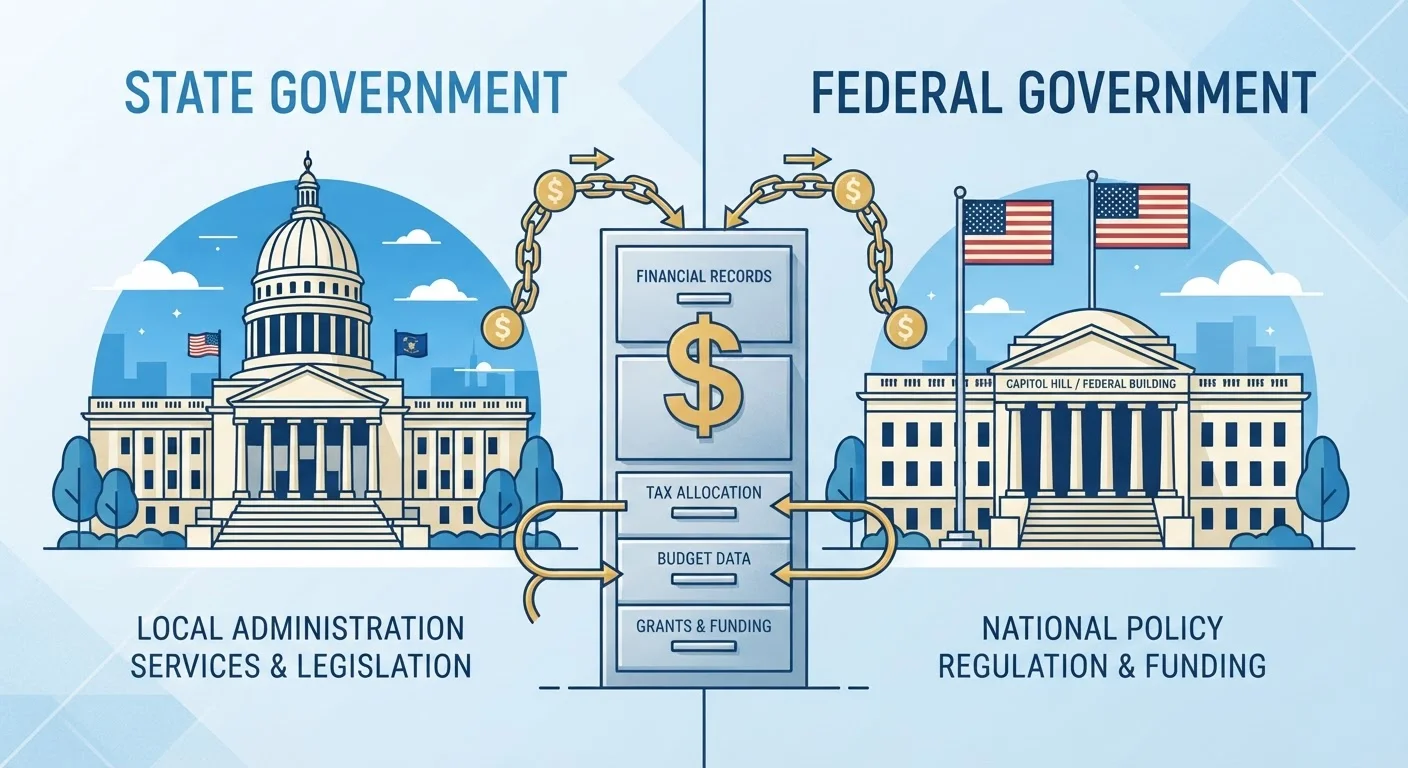
Photo: searchopenrecords editorial
—— In This Article
Key Takeaways
- State programs handle most unclaimed property — dormant accounts, uncashed checks, and abandoned assets from private holders.
- Federal programs are agency-specific and cover funds owed directly by the U.S. government, not private companies.
- Searching one level does not substitute for the other — a thorough search requires checking both state and federal sources.
- All legitimate state and federal search tools are free to use; no payment is required to search or file a claim.
- State dormancy rules and claim procedures vary significantly; federal agencies each operate under their own regulations.
Who Controls Unclaimed Property — and Why It Matters
When most people hear "unclaimed money," they picture a single searchable government database. In reality, unclaimed property is managed across two distinct governmental layers — state and federal — each with its own rules, asset types, and search portals. Knowing which layer holds your funds is the first step toward finding them.
The vast majority of unclaimed property in the United States is handled at the state level. Every state has an unclaimed property law that requires private-sector holders — banks, insurance companies, brokerages, utilities, and employers — to report and remit dormant assets to the state treasurer after a defined period of inactivity, called the dormancy period. Once transferred, the state holds those funds in perpetuity on behalf of the rightful owner, who can claim them at any time without a deadline in most states.
Federal programs operate on an entirely different track. They cover money the federal government itself owes — unpaid tax refunds, unredeemed savings bonds, pension benefits from federally administered plans, veterans' life insurance dividends, and wages owed by federal contractors. These funds never pass through a state treasurer's office; they remain with the originating agency until claimed.
See our guide to federal vs. state unclaimed property searches for a detailed breakdown of what each system covers and how to avoid duplicating effort when searching both.
State Programs: Scope, Rules, and How to Search
State unclaimed property programs are administered by each state's treasurer or controller. The core mechanism is escheatment: after a dormancy period — typically one to five years depending on the asset type and state — holders must turn over abandoned property to the state. The state then makes it searchable through a public portal.
| Criterion | State Programs | Federal Programs |
|---|---|---|
| Administered by | State treasurer or controller | Individual federal agencies |
| Primary asset types | Bank accounts, securities, insurance, utilities | Tax refunds, savings bonds, pensions, VA benefits |
| Unified search portal | Yes — MissingMoney.com and state portals | No — each agency has its own search |
| Who reports the funds | Private-sector holders (banks, insurers, etc.) | Federal government itself |
| Dormancy rules | Set by state law; varies by state and asset type | Set by agency or federal statute |
| Claim deadline | Usually none — funds held indefinitely | Varies by agency and program |
| Cost to search | Free | Free |
Dormancy periods and the types of property covered vary considerably from state to state. A savings account may have a three-year dormancy period in one state and five years in another. How unclaimed property laws vary across U.S. states explains these differences in detail and why they can affect when your property appears in a database.
To search state databases, start with your state treasurer's official website or use the National Association of Unclaimed Property Administrators (NAUPA) portal at MissingMoney.com, which aggregates records from participating states. Both are free. For a reference guide to individual state portals, see a state-by-state overview of unclaimed property portals.
If you've lived or worked across state lines, funds may sit in multiple state databases. The guide to searching unclaimed property across multiple states walks through how to run an efficient multi-state search without missing anything.
Federal Programs: Agency-Specific and Separate from States
Unlike state programs, there is no single federal unclaimed property database. Each agency manages its own fund type, and claimants must go directly to the relevant source:
- Unclaimed tax refunds: The IRS holds refunds for returns that were filed but had an undeliverable address. Check IRS.gov's "Where's My Refund?" tool or file a current-year return to trigger payment.
- Matured savings bonds: The U.S. Treasury holds billions in matured, unredeemed savings bonds. Use the TreasuryDirect website's tools or submit a claim form to the Bureau of the Fiscal Service.
- Pension benefits (PBGC): The Pension Benefit Guaranty Corporation insures certain private-sector pension plans. If your former employer's plan was terminated, the PBGC may hold your benefit. Search PBGC.gov's missing participant database.
- Veterans' benefits: The Department of Veterans Affairs administers unclaimed insurance dividends and benefit payments. Contact the VA directly or use VA.gov.
- Federal wages and contractor payments: The Department of Labor and other agencies may hold unpaid wages from federally covered employment.
Because federal agencies each maintain their own records, there is no shortcut equivalent to MissingMoney.com for the federal side. You must identify which agency is relevant to your situation and search there directly.
Beware of Third-Party Search Services
Both state and federal unclaimed property searches are free through official government portals. Third-party companies may charge fees or a percentage of recovered funds to perform searches on your behalf. While some operate legally, their services are never required — you can always search and claim on your own at no cost. If you use a third-party service, verify its legitimacy before sharing personal information or signing any agreement.
Once you've located funds at either level, the next step is filing a formal claim. Our guide to claiming your money covers required documentation, timelines, and what to expect from the review process. If property is held by more than one state, see claiming funds across multiple states at once for guidance on managing parallel claims.
This article is for general informational purposes only and does not constitute legal, financial, or tax advice. For guidance specific to your situation, consult a qualified professional.

Unclaimed Money Editorial Team
Unclaimed Money Editorial Team is the collective byline for our editorial team and contributor network. Articles published under this byline or an editorial pen name are researched, written, and reviewed according to our editorial standards for clarity, consistency, and independence before publication.
View author profile