
State Title Records vs. Federal Databases: Where VIN Data Comes From
Vehicle history data is aggregated from state DMVs, federal agencies, and insurers. See how these sources differ and why that affects report completeness.
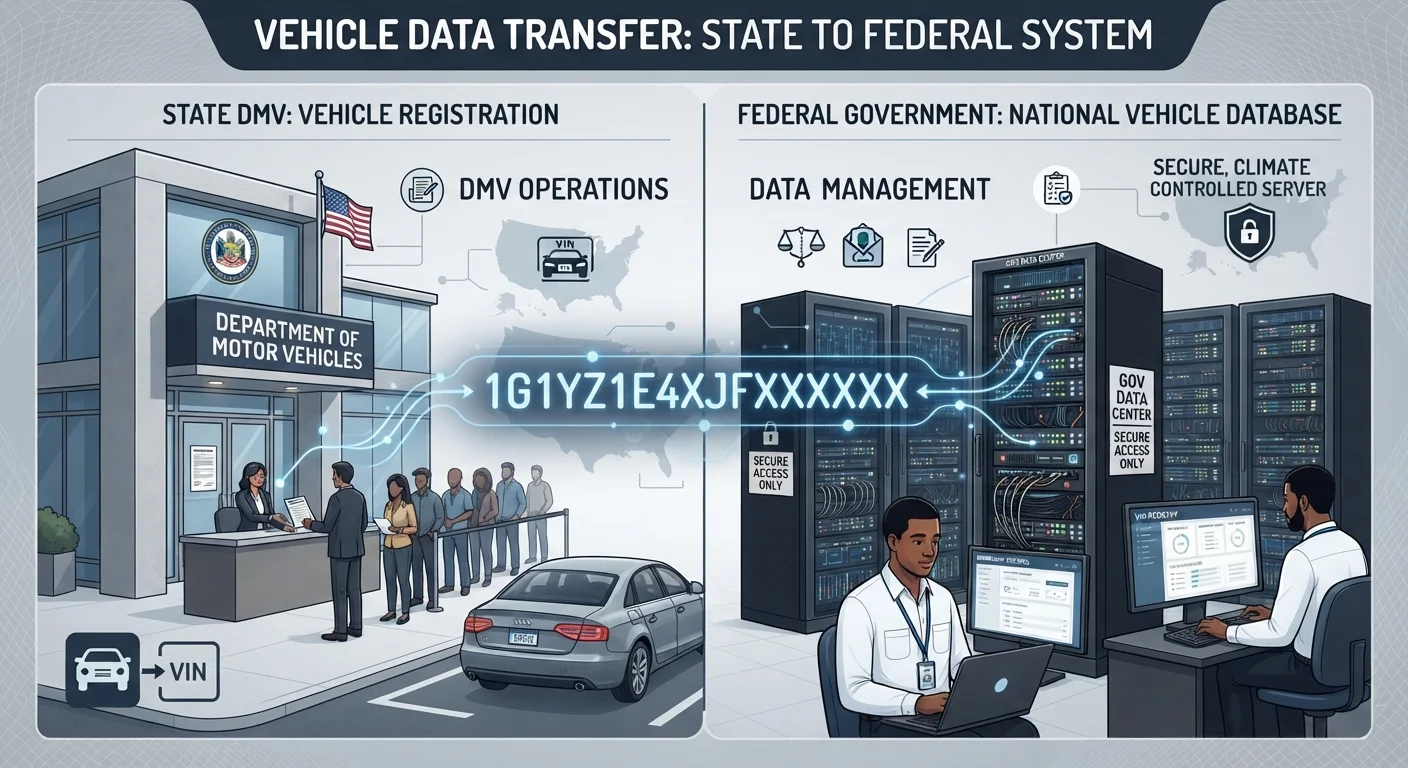
Photo: searchopenrecords editorial
—— In This Article
Key Takeaways
- State DMVs are the authoritative source for title, lien, registration, and odometer records tied to a VIN.
- Federal databases such as NHTSA's systems cover safety recalls, theft reports, and manufacturer data — not ownership history.
- Vehicle history reports aggregate both layers, but coverage gaps exist because state data sharing is voluntary and inconsistent.
- A VIN search is only as complete as the sources that have reported incidents for that specific vehicle.
- Understanding where data originates helps you assess what a report can and cannot tell you about a vehicle.
How the Two Data Layers Work
Every vehicle sold or registered in the United States accumulates records in two distinct systems — state-level title offices and federal agencies — that serve very different legal purposes. Understanding which layer covers what prevents misreading a VIN report. See our complete walkthrough of VIN and title records for background on how the public record trail forms over a vehicle's lifetime.
State title records are maintained by each state's Department of Motor Vehicles (or equivalent agency). When a vehicle is sold, inherited, repossessed, or salvaged, the title transaction is recorded at the state level. These records document the legal owner of record, any lien holders (such as a financing bank), odometer readings at each transfer, and title brands — designations like salvage, rebuilt, flood, or junk that permanently alter the title's status.
Federal databases operate at the national level and are not concerned with individual ownership. The National Highway Traffic Safety Administration (NHTSA) maintains recall and defect data tied to VINs. The National Crime Information Center (NCIC), managed by the FBI, stores reports of stolen vehicles submitted by law enforcement agencies. Neither of these federal systems tracks who owns a vehicle — they track safety and law enforcement information about vehicle models and reported incidents.
| Criterion | State Title Records | Federal Databases |
|---|---|---|
| Governing body | State DMV or equivalent agency | NHTSA, FBI/NCIC, NMVTIS |
| Primary data type | Ownership, liens, title brands, odometer | Recalls, stolen vehicle reports, defect data |
| Scope | State-by-state; sharing varies | National; mandatory manufacturer reporting |
| Legal authority | Certifies ownership and encumbrances | Safety enforcement and law enforcement |
| Reporting requirement | Varies; NMVTIS participation not universal | Manufacturers must report recalls to NHTSA |
| Accident data | Indirectly via salvage/flood title brands | Not directly; law enforcement may report theft |
| Consumer access | Via state DMV or NMVTIS-connected reports | NHTSA recall search free at nhtsa.gov by VIN |
Why State Data Is Fragmented — and What That Means for Reports
A common misconception is that a vehicle history report pulls from a single, unified national database. In reality, the backbone of any history report is state DMV data — and that data is inconsistently shared. States are not federally required to report title transactions to a central repository. Some states participate in the National Motor Vehicle Title Information System (NMVTIS), a federally authorized database that aggregates state title and brand data, but participation levels and reporting timeliness vary by state.
This means a salvage title branded in one state may not immediately appear in another state's records — a gap that can be exploited through a practice known as title washing, where a branded title is re-registered in a state with looser reporting requirements to obscure its history. NMVTIS was created partly to close this gap, but it is not a complete solution.
For consumers, the practical implication is this: if a vehicle spent time registered in a state that reports slowly or incompletely to NMVTIS, events from that period may be absent from a history report. This is one of the core limitations addressed in our article on the limits of what a VIN search can find.
50+
Separate state title record systems in the US
Each US state and territory maintains its own title registry, creating a patchwork of databases rather than a single national ownership record.
~87%
Share of US titles covered by NMVTIS reporting
The US Department of Justice has noted NMVTIS does not yet achieve universal state coverage, leaving a meaningful share of title events potentially unreported to the central system.
Millions
Recalls tracked by NHTSA VIN lookup tool
NHTSA's free VIN-specific recall checker draws on manufacturer-submitted campaigns, covering millions of vehicles across hundreds of separate recall actions.
What Each Source Can and Cannot Tell You
Knowing each layer's scope prevents over-reliance on any single report. State title records can tell you: how many times a vehicle changed hands, whether a lien is currently attached, whether the title carries a brand like salvage or flood, and what the odometer read at each transfer. They cannot tell you about mechanical problems that were never reported to an insurer or state agency, or incidents that occurred in states with reporting gaps.
Federal databases can tell you: whether an open safety recall exists for a vehicle's VIN, whether the vehicle was reported stolen through law enforcement channels, and certain manufacturer-reported defect information. They cannot tell you about private sales, title transfers, or the vehicle's registration history.
Vehicle history aggregators combine both layers — along with insurer-reported accident data, auction records, and fleet records — to produce the reports consumers use. For a detailed breakdown of what those compiled reports actually contain, see what a vehicle history report actually contains. For a comparison of free and paid access options, free VIN lookups vs. paid vehicle history reports explains what each tier actually delivers.
No aggregated report is guaranteed to be complete. A cash-purchase accident repaired privately, never filed with an insurer, and occurring in a state with limited reporting will likely leave no trace in any database. Treat VIN reports as a strong but imperfect research tool, not a definitive certification of a vehicle's condition or history.
Check NHTSA Recalls Directly — It's Free
Consumers can search for open safety recalls on any vehicle at no cost using the VIN lookup tool on NHTSA's official website (nhtsa.gov). This federal tool is authoritative for recall status and does not require a paid history report. It does not, however, provide title or ownership information — for that, you need state-sourced records.

Vin Search Editorial Team
VIN Search Editorial Team is the collective byline for our editorial team and contributor network. Articles published under this byline or an editorial pen name are researched, written, and reviewed according to our editorial standards for clarity, consistency, and independence before publication.
View author profile