
Free VIN Lookups vs. Paid Vehicle History Reports: What Each Actually Provides
Free VIN decoders and paid history reports serve different purposes. Understand what data each source draws from before you rely on either.
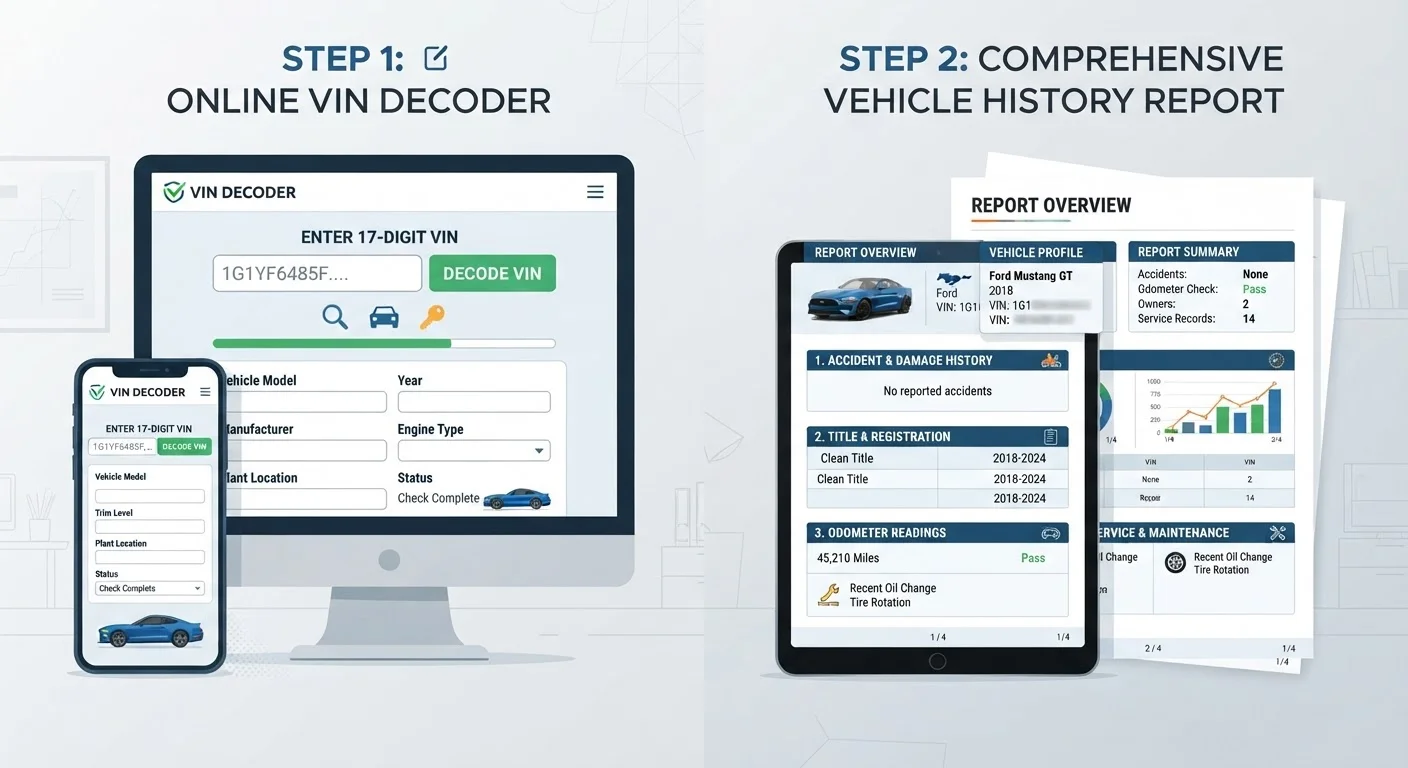
Photo: searchopenrecords editorial
—— In This Article
Key Takeaways
- Free VIN decoders decode the vehicle's built-in specification data; they do not pull event history.
- Paid reports aggregate records from state DMVs, insurers, and federal databases to show what happened to the vehicle.
- Neither source is complete on its own — coverage gaps exist in both public and reported data.
- Understanding what each tool actually draws from helps you use both more effectively.
- A paid report is most valuable when you need title, accident, or odometer history before a purchase.
What a VIN Actually Encodes
A VIN is a standardized 17-character string assigned to every road vehicle manufactured for sale in the United States after 1981, governed by NHTSA regulations. Each character position carries a specific meaning: the first three characters form the World Manufacturer Identifier, characters four through eight describe vehicle attributes such as body style, engine type, and restraint systems, and the final group encodes model year, plant, and production sequence.
This is the data a free VIN decoder reads. When you enter a VIN into a free lookup tool — including the official NHTSA decoder at vpic.nhtsa.dot.gov — the tool translates those character positions into human-readable specifications. What it returns is essentially a reading of the vehicle's birth certificate: make, model, year, trim, engine, country of manufacture. No event has to be reported anywhere for this data to appear — it is baked into the VIN itself.
For a deeper look at how state and federal agencies contribute differently to the record ecosystem, see our article on where VIN data comes from.
What Free VIN Lookups Do and Don't Provide
Free VIN decoders are accurate and useful for specification verification. If a seller claims a truck has a particular engine or a car was built in a specific plant, a free decoder can confirm or contradict that claim in seconds. This makes them valuable for spotting misrepresented listings or verifying that a VIN plate matches what the seller describes.
What free decoders cannot do is tell you anything about the vehicle's history after it left the factory. They have no access to:
- State DMV title records (ownership transfers, salvage or rebuilt titles)
- Insurance company claim data
- Accident reports submitted to law enforcement or insurers
- Odometer disclosures recorded at sale
- Recall completion status beyond what NHTSA's separate recall database provides
The NHTSA recall lookup tool is a separate, free resource that cross-references a VIN against open safety recalls — and it is worth using independently of any history report. But it, too, draws only from a specific federal dataset and does not reflect title or accident history.
| Free VIN Decoder | Paid Vehicle History Report | |
|---|---|---|
| Primary data source | NHTSA manufacturer database | State DMVs, insurers, auctions, fleets |
| Specification data (make, model, engine) | Yes — decoded from VIN structure | Yes — typically included |
| Title history and brands | No | Yes, where reported to DMV |
| Accident and damage records | No | Yes, where reported to insurer or auction |
| Odometer disclosure history | No | Yes, from title transfer filings |
| Open recall lookup | Via separate NHTSA recall tool | Often included |
| Cost | Free | Typically a per-report or subscription fee |
| Coverage gaps | Cannot show any post-sale events | Private sales, unreported incidents |
What Paid Vehicle History Reports Actually Aggregate
Paid history reports are compiled by data aggregators who license or collect records from multiple sources: state DMV title filings, auction records, insurance total-loss declarations, fleet and rental company disclosures, junkyard and salvage yard notifications, and in some cases law enforcement records. The breadth of sourcing is why these reports can surface information that no single public database contains.
Key data categories a paid report typically attempts to cover include:
- Title history: How many owners, in which states, and whether the title ever carried a brand (salvage, flood, rebuilt, lemon law buyback).
- Odometer readings: Disclosed mileage at each ownership transfer, useful for detecting potential rollback.
- Accident and damage records: Incidents reported to insurers or recorded at auctions — not all accidents appear, only those that generated a reportable event.
- Use history: Whether the vehicle was registered as a rental, taxi, fleet unit, or government vehicle.
For a thorough breakdown of what each field means, see what a vehicle history report actually contains.
Critically, paid reports are only as complete as their source data. A cash sale with no title transfer recorded, an accident that was never reported to an insurer, or damage repaired privately will typically not appear. This is not a flaw unique to any one provider — it reflects the structural limits of how incident data flows into commercial databases. Our guide on the limits of VIN search data explains these gaps in detail.
Choosing the Right Tool for Your Situation
Neither tool replaces the other, and neither replaces a physical inspection by a qualified mechanic. Think of them as operating at different layers of due diligence:
- Free VIN decoder: Use first, to verify the vehicle is what the seller claims it is at the specification level.
- Paid history report: Use when you are seriously considering a purchase, to surface title brands, ownership patterns, and reported damage events.
- Physical inspection and document review: Use alongside both, to catch what neither database captures.
If a paid report raises questions — unfamiliar title brands, odometer inconsistencies, or a gap in ownership history — those findings deserve investigation before proceeding. Our walkthrough on interpreting a vehicle history report explains how to read each section with confidence, and our article on red flags in vehicle history reports covers the patterns that warrant closer scrutiny.
It is also worth knowing that the same VIN can produce different results from different paid providers, because each aggregator maintains its own source agreements. Why the same VIN can produce different reports explains why discrepancies occur and how to reconcile them.

Vin Search Editorial Team
VIN Search Editorial Team is the collective byline for our editorial team and contributor network. Articles published under this byline or an editorial pen name are researched, written, and reviewed according to our editorial standards for clarity, consistency, and independence before publication.
View author profile