
VIN Decoded: A Position-by-Position Guide to Every Character
Each of the 17 characters in a VIN carries specific meaning. This reference breaks down every position so you can read any VIN yourself.
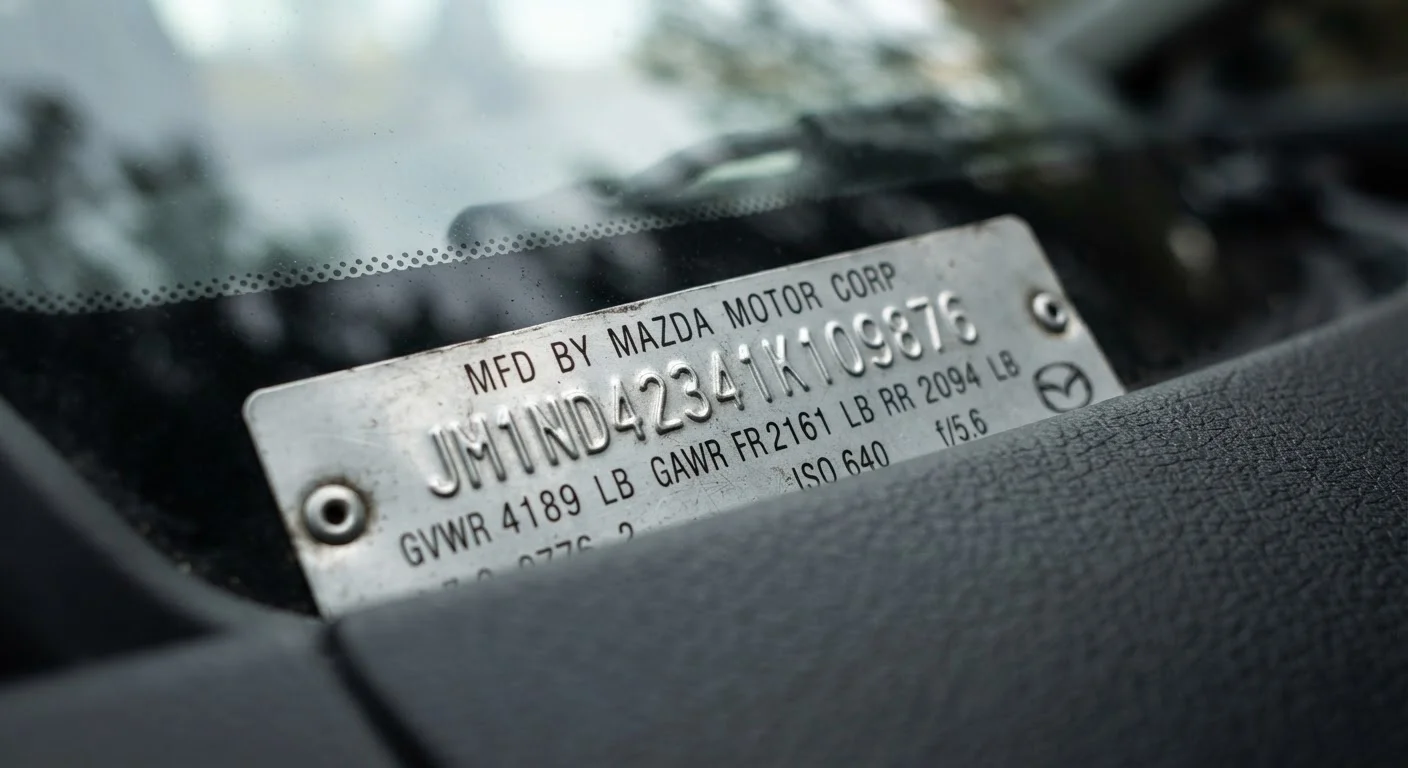
Photo: searchopenrecords editorial
—— In This Article
What the 17-Character Standard Means
Since 1981, the National Highway Traffic Safety Administration (NHTSA) has required all vehicles sold in the United States to carry a standardized 17-character Vehicle Identification Number (VIN). No two VINs assigned in the same calendar year are identical, making each one a unique fingerprint for a specific vehicle. The characters follow a rigid positional grammar — every digit or letter occupies a slot with a defined purpose.
Understanding that grammar lets you extract meaningful information from a VIN without any tool. For background on what a VIN is and where the standard originated, see what a VIN actually is. This guide focuses exclusively on position-by-position decoding.
The 17 characters are divided into three logical sections:
- Positions 1–3 — World Manufacturer Identifier (WMI)
- Positions 4–9 — Vehicle Descriptor Section (VDS)
- Positions 10–17 — Vehicle Identifier Section (VIS)
The letters I, O, and Q are never used in a VIN to prevent confusion with the numerals 1 and 0.
World Manufacturer Identifier (WMI)
The first three characters of a VIN, assigned by SAE International to identify the country of manufacture and the specific automaker or division responsible for a vehicle.
Vehicle Descriptor Section (VDS)
Positions 4 through 9 of a VIN. These characters encode vehicle-specific attributes such as body style, engine type, and restraint systems, plus a check digit for authenticity verification.
Vehicle Identifier Section (VIS)
Positions 10 through 17 of a VIN. This section encodes the model year, assembly plant, and a sequential production number that makes each VIN unique.
Check Digit
The character in position 9, mathematically calculated from all other VIN characters using a NHTSA-defined formula. It allows verification that a VIN has not been altered or falsified.
GVWR
Gross Vehicle Weight Rating — the maximum operating weight of a vehicle as specified by the manufacturer, including the vehicle itself, passengers, cargo, and fuel. Encoded in the VDS for trucks and larger vehicles.
Model Year Code
A single character in VIN position 10 that represents the vehicle's model year using a standardized NHTSA alphanumeric table. The cycle runs from 1980 forward and repeats every 30 years.
Positions 1–3: World Manufacturer Identifier (WMI)
The first three characters collectively form the World Manufacturer Identifier, assigned by SAE International (formerly the Society of Automotive Engineers) under an agreement with ISO standard 3779.
| Total VIN length | 17 characters (NHTSA standard, effective 1981) |
| Characters never used in a VIN | I, O, Q (ISO 3779 / NHTSA regulation) |
| WMI assigning authority | SAE International (Under ISO 3779 agreement) |
| Check digit position | Position 9 (NHTSA CFR Title 49, Part 565) |
| Model year encoding position | Position 10 (NHTSA standard VIN table) |
| Production sequence characters | Positions 12–17 (Standard for volume manufacturers) |
- Position 1 — Country of manufacture: A letter or digit that identifies the geographic region where the vehicle was assembled. For example,
1,4, and5indicate the United States;2indicates Canada;3indicates Mexico;Jindicates Japan;Windicates Germany. - Position 2 — Manufacturer: Combined with Position 1, this character narrows identification to a specific automaker. For instance,
1Gis General Motors (U.S.), whileJTis Toyota (Japan). - Position 3 — Vehicle type or division: Refines the manufacturer code to a division or vehicle category. Together, positions 1–3 uniquely identify the manufacturing entity responsible for the vehicle.
Manufacturers producing fewer than 500 vehicles per year receive a WMI ending in 9 at position 3, and positions 12–14 of the VIS then carry the true manufacturer code.
Positions 4–9: Vehicle Descriptor Section (VDS)
The six characters in the VDS are defined by the manufacturer — NHTSA sets the rules for what must be encoded here, but each automaker chooses how to arrange the specifics within those rules.
- Positions 4–8 — Vehicle attributes: These positions collectively describe the vehicle's platform characteristics, typically including body style (sedan, SUV, pickup), engine type and displacement, restraint systems (airbag configuration, seatbelt type), and GVWR (Gross Vehicle Weight Rating) for trucks. The exact order and meaning vary by manufacturer, which is why decoding these positions accurately requires a manufacturer-specific key.
- Position 9 — Check digit: This single character is mathematically derived from all other 17 characters using a formula established by NHTSA. It serves as a built-in authenticity verification — a computed value that reveals whether a VIN has been altered or fabricated. The check digit can be any numeral 0–9 or the letter
X(representing 10).
For a practical walkthrough of reading these sections without software, reading a VIN plate manually provides step-by-step guidance.
Positions 10–17: Vehicle Identifier Section (VIS)
The final eight characters form the VIS, which functions like a serial number within a manufacturer's production run for a given year and plant.
- Position 10 — Model year: A single letter or digit encodes the model year using a standardized NHTSA table. For example,
A= 1980,B= 1981 …Y= 2000,1= 2001 …9= 2009,A= 2010 (the cycle restarts). The letters I, O, Q, U, and Z are excluded from this table. - Position 11 — Assembly plant: Identifies the specific factory where the vehicle was assembled. Each manufacturer defines its own plant codes, so the same letter can mean different plants at different automakers.
- Positions 12–17 — Production sequence number: A six-character serial number assigned sequentially on the assembly line. This is what makes each VIN unique within a model year and plant. For small-volume manufacturers (WMI ending in
9), positions 12–14 instead carry the manufacturer identifier, and only positions 15–17 are the true sequence.
Once you understand these positions, you can begin to see why VIN data connects to title and registration records. Explore how that works through VIN and title records, and see what history reports can surface via vehicle history reports.
Keep in mind that knowing how to decode a VIN is only the first step. For a clear picture of what that decoded data can — and cannot — tell you, see eight things a VIN can reveal.

Vin Search Editorial Team
VIN Search Editorial Team is the collective byline for our editorial team and contributor network. Articles published under this byline or an editorial pen name are researched, written, and reviewed according to our editorial standards for clarity, consistency, and independence before publication.
View author profile