
How to Read a VIN Plate Without a Decoder Tool
You don't need an app to make sense of a VIN. Follow these steps to manually decode each section of a vehicle's identification number.
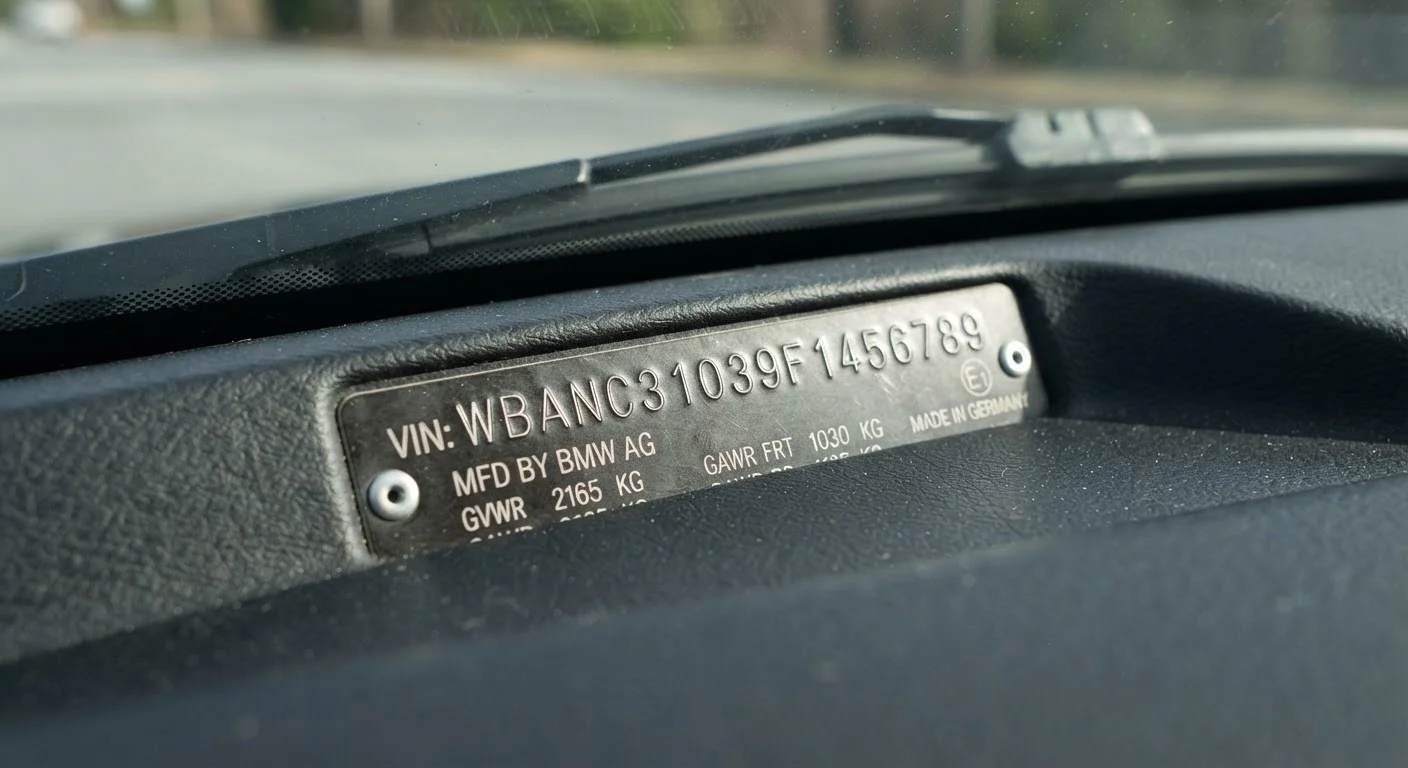
Photo: searchopenrecords editorial
—— In This Article
Key Takeaways
- A VIN is always exactly 17 characters long and follows a standardized NHTSA format used across all US vehicles since 1981.
- The 17 characters split into three groups: World Manufacturer Identifier, Vehicle Descriptor Section, and Vehicle Identifier Section.
- Letters I, O, and Q are never used in any VIN to avoid confusion with the digits 1 and 0.
- Position 9 is a mathematical check digit you can use to spot an invalid or fraudulent VIN.
- Manual decoding reveals country of origin, manufacturer, vehicle type, model year, assembly plant, and production sequence.
What You're Looking At: The VIN's Basic Structure
A Vehicle Identification Number (VIN) is a 17-character alphanumeric code assigned to every motor vehicle manufactured for sale in the United States. The National Highway Traffic Safety Administration (NHTSA) standardized this format in 1981, so any vehicle built from that year onward follows the same positional rules. If you're new to VIN searches, our beginner's overview explains the fundamentals.
The 17 characters are divided into three sections, each carrying a distinct category of information:
- Positions 1–3 — World Manufacturer Identifier (WMI): Identifies the country of manufacture and the specific manufacturer.
- Positions 4–9 — Vehicle Descriptor Section (VDS): Describes the vehicle's type, restraint systems, model, body style, engine, and a mathematical check digit.
- Positions 10–17 — Vehicle Identifier Section (VIS): Pinpoints the model year, assembly plant, and the vehicle's unique production sequence number.
One universal rule: the letters I, O, and Q never appear in any VIN. Standardizers excluded them to prevent confusion with the digits 1 and 0. If you see one of those letters on a plate, the VIN is either misread or fraudulent.
For a character-by-character reference, see our position-by-position VIN guide.
Where Else to Find the VIN
Beyond the dashboard plate, your VIN also appears on the vehicle's title certificate, registration documents, insurance cards, and often on a sticker inside the driver-side door jamb. If characters on the plate are worn, these documents provide a reliable cross-reference. Always confirm the VIN matches across all sources before relying on it.
Step-by-Step: Decoding Each Section by Hand
Work through the VIN left to right using the steps below. All you need is the physical VIN — found on the driver-side dashboard near the windshield, the driver-side door jamb sticker, and official title or registration documents — and a pencil and paper to transcribe it accurately.
Locate and transcribe the VIN accurately
Find the VIN plate on the driver-side dashboard, visible through the windshield from outside the vehicle. Write down all 17 characters exactly as they appear, distinguishing carefully between letters and numbers — especially B vs. 8, S vs. 5, and Z vs. 2. Verify your transcription against the door jamb sticker before proceeding.
Decode positions 1–3: country and manufacturer
The first character indicates the country of manufacture. Common US-market values include: 1, 4, or 5 for the United States; 2 for Canada; 3 for Mexico; J for Japan; W for Germany; K for South Korea. The second character narrows down the manufacturer category, and the third specifies the vehicle type within that manufacturer's lineup. Together, these three characters form the World Manufacturer Identifier (WMI), which NHTSA assigns to manufacturers globally.
Read positions 4–8: vehicle attributes
These five characters make up the first part of the Vehicle Descriptor Section (VDS). Their exact meaning varies by manufacturer — each automaker assigns its own encoding scheme within NHTSA guidelines. Generally, these positions describe: body style (sedan, SUV, truck), restraint system type, engine displacement or configuration, and model line. Without a manufacturer-specific key, you may not resolve every character, but you can often identify broad categories (e.g., truck vs. passenger car) from publicly available manufacturer documentation.
Verify position 9: the check digit
Position 9 is a mathematically derived check digit, calculated by assigning numerical values to each of the other 16 characters, multiplying each by a positional weight defined by NHTSA, summing the results, and finding the remainder when divided by 11. The remainder — expressed as a digit 0–9 or the letter X (representing 10) — must match position 9 exactly. If it does not, the VIN is either incorrectly transcribed or potentially fraudulent. Full weighting tables are available in NHTSA's public documentation.
Decode position 10: model year
Position 10 encodes the vehicle's model year using a standardized NHTSA letter/number cycle. The sequence began in 1980 and cycles through specific letters and digits (excluding I, O, Q, U, and Z). For example: A = 1980, B = 1981 … Y = 2000, 1 = 2001 … 9 = 2009, A = 2010 (cycle repeats). As of 2010, the cycle restarted, so cross-reference with the vehicle's actual age if ambiguity arises.
Read position 11 and positions 12–17: plant and sequence
Position 11 identifies the assembly plant where the vehicle was built. The meaning of this character is manufacturer-specific — automakers assign plant codes internally. Positions 12–17 form the production sequence number: a six-digit serial that distinguishes this individual vehicle from all others built to the same specification at the same plant in the same model year. Together, these make the VIN globally unique.
After completing these steps, you'll have extracted the core facts encoded in the VIN itself. For a full picture of what that VIN has been through — title changes, reported accidents, odometer readings — a vehicle history report builds on that foundation. Keep in mind that a VIN can confirm factory specifications, but it cannot tell you everything; our article on what a VIN can and cannot reveal explains those boundaries clearly.
Practical Considerations and Common Mistakes
Manual VIN reading is reliable when done carefully, but a few pitfalls trip up first-time readers:
- Transcription errors: Copy the VIN character by character, then double-check it. A single wrong digit produces an entirely different vehicle identity.
- Worn or tampered plates: If the plate characters are difficult to read, cross-reference against the door jamb sticker or title document. A VIN that differs across locations on the same vehicle is a serious red flag — this is explored further in our VIN and title records hub.
- Pre-1981 vehicles: Older vehicles used manufacturer-specific VIN formats of varying lengths. The NHTSA 17-character standard does not apply to these.
- Check digit failures: If your check digit calculation does not match position 9, either the VIN has been miscopied or the number itself may be invalid.
It's also worth understanding how a VIN compares to other identifiers. Our piece on VIN vs. license plate explains why a VIN is typically the more durable and informative identifier for verifying a vehicle's history.
This article is for general informational purposes only. VIN decoding provides manufacturer-encoded data and does not constitute a complete vehicle history or a guarantee of a vehicle's condition, title status, or legal standing. Consult official state DMV records and qualified professionals for decisions involving vehicle purchase or title verification.

Vin Search Editorial Team
VIN Search Editorial Team is the collective byline for our editorial team and contributor network. Articles published under this byline or an editorial pen name are researched, written, and reviewed according to our editorial standards for clarity, consistency, and independence before publication.
View author profile