
Civil Court Records vs. Criminal Court Records: Key Distinctions
Civil and criminal cases produce different records, held in different places. Here's how to tell them apart and find each.
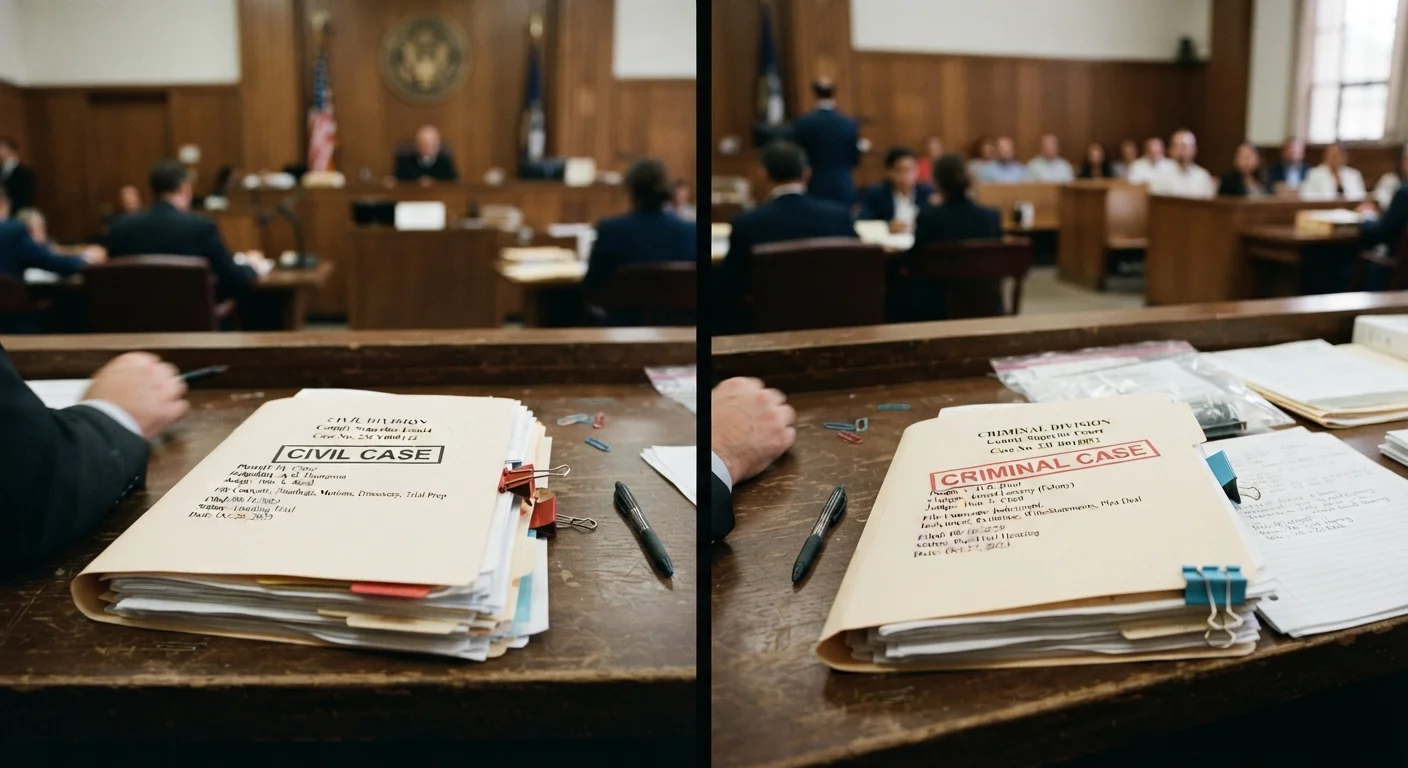
Photo: searchopenrecords editorial
—— In This Article
Key Takeaways
- Civil records document disputes between private parties; criminal records document state or federal prosecutions.
- Criminal records can include arrests, charges, convictions, and sentences — civil records do not.
- Both record types are generally public but are stored in different court systems and databases.
- Civil judgments can appear on background checks, but they are categorically distinct from criminal findings.
- Searching each type requires knowing which court — trial, federal, or specialty — holds the relevant case.
What Separates Civil from Criminal Cases
The distinction between civil and criminal court records begins with who brings the case and why. In a criminal case, a government entity — a state prosecutor or the federal Department of Justice — files charges against an individual or organization accused of violating a penal statute. The outcome can include incarceration, probation, fines payable to the government, or a formal conviction that becomes part of the defendant's permanent record.
In a civil case, one private party (the plaintiff) sues another (the defendant) over a legal dispute — a broken contract, personal injury, property claim, or unpaid debt. No criminal charges are involved, and the remedy is almost always monetary or injunctive (a court order to do or stop doing something). A civil judgment does not result in a criminal record. For a broader look at how the U.S. public records system is structured, see how public records work.
This foundational difference shapes everything downstream: where records are stored, what they contain, and how they surface in background checks.
What Each Record Type Contains
Criminal court records typically include: the charging document (indictment or information), the defendant's plea, pre-trial motions, the verdict or guilty plea, sentencing documents, and any appeals. Arrest records — generated by law enforcement before a case reaches court — are related but technically separate from court records. For a detailed breakdown of these document types, see types of court records and what each reveals.
Civil court records contain: the complaint filed by the plaintiff, the defendant's answer, discovery filings, motions, the court's judgment, and enforcement documents such as liens or garnishment orders. Specialty civil courts — small claims, probate, family, and bankruptcy — maintain their own filing systems and may not be indexed in general civil court searches.
| Criterion | Civil Court Records | Criminal Court Records |
|---|---|---|
| Who initiates the case | Private party (plaintiff) | Government prosecutor |
| Purpose | Resolve disputes; award remedies | Prosecute violations of penal law |
| Possible outcomes | Monetary judgment, injunction | Conviction, incarceration, probation, fine |
| Standard of proof | Preponderance of evidence | Beyond a reasonable doubt |
| Where records are held | County civil court; PACER (federal) | County criminal court; PACER (federal) |
| Appears in standard background check | Inconsistently; varies by check type | Yes; core component of most checks |
| FCRA reporting limits | Seven years for some civil judgments | Convictions generally reportable indefinitely |
Understanding what each file contains helps you interpret what you find — and recognize what might be missing from a partial search.
Where to Find Each Type of Record
Criminal records are maintained at multiple levels. State-level convictions are held by county clerks of court and state court administrative offices. Many states offer online case lookup portals through their unified court system websites. Federal criminal cases are searchable through PACER (Public Access to Court Electronic Records), the federal judiciary's online records system. It is important to note that no single national database consolidates all state criminal court records — searches typically must be conducted state by state, and sometimes county by county.
For an explanation of why federal and state records are kept separately and how to navigate each, see federal vs. state court records.
Civil records are similarly fragmented. State civil cases are filed at the county courthouse and may be accessible through the same state court portals used for criminal records, though the civil and criminal indexes are usually separate. Federal civil cases, including bankruptcy filings, are available through PACER. Liens and judgments that have been recorded against property are also indexed through county recorder or register of deeds offices, separate from court files entirely.
How Each Type Appears in Background Checks
Criminal records form the core of most standard background checks. Under the Fair Credit Reporting Act (FCRA), consumer reporting agencies that compile background check reports must follow specific accuracy and disclosure rules. Convictions generally may be reported indefinitely; arrests without convictions are subject to a seven-year reporting limit under the FCRA in most contexts, though state laws vary.
Civil records appear in background checks less consistently. Judgments and liens may surface in credit-based or comprehensive public records searches, but many standard employment background checks do not search civil court indexes at all. Civil records in background checks — including what lawsuits, judgments, and liens actually mean — warrant separate review, because their presence does not imply criminal conduct.
For a full picture of how different check types are assembled and what each covers, see how different background check types are structured. Knowing which record type a check searches — and which it omits — is essential to interpreting any report accurately.

Background Checks Editorial Team
Background Checks Editorial Team is the collective byline for our editorial team and contributor network. Articles published under this byline or an editorial pen name are researched, written, and reviewed according to our editorial standards for clarity, consistency, and independence before publication.
View author profile