
Civil Fraud Judgments vs. Criminal Fraud Convictions in Background Checks
Civil and criminal fraud records look similar but carry very different legal meanings. Here's how to tell them apart in a background check.
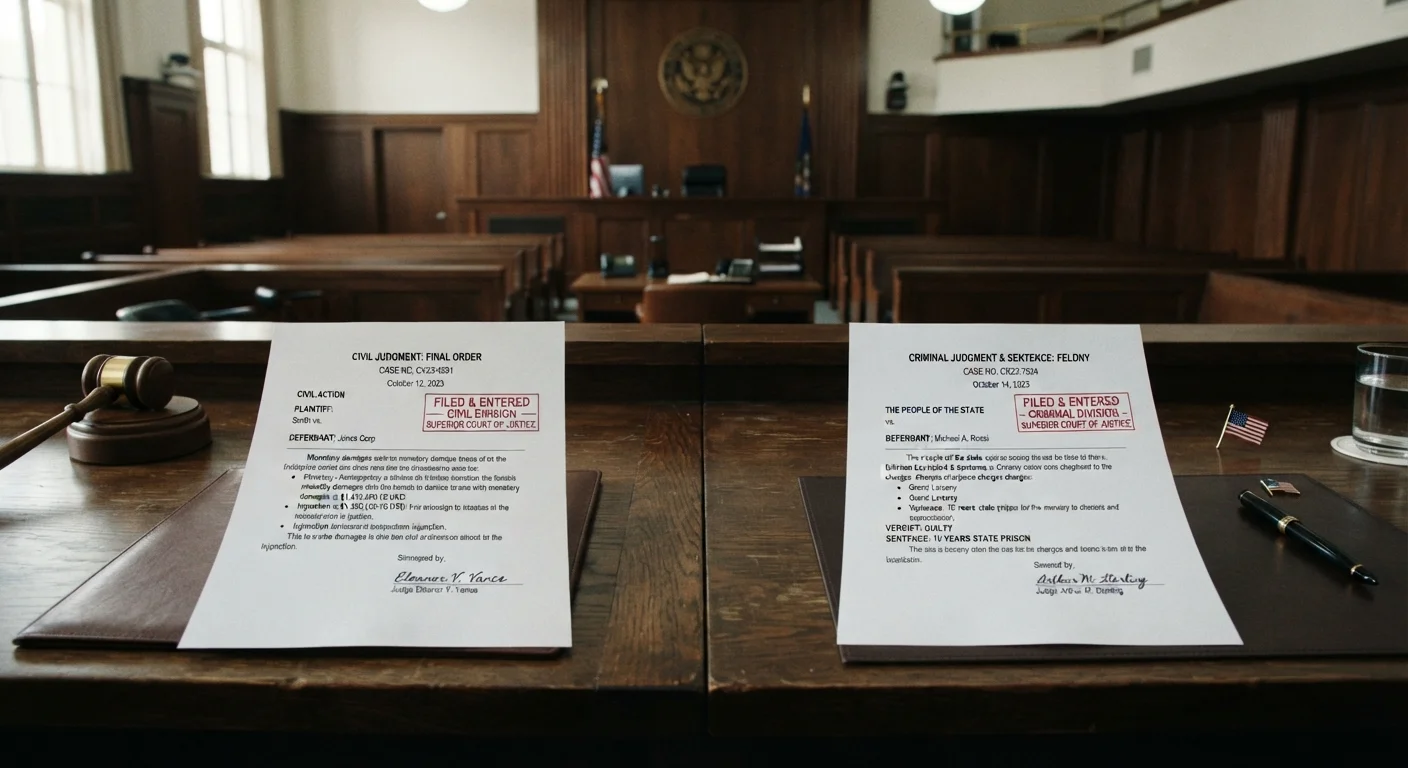
Photo: searchopenrecords editorial
—— In This Article
Key Takeaways
- Civil fraud judgments are filed by private parties seeking financial damages; criminal fraud convictions are brought by government prosecutors.
- The burden of proof differs dramatically: civil cases use a preponderance-of-evidence standard, while criminal cases require proof beyond a reasonable doubt.
- A civil judgment does not mean a person was found criminally guilty — the two records carry entirely different legal meanings.
- Both record types can appear in a background check but are indexed and stored in separate court systems.
- Misreading a civil judgment as a criminal conviction is a common and consequential error when reviewing public records.
How Each Record Type Is Created
Understanding how these two record types come into existence is the foundation for reading them correctly. A civil fraud judgment results from a lawsuit filed by a private individual or organization against another party. The plaintiff alleges that the defendant deceived them in a way that caused measurable financial harm. If the court finds in the plaintiff's favor, it enters a judgment — a formal court order that typically requires the losing party to pay a specified dollar amount.
A criminal fraud conviction, by contrast, originates with a government prosecutor — either a state district attorney or a federal U.S. Attorney — who files charges on behalf of the public interest. The defendant is tried under criminal law, and a conviction requires the jury or judge to find guilt beyond a reasonable doubt, the highest evidentiary standard in the U.S. legal system. Penalties can include imprisonment, supervised release, and criminal fines, in addition to any restitution owed to victims.
For a deeper look at how courts generate these records, see our article on how courts and agencies generate fraud records. The court records search hub also explains where each type of record is physically held.
Key Legal Differences You Must Recognize
| Criterion | Civil Fraud Judgment | Criminal Fraud Conviction |
|---|---|---|
| Who initiates the case | Private plaintiff (individual or business) | Government prosecutor (state or federal) |
| Burden of proof | Preponderance of evidence (>50%) | Beyond a reasonable doubt |
| Possible outcome | Monetary damages, injunctions | Imprisonment, fines, probation, restitution |
| Where record is filed | Civil court docket | Criminal court docket |
| Implies criminal guilt | No | Yes |
| Typical report section | Civil judgments / court records | Criminal history |
The most critical distinction is the burden of proof. In a civil case, the plaintiff must show it is more likely than not — often described as a greater than 50% probability — that fraud occurred. In a criminal case, the state must eliminate reasonable doubt entirely. This means a person can lose a civil fraud lawsuit without ever being charged with a crime, and someone acquitted of criminal fraud charges can still face — and lose — a civil suit over the same conduct.
The defendant's rights also differ. Criminal defendants hold Fifth Amendment protections against self-incrimination. Civil defendants can be compelled to testify in depositions. These procedural distinctions affect what evidence appears in the public record and what a researcher can infer from the outcome.
For broader context on how civil and criminal court records differ structurally, see civil court records vs. criminal court records.
How These Records Appear in Background Checks
Background check reports draw from multiple court databases, and both record types can surface in the same report. However, they are catalogued differently. Criminal fraud convictions typically appear in a criminal history section, sourced from state criminal repositories, county court records, or federal PACER filings. They will list the statute violated, the plea or verdict, the sentence, and in some cases the disposition date.
Civil fraud judgments appear in a separate civil records or court judgment section, often alongside other civil liabilities such as liens or lawsuits. The entry will typically identify the case as civil, name the plaintiff and defendant, state the judgment amount, and indicate whether the judgment has been satisfied (paid) or remains outstanding.
A common misreading occurs when a report user sees the word "fraud" associated with a civil case and assumes criminal wrongdoing. The record may confirm that a court found deceptive conduct — but under a lower legal standard and without any criminal penalty. Confusing these two is not just an interpretive mistake; it can lead to unfair decisions about the person being screened. Our guide on fraud flags in background checks explains how to interpret these entries carefully.
Default Judgments Are Common in Civil Cases
A civil fraud judgment is sometimes entered by default when a defendant fails to respond to a lawsuit, meaning no full hearing on the merits occurred. This does not necessarily indicate that evidence of fraud was weighed and confirmed by a judge. When reviewing a civil judgment, check the case docket for whether the defendant contested the claim or whether the judgment was entered without opposition.
Civil records like judgments can also appear alongside liens and lawsuits in a single background report. The article on civil court records and background checks breaks down each of these civil record types in detail.
Practical Implications for Record Readers
When you encounter a fraud-related entry in a public records report, apply a consistent three-step check. First, confirm whether the case is labeled civil or criminal. Second, note the outcome — was there a judgment or conviction, or was the case dismissed or settled? Third, consider whether a criminal fraud conviction reflects a completed sentence or whether any supervised release or restitution is still in effect, which may be noted in the record.
Neither record type alone tells a complete story. A civil judgment may have been entered by default because a defendant never responded, not because the court weighed full evidence on both sides. A criminal conviction may have resulted in a deferred sentence or expungement that limits what the record legally shows. Context matters at every step.
For a broader survey of which types of fraud generate which kinds of records, see types of fraud that leave a public record trail.
This article is for general informational and educational purposes only and does not constitute legal advice. Readers with questions about specific background check findings or their legal implications should consult a licensed attorney.

Background Checks Editorial Team
Background Checks Editorial Team is the collective byline for our editorial team and contributor network. Articles published under this byline or an editorial pen name are researched, written, and reviewed according to our editorial standards for clarity, consistency, and independence before publication.
View author profile