
Background Check Records: Federal, State, and County — What Each Level Captures
Criminal and court records exist across multiple government levels. This guide explains what each jurisdiction captures and why coverage can vary widely.
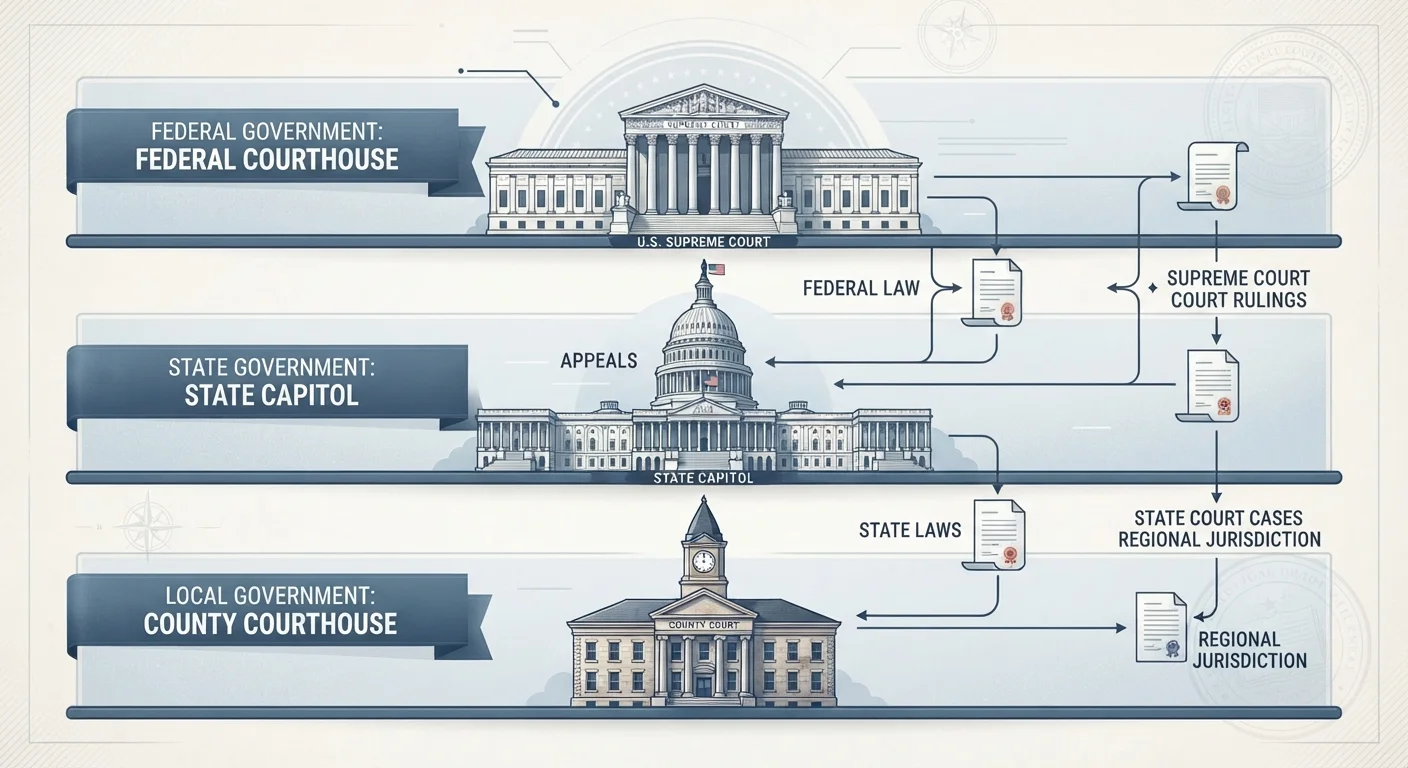
Photo: searchopenrecords editorial
—— In This Article
Why Jurisdiction Determines What a Background Check Finds
One of the most common misconceptions about background checks is that they draw from a single, unified government database. In reality, criminal and court records are distributed across three distinct jurisdictional tiers — federal, state, and county — and each maintains its own separate systems with its own filing rules, retention policies, and public access standards.
This fragmentation matters practically. A background check that searches only one level can entirely miss records housed at another. Understanding what each tier captures helps consumers and employers interpret results more accurately — and recognize when coverage may be incomplete.
For a broader look at how checks are assembled, see how background checks work. For a breakdown of the types of records those checks pull together, types of court records and what each one reveals is a useful companion reference.
Federal Records: Crimes That Cross Jurisdictional Lines
Federal courts handle cases involving violations of U.S. federal law — offenses that are investigated by agencies such as the FBI, DEA, or ATF and prosecuted by U.S. Attorneys. Examples include wire fraud, drug trafficking across state lines, immigration offenses, federal tax crimes, and crimes committed on federal property.
Federal criminal records are maintained through the Public Access to Court Electronic Records (PACER) system, which provides case-level data for all 94 U.S. district courts. The FBI's Interstate Identification Index (III) also aggregates fingerprint-based criminal history submitted voluntarily by states, though access to III is largely restricted to law enforcement and authorized employers in sensitive industries.
Critically, federal courts handle a relatively small proportion of all criminal prosecutions nationally. The vast majority of crimes — including most violent offenses, property crimes, and DUIs — are state or local matters. A background check that searches only federal courts will therefore miss most of a person's potential criminal history. See federal vs. state court records for a deeper look at how these systems diverge.
State Records: The Broadest Layer of Criminal History
State-level records are typically the richest source of criminal history for most individuals. Each state maintains a central criminal history repository — often housed within the state police or department of justice — that aggregates arrest and conviction data reported by courts and law enforcement agencies statewide.
State repositories ideally capture felonies and misdemeanors prosecuted in that state's courts, along with disposition data showing whether charges were dismissed, resulted in conviction, or led to incarceration. However, completeness varies. Some states have strong mandatory reporting requirements; others have significant gaps, particularly for older cases or misdemeanor dispositions.
State sex offender registries represent another distinct data layer. These are maintained separately from general criminal history repositories and are publicly searchable in all 50 states. Sex offender registry data in background reports covers the scope and limits of this information in detail.
State law also shapes what can be reported. Several states restrict look-back periods, limit reporting of non-conviction records, or require adverse action procedures beyond federal FCRA minimums. State-level background check protections explains where those additional rights apply.
County Records: The Most Granular and Often Most Current Source
County courts — sometimes called circuit, superior, district, or municipal courts depending on the state — are where most criminal cases are actually filed and adjudicated. Because county clerks maintain their own dockets independently of state repositories, county-level searches often surface more current and more complete case-level detail than state repositories alone.
Charges filed, hearing dates, plea agreements, sentences, and probation terms are all recorded at the county level. Importantly, state repositories may lag weeks or months behind actual case activity; a county court search pulls directly from the source. This makes county searches especially valuable for recent cases that may not yet appear in aggregated state data.
The trade-off is coverage. The U.S. has over 3,000 counties and equivalent jurisdictions. Searching one or two counties misses any records in counties where the individual lived, worked, or traveled. Comprehensive background checks typically combine a national database scan — which aggregates data from many county and state sources — with direct county-level verification in jurisdictions of particular relevance.
For a full reference on which government tier holds which type of document, see federal, state, and county record jurisdiction. To understand which records typically surface — and which do not — in a standard background check, criminal records in background checks: what's included and what isn't provides essential context.
PACER
Public Access to Court Electronic Records — the federal judiciary's online system for retrieving case and docket information from U.S. district, bankruptcy, and appellate courts.
State criminal history repository
A centralized database maintained by a state agency — typically state police or a department of justice — that aggregates arrest and conviction records reported by courts and law enforcement across that state.
Interstate Identification Index (III)
An FBI-managed system that links fingerprint-based criminal history records from participating states. Access is primarily limited to authorized law enforcement and certain credentialed employers.
Disposition
The final outcome of a criminal charge — such as conviction, acquittal, dismissal, or plea agreement. Disposition data is critical for distinguishing arrests from actual convictions in background reports.
County court docket
The official log of all filings, hearings, and actions in a case maintained by a county court clerk. Dockets are typically the most current and granular source of case-level criminal information.
FCRA (Fair Credit Reporting Act)
The primary federal law governing how consumer reporting agencies collect, use, and report background check information. It establishes consumer rights to accuracy, disclosure, and dispute resolution.

Background Checks Editorial Team
Background Checks Editorial Team is the collective byline for our editorial team and contributor network. Articles published under this byline or an editorial pen name are researched, written, and reviewed according to our editorial standards for clarity, consistency, and independence before publication.
View author profile