
Digitised Archives vs. Physical Repository Visits: Weighing Your Research Options
Online digitisation has transformed genealogy, but some records remain offline. Compare both approaches to plan the most effective research strategy.
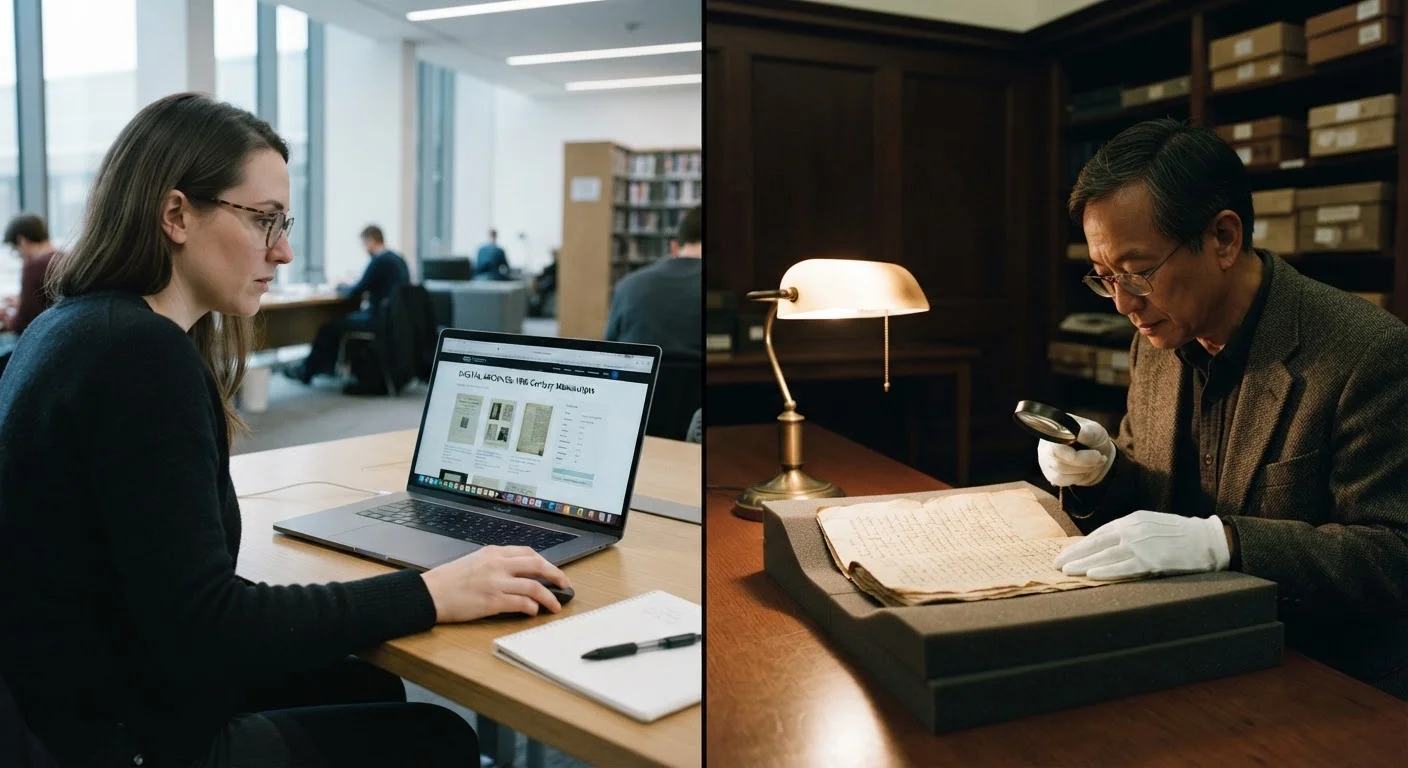
Photo: searchopenrecords editorial
—— In This Article
Key Takeaways
- Digitised archives offer unmatched convenience but cover only a fraction of existing historical records.
- Physical repository visits often uncover original documents, annotations, and context that scans cannot capture.
- A hybrid strategy — searching online first, then visiting in person for gaps — yields the strongest results.
- Not all undigitised records are inaccessible; many repositories accept mail or email requests.
- Record quality and indexing errors in digital databases make cross-verification against originals essential.
What Digitised Archives Actually Offer
Over the past two decades, large-scale digitization projects — led by institutions such as the National Archives and Records Administration (NARA), the Family History Library, and state historical societies — have placed hundreds of millions of records within reach of a home computer. Federal census schedules through 1950, many passenger arrival lists, military service records, and vital records from heavily populated states are now searchable by keyword and browsable at no cost or modest subscription.
The practical advantages are significant. A researcher in Minnesota can examine an 1880 census page from a Georgia county courthouse without leaving their chair. Keyword and phonetic-variant search tools help surface records even when a surname was spelled inconsistently. For an overview of how to find and use historical archives, digitised collections make an ideal entry point.
However, digitization is not the same as completeness. Transcription errors — where an indexer misreads a handwritten name — can cause records to vanish from search results entirely. Images may be low-resolution, fragmented, or mislabeled. As explored in depth in the hidden trade-offs of relying solely on digitised records, convenience can create a false sense of comprehensiveness.
What Physical Repository Visits Provide
County courthouses, state archives, local historical societies, and church record repositories hold vast quantities of material that has never been photographed, let alone indexed online. Land deeds, probate packets, coroner's inquests, local court minutes, and institutional ledgers frequently exist only in their original form. For researchers tracing rural or immigrant ancestors, these undigitised collections are often the decisive source.
Beyond simple availability, originals convey information that scans cannot. Marginal annotations added by a clerk years after the original entry, paper texture, seal impressions, and the physical grouping of documents within a folder all carry evidentiary weight. An experienced archivist can also point researchers toward finding aids, related record series, or predecessor collections that are not described anywhere online. For a structured look at which record types still require in-person or mail contact, see offline records that have no online equivalent.
The practical barriers are real: travel costs, limited reading-room hours, and the need to plan appointments in advance. Still, many repositories accept written requests for specific documents, and some county clerks will certify copies by mail — a middle path worth exploring before committing to a trip.
| Digitised Archives | Physical Repository Visits | |
|---|---|---|
| Accessibility | Available 24/7 from any location | Requires travel and scheduled hours |
| Record Coverage | Broad but incomplete; major gaps exist | Comprehensive for local and niche collections |
| Search Speed | Instant keyword and index search | Manual browsing; slower but thorough |
| Transcription Accuracy | Errors can obscure records | Original document is the ground truth |
| Cost | Free to subscription-based | Travel, lodging, and copying fees |
| Document Context | Image only; annotations may be cut off | Full physical context and archivist guidance |
| Suitability for Rare Records | Low — many niche records never scanned | High — originals often only held locally |
Building a Hybrid Research Strategy
The most productive approach treats digitised searching as reconnaissance and repository visits as targeted excavation. Begin online to establish timelines, identify record gaps, and confirm which repositories hold the collections you need. Tools such as the DNA and digital ancestry resources can refine geographic focus before you commit resources to travel.
Once online research has identified a specific record series or locality, contact the holding institution directly. Ask whether the relevant material has been digitised, microfilmed, or indexed — and whether remote copies are available. Many state archives maintain detailed online inventories; cross-referencing these against what major archives hold and what access costs saves significant time.
When a physical visit is warranted, preparation matters. Compile a clear research objective list, review the repository's access policies, and request a finding-aid review in advance. For obituary research specifically, navigating both digitised and physical obituary archives illustrates how the hybrid model works in practice for a focused record type. The combination of digital efficiency and archival depth consistently outperforms either method alone.

Genealogy Search Editorial Team
Genealogy Search Editorial Team is the collective byline for our editorial team and contributor network. Articles published under this byline or an editorial pen name are researched, written, and reviewed according to our editorial standards for clarity, consistency, and independence before publication.
View author profile