
Reading Between the Lines: What a Death Certificate Can Tell You About Your Ancestors
Death certificates often contain more than a date. Learn how to interpret informant details, causes of death, and burial locations for genealogy clues.
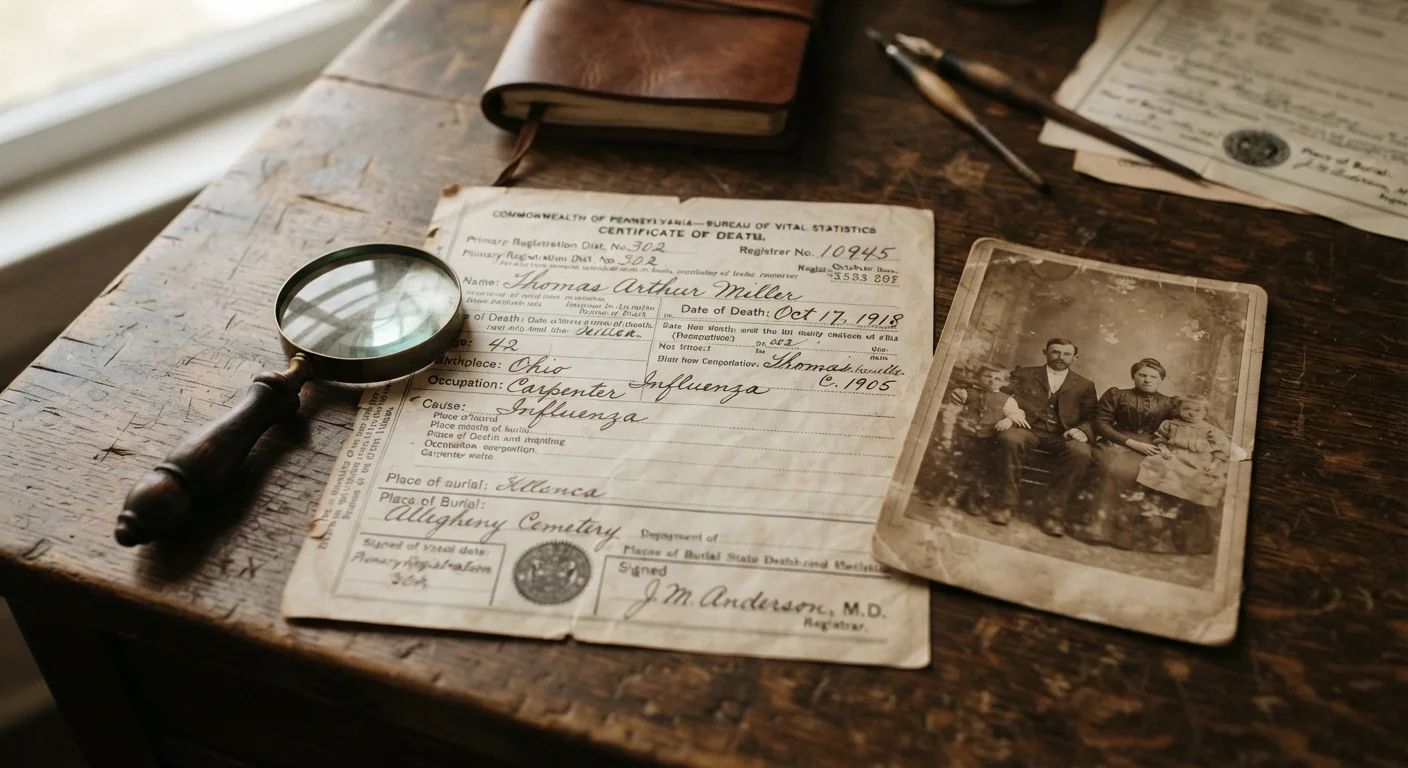
Photo: searchopenrecords editorial
—— In This Article
Key Takeaways
- Death certificates routinely include birthplace and parentage data that can push research back a generation.
- The informant field reveals who provided the information — and signals how reliable that data likely is.
- Cause of death can point to hereditary conditions, occupational hazards, and historical epidemics.
- Burial location and funeral home details can lead to cemetery records, grave markers, and additional family groupings.
- Errors on death certificates are common — always cross-reference with at least one other record type.
The Standard Fields — and What They Really Contain
At first glance, a death certificate looks like a routine administrative form. On closer inspection, it functions more like a structured biography of a person's life, filtered through what was known — or believed — at the moment of their death.
Standard U.S. death certificates from the 20th century typically include:
- Full legal name — including maiden names for women, which is a direct link to a family's surname history.
- Date, time, and place of death — pinpointing geography helps narrow census, tax, and church record searches.
- Birthdate and birthplace — especially valuable for immigrant ancestors, where even a region or country narrows research significantly.
- Occupation — a person's trade can lead to union records, employer archives, or occupational pension files.
- Residence at time of death — confirms where to search for local records, even if the person moved frequently.
- Parents' names and birthplaces — this single field can advance research an entire generation in one step.
- Marital status and surviving spouse's name — confirms family structure and opens a parallel research thread.
Each field deserves deliberate attention. Researchers who skim past the occupation line, for example, may miss an opening to a rich set of occupational or union records they hadn't considered.
The Informant: Your Most Underrated Clue
The informant field names the person who supplied the biographical details about the deceased. This seemingly minor box carries two distinct research benefits.
First, it helps you weigh the reliability of the information. A spouse who lived with the deceased for decades is more likely to know the correct birthplace or parents' names than a neighbor or funeral home employee who filled in the form from hearsay. When an informant is identified as a child or sibling, consider that they may have had incomplete or second-hand knowledge of facts from a generation before their own.
Second, the informant is often a family member you hadn't yet placed in your tree. An informant named with a different surname than the deceased could be a married daughter, a son-in-law, or even a previously unknown half-sibling. That name is worth researching in its own right.
Informant Reliability Varies Widely
If the informant's relationship to the deceased is not stated on the certificate, search for them in the same census years and localities as the deceased. A shared household or nearby address in an earlier census can confirm kinship and help you assess how firsthand their knowledge of the facts was likely to be.
If the informant's relationship to the deceased is not stated on the certificate, search for them in the same census years and localities as the deceased. A shared household or nearby address in an earlier census can confirm kinship.
Cause of Death: Medical History and Historical Context
The cause of death field is among the most misunderstood sections of a death certificate, particularly on older records. Pre-20th-century terminology often used descriptive or symptomatic language rather than clinical diagnoses. 'Dropsy' referred to fluid retention now associated with heart or kidney failure. 'Putrid fever' described what we would call typhus or typhoid. 'Teething' was once listed as a cause of infant death, reflecting the medical assumptions of the era rather than the actual pathology.
For genealogists, the cause of death serves multiple purposes:
- Hereditary patterns — Repeated causes across a family line (heart disease, certain cancers) may be medically meaningful and personally relevant to living descendants.
- Occupational hazards — Silicosis in miners, lead poisoning in painters, or industrial accidents in factory workers can be cross-referenced with occupational records.
- Epidemic context — A cluster of deaths in a family within weeks or months may reflect a documented epidemic. The 1918 influenza pandemic, for example, appears across thousands of death certificates and is a recognizable pattern in family records from that era.
The attending physician's name is also recorded here — and physicians sometimes kept their own records or appeared in local directories that can add further context to a family's medical and social history.
Burial Details and What Comes Next
The final section of most death certificates records burial or cremation details: the cemetery name, its location, and often the name of the funeral home. Each of these is an actionable research lead.
Cemeteries often maintain their own interment records, sexton logs, and plot maps that identify who else is buried nearby — frequently close relatives. Grave markers may list birth dates or family relationships not captured anywhere else. Many cemeteries have been photographed and indexed through volunteer projects, making remote searching increasingly feasible.
Funeral homes sometimes preserved their own registers going back generations. These records can include the name of the person who arranged and paid for the funeral, additional family contacts, or details about where the body was transported from — useful when an ancestor died away from home.
Understanding burial location also confirms an ancestor's religious affiliation in many cases. Church-affiliated cemeteries or specific sections within a municipal cemetery can point toward denominational records — baptisms, confirmations, and marriage registers — that predate civil vital registration entirely.
Once you've extracted every layer from a death certificate, pair it with complementary records. Obituaries can fill in the social and narrative context that certificates lack, and vital records as a whole form the backbone of any solid ancestry research plan. When reading death records alongside obituary details most researchers overlook, the combined picture of an ancestor's life becomes considerably clearer.
Frequently Asked Questions

Genealogy Search Editorial Team
Genealogy Search Editorial Team is the collective byline for our editorial team and contributor network. Articles published under this byline or an editorial pen name are researched, written, and reviewed according to our editorial standards for clarity, consistency, and independence before publication.
View author profile