
Researching Family History Across Borders: A Country-by-Country Record Guide
Record-keeping systems differ widely by country and era. This reference covers what genealogy records exist and where they're held across major regions.
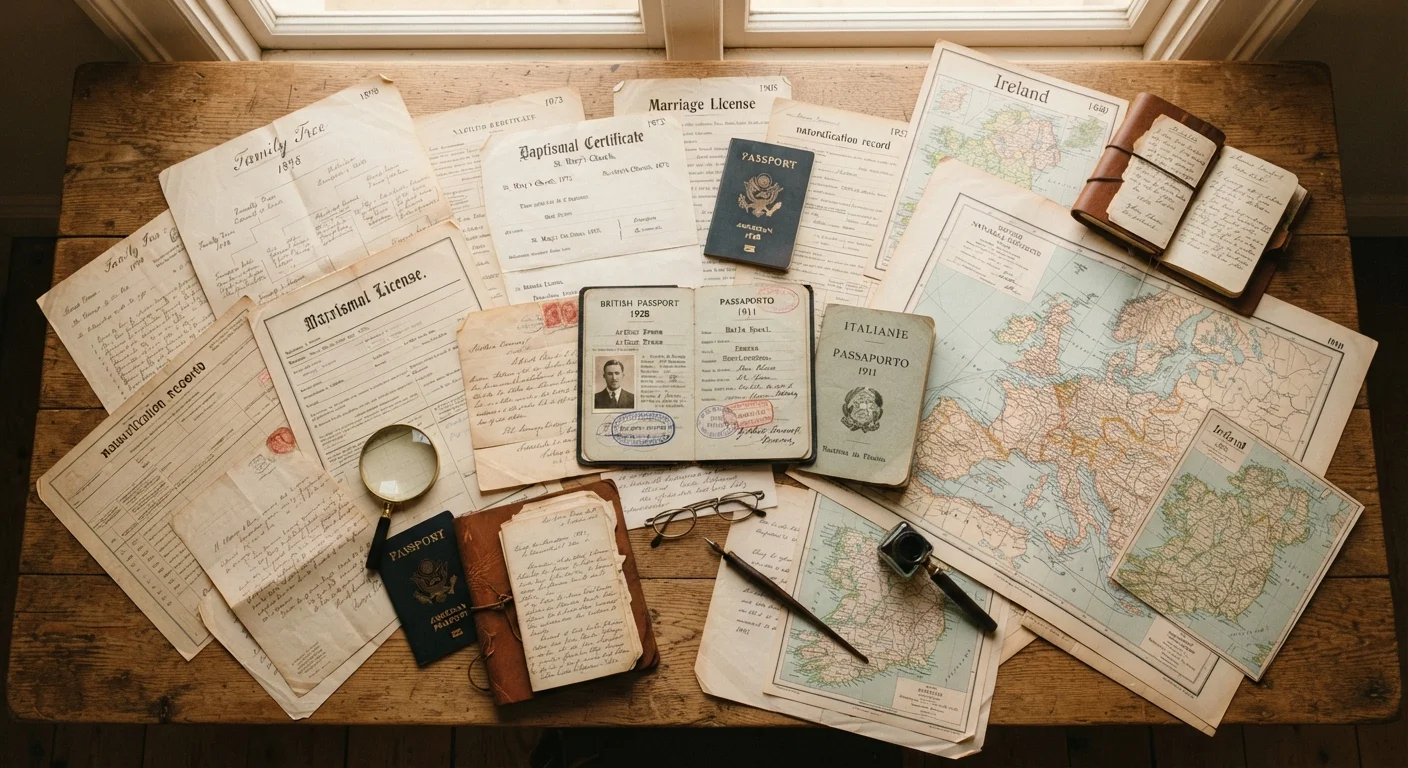
Photo: searchopenrecords editorial
—— In This Article
Key Takeaways
- Civil registration start dates vary from the 1530s (England) to the late 1800s in many nations.
- Church records often predate government registration by centuries and are frequently digitized.
- Many national archives offer free online access to core genealogy record collections.
- Name spellings and political borders changed over time — always search variant spellings.
- Understanding a country's administrative history is essential before searching its records.
Why Record Systems Differ So Widely by Country
Every nation developed its record-keeping practices based on its own legal history, religious institutions, and administrative structure. Some countries centralized vital records under government control as early as the sixteenth century; others did not establish civil registration until the twentieth century. The practical consequence for genealogists is significant: the records that exist, what they contain, and where they are held can differ completely from one country to the next — and sometimes from one province to the next within the same country.
Before searching any foreign record system, it helps to understand three foundational questions: When did civil registration begin? Who kept records before that — the church, a local lord, a colonial administration? And have those records survived and been digitized? The answers shape your entire research approach. For a broader introduction to the document types you are likely to encounter, see our guide to historical record types.
Before searching any foreign archive, identify the specific village or town where your ancestor lived — not just the country. Most pre-twentieth-century records are organized geographically at the local level, not nationally.
National databases rarely index every locality; knowing the precise place of origin allows you to go directly to the relevant parish register or civil office collection, dramatically narrowing your search.
When a record collection seems to end abruptly, check whether a parallel religious denomination kept separate registers for the same community. Catholic, Lutheran, Reformed, Jewish, and Orthodox communities often documented the same population independently.
Overlapping record sets from different institutions frequently survive when one set was destroyed, providing continuity researchers would otherwise lose.
United Kingdom and Ireland
England and Wales introduced civil registration of births, marriages, and deaths in 1837. Scotland followed in 1855 with a more detailed system that often included parents' ages and birthplaces. Before civil registration, parish registers — many surviving from the 1500s and 1600s — are the primary source. The General Register Office holds post-1837 records; ScotlandsPeople provides online access to Scottish records.
Ireland presents a distinct challenge. The destruction of the Public Record Office in 1922 eliminated many pre-1900 census returns and wills. Researchers must piece together alternative sources: Griffith's Valuation (1847–1864), Tithe Applotment Books (1823–1837), and surviving Catholic and Church of Ireland parish registers, many accessible through IrishGenealogy.ie. Northern Ireland records are held separately at the Public Record Office of Northern Ireland (PRONI).
Germany, Austria, and Switzerland
German-speaking lands were not unified nations until the 1870s and 1871 respectively, meaning records were kept at the state (Bundesland) or local parish level for most of history. Lutheran and Catholic church books (Kirchenbücher) are the dominant pre-civil-registration source and date as far back as the mid-1500s in some parishes. Civil registration began at different dates by region — Prussia introduced it in 1874, Bavaria in 1876.
Vital records in Germany are held at local civil registration offices (Standesamt), with older records increasingly transferred to state archives (Landesarchiv). The Matricula Online portal provides free access to digitized Catholic parish registers across much of Central Europe. In Austria, FamilySearch has partnered with the Vienna Diocesan Archive to index millions of records. Swiss records are cantonal in nature, so each canton's archive must be consulted separately.
A key challenge here is border changes: ancestors described as being from "Prussia" or "the Austro-Hungarian Empire" may have records held today in Poland, Czech Republic, Hungary, or Romania. Always identify the modern political location of the ancestor's birthplace before searching. For repositories that hold these overlooked collections, see record repositories worth knowing.
Scandinavia
The Nordic countries — Sweden, Norway, Denmark, and Finland — are among the best-documented societies for genealogical purposes. Sweden's household examination records (husförhörslängder), maintained by Lutheran clergy from the 1680s onward, track entire households across decades and are widely regarded as one of the richest genealogical sources in the world. The Swedish National Archives (Riksarkivet) provides free access through its Digitala Forskarsalen portal.
Norway's Digitalarkivet offers free access to census records, farm books, and church registers. Danish records are centralized through Arkivalieronline and the Danish Demographic Database. Finland's records, held at the National Archives of Finland, reflect dual Swedish and Russian administrative histories. Most Scandinavian civil registration began in the mid-1800s, but church records extend the documented lineage considerably further.
Eastern Europe and the Former Soviet Union
Research in Eastern Europe requires confronting layers of imperial and political history. Records for ancestors from Poland, Lithuania, Belarus, and Ukraine may be held in archives in Warsaw, Vilnius, Minsk, Kyiv, or Moscow — depending on which empire controlled the region at the time. The Pale of Settlement complicates Jewish genealogy specifically; records may be in Hebrew, Yiddish, Russian, German, or Polish depending on jurisdiction and era.
Many metrical books (church-based vital records under Russian Imperial administration) survive for the region. FamilySearch has indexed substantial collections from Poland, Ukraine, and the Baltic states. Romania's civil registration dates from 1865, but Orthodox church registers predate this. Hungary's state civil registration began in 1895; earlier records are primarily Catholic or Reformed church books.
The Forum of Genealogical Societies in Poland (Polskie Towarzystwo Genealogiczne) and similar national societies often maintain regional indexes and can direct researchers to the correct state archive (Archiwum Państwowe). Understanding the historical division of Polish lands between the Russian, German, and Austrian empires is a prerequisite for effective searching. For an expanded view of how these international systems work in practice, this cross-border research guide provides useful context.
Latin America and the Caribbean
Catholic Church records are the backbone of genealogical research throughout Latin America, often predating Spanish or Portuguese civil administration by decades. Parish registers in Mexico, Peru, and Brazil can extend back to the mid-1500s. Civil registration was introduced at various points in the nineteenth century: Mexico in 1857, Brazil in 1888, Argentina in 1886. Records are typically held at state or municipal civil registries (Registro Civil) and diocesan archives.
For Caribbean research, the record landscape varies significantly by colonial history. Cuba's civil registration began under Spanish rule in 1885. Puerto Rico records are held partly by the Puerto Rico Demographic Registry and partly through the Family History Library's microfilm holdings. Haiti's records reflect French colonial administration; many earlier records were lost to political upheaval and the 2010 earthquake. Jamaican records are held at the Island Record Office in Spanish Town.
Vital records — births, marriages, and deaths — remain the starting point in any region, but in Latin America the Catholic sacramental record often provides more detail than the civil equivalent, particularly for indigenous and African-descended families.
Building Your Cross-Border Research Strategy
No matter which countries your research spans, a consistent methodology helps. Start with what you know in the country where your family most recently lived, then work backward generation by generation, crossing borders only when the evidence supports it. Document sources meticulously — citing exactly which register, archive, and folio you consulted — so you can return to re-examine records if new information surfaces.
Expect to encounter name variations. Immigration officers, census enumerators, and clerks regularly anglicized, phonetically rendered, or misspelled foreign names. Search broadly using Soundex, wildcard characters, and variant spellings. Political and administrative boundary changes mean that a village recorded under one country's name in one era may appear under a different country's records in another.
Free starting points worth knowing: FamilySearch.org indexes hundreds of millions of records worldwide at no cost. National archives in most countries maintain online portals, and many partner with volunteer indexing projects. Obituary records can also anchor a research chain — see our obituary and family history resources for guidance on using them effectively. For a deeper look at specific document types used across all these systems, our overview of major genealogy record types is a useful companion reference.

Genealogy Search Editorial Team
Genealogy Search Editorial Team is the collective byline for our editorial team and contributor network. Articles published under this byline or an editorial pen name are researched, written, and reviewed according to our editorial standards for clarity, consistency, and independence before publication.
View author profile