
The Line Between Public Interest and Personal Privacy
Access laws try to balance transparency with privacy. Here's how courts and agencies draw that boundary in practice.
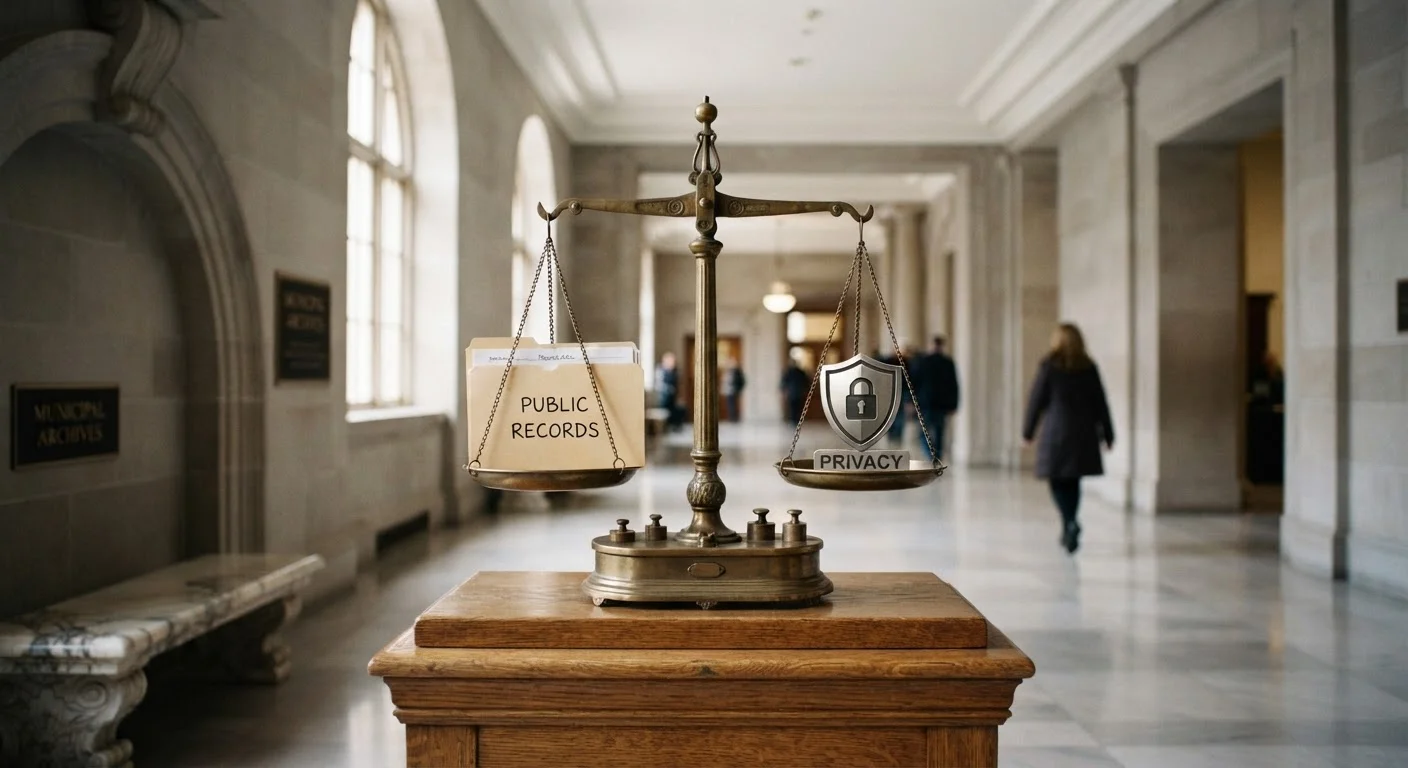
Photo: searchopenrecords editorial
—— In This Article
Key Takeaways
- Public records access is not absolute — legal exemptions exist to protect individual privacy.
- Courts apply a balancing test that weighs public benefit against privacy harm in each case.
- Sensitive categories like health, financial, and juvenile records receive stronger statutory protection.
- The purpose behind a records request can affect whether access is granted.
- Access to a record does not automatically mean you can use it for any purpose.
Why the Boundary Exists
Democratic governance depends on transparency. Citizens have a legitimate interest in knowing how public institutions operate, how tax money is spent, and whether officials are acting within the law. At the same time, individuals have a constitutional and statutory interest in controlling sensitive personal information about themselves.
These two principles collide constantly. When a court case is filed, it becomes part of the public docket — but it may also contain medical records, financial disclosures, or home addresses. When a government employee is disciplined, the public may have a right to know about misconduct — but the employee retains some privacy rights too. The legal framework tries to resolve these tensions systematically rather than arbitrarily.
The legal structure behind public records in the U.S. is built on a default of openness, with specific, defined exceptions — not the other way around. Understanding the exceptions is just as important as understanding the baseline right of access.
How Courts and Agencies Draw the Line
Neither courts nor agencies resolve these conflicts by instinct. They apply structured legal tests, most of which hinge on three core questions:
- What is the privacy interest at stake? The more sensitive the information — health data, sexual behavior, personal finances, home address of a private individual — the stronger the presumption in favor of protection.
- What is the public benefit of disclosure? Information that directly illuminates how a government body exercised its power carries high public value. Information that is merely interesting or embarrassing to a private person does not.
- Is the privacy harm proportionate to the public gain? Even when some public benefit exists, agencies can redact or partially withhold records if the privacy cost is disproportionately high.
Federal FOIA Exemption 6, for example, protects personnel and medical files when disclosure would constitute a "clearly unwarranted invasion of personal privacy." The word "clearly" matters: it signals that the default still tilts toward disclosure, and agencies must affirmatively justify withholding.
State laws vary considerably. Some states apply broader privacy protections than FOIA; others are more permissive. The privacy laws that shape what you can find online explains how these federal and state layers interact in practice.
State Laws Often Go Further Than Federal FOIA
Federal FOIA applies only to federal agencies. Each state has its own open-records law, and these vary significantly in scope. Some states grant broader access than FOIA; others impose stricter privacy protections. Always check the specific statute governing the agency or jurisdiction where the records are held before assuming federal rules apply.
Categories That Receive Stronger Protection
Certain data categories are carved out of the public record system by statute, regardless of how the balancing test might otherwise resolve. These include:
- Health and medical information — protected by HIPAA and generally unavailable in any government-held record unless the individual has explicitly authorized disclosure. The full scope of HIPAA's limits is worth understanding before searching for health-related records.
- Education records — shielded by FERPA, which bars disclosure of student records without consent.
- Driver and vehicle records — the Driver's Privacy Protection Act (DPPA) restricts who can access motor vehicle records and for what purpose.
- Juvenile records — most states seal or restrict access to records involving minors.
- Certain financial records — bank account details and tax returns are protected under separate statutory frameworks.
These categorical protections are not subject to routine balancing — they represent policy judgments that the privacy interest in these domains is almost always strong enough to prevail. For a plain-language breakdown of the federal statutes involved, see federal privacy laws that shape what you can access.
9
FOIA exemptions that limit public access
The federal Freedom of Information Act contains nine statutory exemptions, including protections for personal privacy, law enforcement records, and national security information.
50
U.S. states with open-records laws
All 50 states have enacted their own public records or sunshine laws, each with different exemption standards and balancing tests that may be broader or narrower than federal FOIA.
1974
Year the federal Privacy Act was enacted
The Privacy Act of 1974 established core rules governing how federal agencies collect, maintain, and disclose records about individuals, complementing FOIA's transparency framework.
Public Figures vs. Private Individuals
One of the most consistent principles in this area of law is that public officials and public figures accept reduced privacy expectations — but only with respect to their public roles. A city council member's voting record, a police officer's use-of-force history, and a public company executive's regulatory filings are all subject to robust disclosure norms.
But the same city council member's home address, their child's school records, or their personal medical history remain private. The reduced expectation does not extend to their entire lives — only to how they exercise public power or public trust.
Private individuals, by contrast, retain much stronger protections across the board. When someone appears in a public record — as a party to a lawsuit, a property owner, or a business licensee — that specific record may be accessible, but it does not make all of their personal information fair game. The aggregation problem in the digital age is especially relevant here: combining multiple individually public records can create a privacy intrusion greater than any single record would.
Access Is Not the Same as Unlimited Use
A point many readers overlook: even when you lawfully access a public record, that access does not authorize every possible use of the information. Federal and state laws impose independent restrictions on how certain records can be used once obtained.
For example, using court records or background check data to make discriminatory employment decisions violates civil rights law regardless of whether the underlying records were publicly accessible. Using location information derived from public records to track or harass someone may constitute stalking under criminal law. The ways that using public records can cross a legal line deserve close attention before acting on any information you find.
Similarly, background check reports draw on both public records and aggregated private data — and both types are governed by the Fair Credit Reporting Act (FCRA) when used in certain contexts. Understanding the difference between public records and private data in a background check helps clarify what rules apply and when.
This article provides general legal and policy information for educational purposes only. It is not legal advice. Consult a qualified attorney for guidance specific to your situation.
Frequently Asked Questions

Public Records 101 Editorial Team
Public Records 101 Editorial Team is the collective byline for our editorial team and contributor network. Articles published under this byline or an editorial pen name are researched, written, and reviewed according to our editorial standards for clarity, consistency, and independence before publication.
View author profile