
Holders, Custodians, and the State: Who Is Actually Responsible for Unclaimed Funds?
Banks, insurers, and employers all play a role before the government steps in. Clarify who holds unclaimed money at each stage of the process.
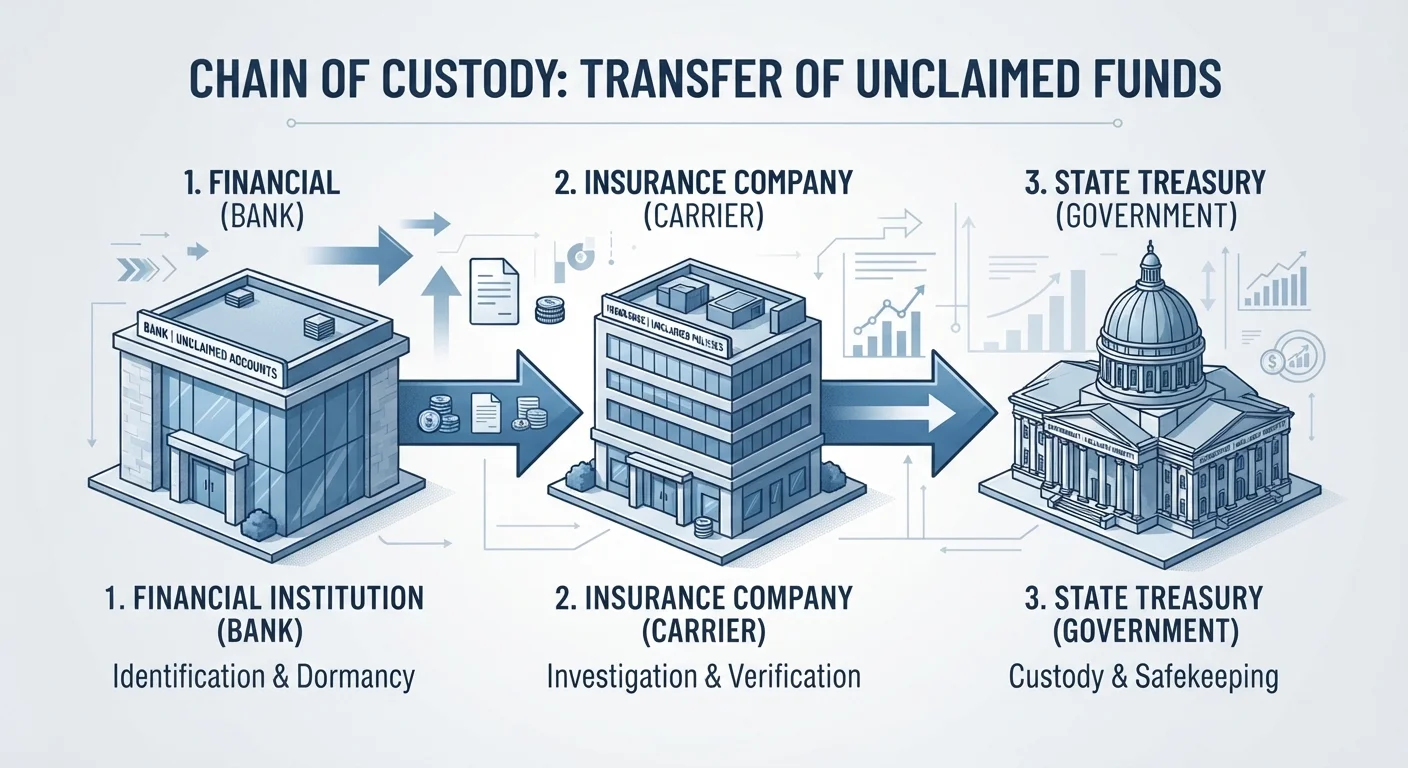
Photo: searchopenrecords editorial
—— In This Article
The Three-Stage Chain of Responsibility
When funds go unclaimed, responsibility doesn't rest with a single party — it shifts through a defined chain. Understanding who holds what, and when, clarifies why the process takes time and why government custody is actually protective rather than punitive.
The chain has three distinct stages:
- The Holder Stage: A business or institution holds funds on behalf of an individual owner. This covers the active and dormant periods before any government involvement.
- The Reporting & Transfer Stage: Once dormancy thresholds are met, the holder is legally obligated to notify the owner, report the asset to the state, and transfer it.
- State Custodianship: The state treasurer or comptroller holds the funds indefinitely until the rightful owner — or their heir — files a valid claim.
This sequence is governed by each state's unclaimed property statutes, which set dormancy periods, notice requirements, and reporting deadlines. To trace this process from start to finish, see the full journey of dormant funds.
| Who are common holders? | Banks, credit unions, insurers, brokerages, utilities, and employers |
| Typical dormancy period | 1–5 years, depending on asset type and state law (Varies by state) |
| Required holder action before transfer | Send due diligence notice to owner's last known address |
| Who receives escheated funds? | State treasurer or comptroller's office |
| Does the state own your funds after escheatment? | No — the state holds them in perpetuity for the rightful owner |
| Multi-state search resource | MissingMoney.com (NAUPA-affiliated) |
What Holders Are Actually Required to Do
A holder is any entity holding property that legally belongs to another person. Common holders include banks, credit unions, life insurance companies, brokerage firms, utilities, employers (for uncashed paychecks), and retailers (for unredeemed gift cards, where state law applies).
Holders have three core obligations once an account or asset crosses its state-defined dormancy threshold:
- Attempt owner contact: Most states require holders to send a due diligence notice — typically a written letter — to the owner's last known address before transferring funds.
- File an annual report: Holders must report dormant property to the state on a schedule set by law, usually annually, using standardized formats often defined by NAUPA.
- Remit the property: After reporting, the holder transfers the actual funds or assets to the state treasurer's office.
Holders who fail to comply can face audits, penalties, and interest charges. This legal pressure is what keeps the reporting pipeline functioning. For a closer look at how those obligations play out in practice, see how businesses are required to hand over dormant accounts.
Holder
Any business or institution — such as a bank, insurer, or employer — that holds funds belonging to someone else. Holders are legally required to attempt contact with owners and, if unsuccessful, report and transfer dormant assets to the state.
Escheatment
The legal process by which a holder transfers dormant or unclaimed property to state government custody. Once escheated, the state becomes the custodian and holds the funds indefinitely for the rightful owner.
Dormancy Period
A state-defined window of inactivity — typically one to five years — after which a holder must treat an account or asset as unclaimed and begin the reporting process.
Custodian (State)
After escheatment, the state treasurer or comptroller assumes custodianship of unclaimed property. The state does not own the funds; it holds them on behalf of the rightful owner, who may claim them at any time.
Due Diligence Notice
A required written notification that holders must send to the owner's last known address before transferring unclaimed property to the state, giving the owner a final opportunity to respond.
NAUPA
The National Association of Unclaimed Property Administrators — an organization of state unclaimed property programs that coordinates national standards, reporting formats, and the MissingMoney.com multi-state search portal.
The State's Custodial Role — and What It Means for Owners
Once funds are escheated, the state does not own them — a distinction that matters enormously for claimants. The state acts as a permanent custodian, holding the property on behalf of the rightful owner until a claim is filed and verified.
In most states, this custodianship has no expiration. You — or your heirs — can generally claim escheated property years or even decades after transfer. Some states do impose limits on interest or growth after escheatment, but the principal is typically preserved.
State treasurer and comptroller offices maintain searchable public databases precisely because transparency is part of their custodial duty. The NAUPA-affiliated portal MissingMoney.com aggregates records from many participating states, making multi-state searches practical. Individual state portals remain the authoritative source for filing claims.
To understand what custodial stewardship means in concrete terms for people filing claims, see why unclaimed money doesn't disappear. When you're ready to act, the state database search guides and claims process resources walk you through each step.
This article is for general informational purposes only and does not constitute legal or financial advice. For questions specific to your situation, consult a qualified attorney or financial professional.

Unclaimed Money Editorial Team
Unclaimed Money Editorial Team is the collective byline for our editorial team and contributor network. Articles published under this byline or an editorial pen name are researched, written, and reviewed according to our editorial standards for clarity, consistency, and independence before publication.
View author profile