
The Reporting Chain: How Businesses Are Required to Hand Over Dormant Accounts
Companies don't keep dormant funds forever. Understand the legal reporting obligations that require holders to transfer assets to state custody.
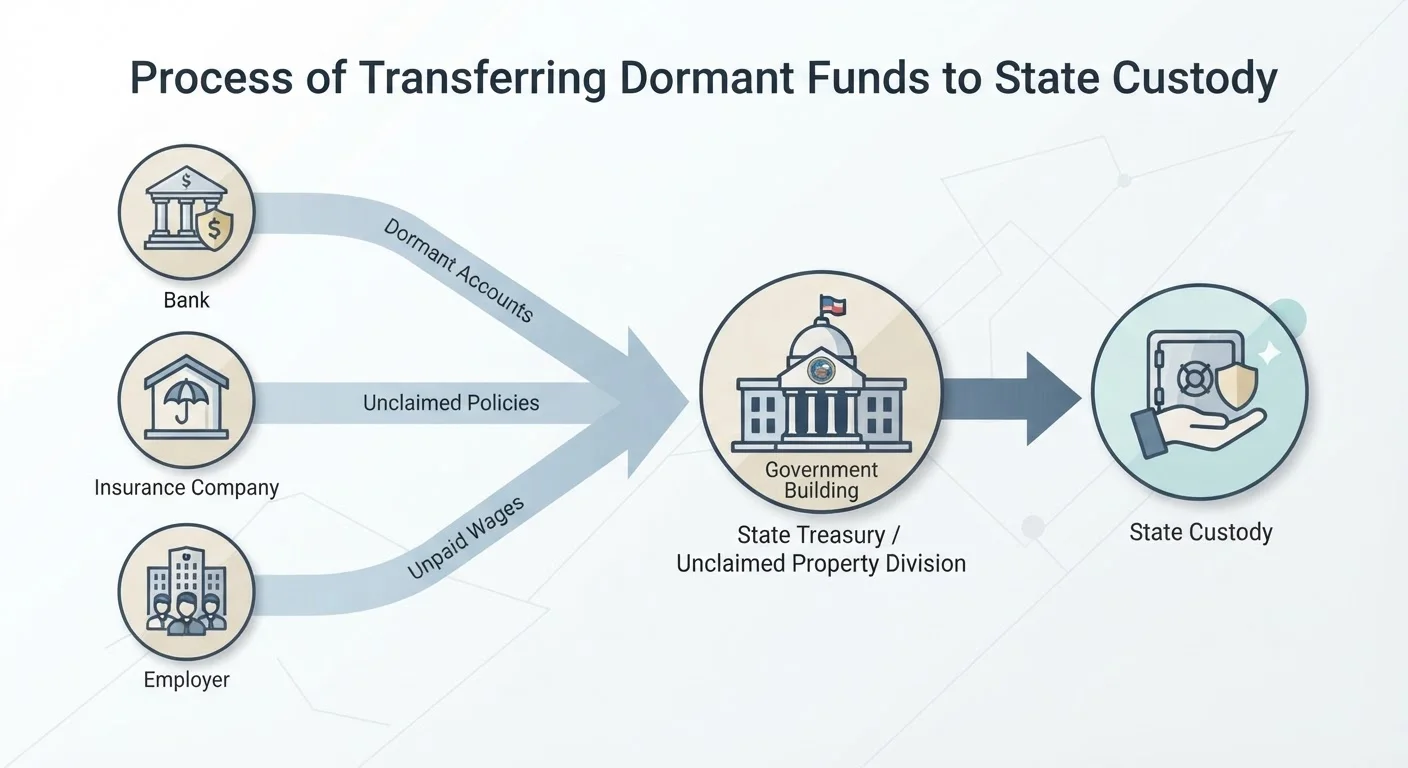
Photo: searchopenrecords editorial
—— In This Article
Key Takeaways
- All 50 states have escheatment laws requiring businesses to report and transfer dormant accounts.
- Dormancy periods vary by property type and state, typically ranging from one to five years.
- Businesses must attempt to notify owners before transferring funds to the state.
- Transferred funds remain the owner's property and can be reclaimed at any time.
- State treasurers list reported accounts in searchable public databases.
What Escheatment Laws Actually Require
Every U.S. state has enacted some form of escheatment law — legislation that compels businesses holding dormant financial assets to transfer those assets to the state government. These laws exist to protect consumers: without them, companies could quietly absorb forgotten balances or indefinitely defer accountability for funds they don't legally own.
Under these statutes, any organization that holds money or property on behalf of another person is considered a "holder." Holders include banks, brokerage firms, life insurance carriers, employers, utilities, and even retailers in certain situations. Their legal obligation follows a predictable sequence: identify dormant accounts, attempt to locate the owner, and then report and remit the funds to the state if no contact is made.
The specific rules — dormancy thresholds, filing deadlines, and report formats — are set by each state individually. Most states model their laws on the Uniform Unclaimed Property Act, a model legislation framework that has been revised several times to improve consistency across jurisdictions. This is why the basic process feels similar from state to state, even though the details differ.
To understand where this reporting obligation fits within the broader journey of dormant funds, see how unclaimed money moves from private hands to public record.
The Dormancy Clock and the Due-Diligence Notice
The reporting chain begins the moment an account enters dormancy — a state triggered by a complete absence of owner-initiated activity. What counts as activity varies, but it generally includes transactions, written correspondence initiated by the owner, or confirmed contact. A bank statement that simply goes unopened does not reset the clock.
Dormancy periods are not one-size-fits-all. A standard checking or savings account typically has a three-to-five-year dormancy threshold. Cashier's checks and money orders may have shorter windows. Matured life insurance benefits can have longer ones. Each property type is assigned its own timeline under state law.
Once a holder determines an account has crossed its dormancy threshold, most states require the business to send a due-diligence notice — typically a letter — to the owner's last known address. This notice informs the owner that their account is about to be transferred to the state and gives them a final opportunity to reclaim or reactivate it. If the letter is returned as undeliverable, or if the owner doesn't respond within the required window, the transfer moves forward.
Act Fast If You Receive a Due-Diligence Notice
If a financial institution sends you a letter stating your account is about to be escheated to the state, contact them immediately to confirm your current address or reactivate the account. Responding promptly prevents the transfer and avoids the additional step of filing a state claim later. Keep your contact information current with all financial institutions to reduce the chance of triggering the dormancy clock in the first place.
This pre-transfer notice is your last opportunity to act before funds leave the business. If you receive any letter from a financial institution referencing "unclaimed property" or "escheatment," treat it as urgent and respond promptly.
For a full timeline view of this process, see the step-by-step unclaimed funds timeline.
Filing the Annual Holder Report
Once due diligence is complete, holders are required to file an annual holder report with the appropriate state agency — usually the state treasurer, comptroller, or department of revenue. This report lists every dormant account being remitted that year, including owner names, last known addresses, account numbers (often partially masked), and the dollar value or asset description.
Most states set a single annual filing deadline, often in the fall, though the exact date varies. Businesses that fail to file on time can face interest charges and penalties. Intentional non-compliance or deliberate concealment of reportable property carries more serious consequences under state law.
The filing format is largely standardized through guidance from the National Association of Unclaimed Property Administrators (NAUPA), which provides a common reporting specification that most states accept. This standardization makes it feasible for large national institutions — which may have reportable property across dozens of states — to file efficiently.
To understand which parties bear responsibility at each stage of this chain, see who is responsible for unclaimed funds at each stage.
$70B+
Total unclaimed property held by U.S. states
According to NAUPA, U.S. states collectively hold more than $70 billion in unclaimed property on behalf of rightful owners.
1–5 years
Typical dormancy period before reporting is required
State escheatment laws set dormancy thresholds that generally range from one to five years depending on property type and jurisdiction.
Millions
Individual accounts reported to states annually
Holders across all industries file annual reports covering millions of individual dormant accounts with state unclaimed property programs each year.
From Report to Public Record: What Happens Next
Once a state receives a holder report and the accompanying funds, it integrates that data into its unclaimed property database — typically a searchable public portal maintained by the state treasurer's office. This is the step that transforms a forgotten private account into publicly accessible, claimable property.
The transfer of funds does not extinguish the owner's right to them. States hold these assets in perpetuity on the owner's behalf. There is no deadline by which you must file a claim. You can search for property belonging to you, a deceased relative, or a dissolved business at any time through your state's official portal or through the multi-state search tool at MissingMoney.com, which is administered in partnership with NAUPA.
The full arc — from a dormant account to a successful claim — is covered in detail in our guide to the full lifecycle of unclaimed property. When you're ready to search, searching state databases is a practical starting point, and claiming your money walks through what to do once you find a match.
This article is for general informational purposes only and does not constitute legal or financial advice. Rules and procedures vary by state; consult your state treasurer's office or a qualified professional for guidance specific to your situation.
Frequently Asked Questions

Unclaimed Money Editorial Team
Unclaimed Money Editorial Team is the collective byline for our editorial team and contributor network. Articles published under this byline or an editorial pen name are researched, written, and reviewed according to our editorial standards for clarity, consistency, and independence before publication.
View author profile