
Federal vs. State Unclaimed Property Searches: Understanding the Difference
Federal agencies hold unclaimed funds separately from state programs. Learn what each covers and how to search both without duplicating effort.
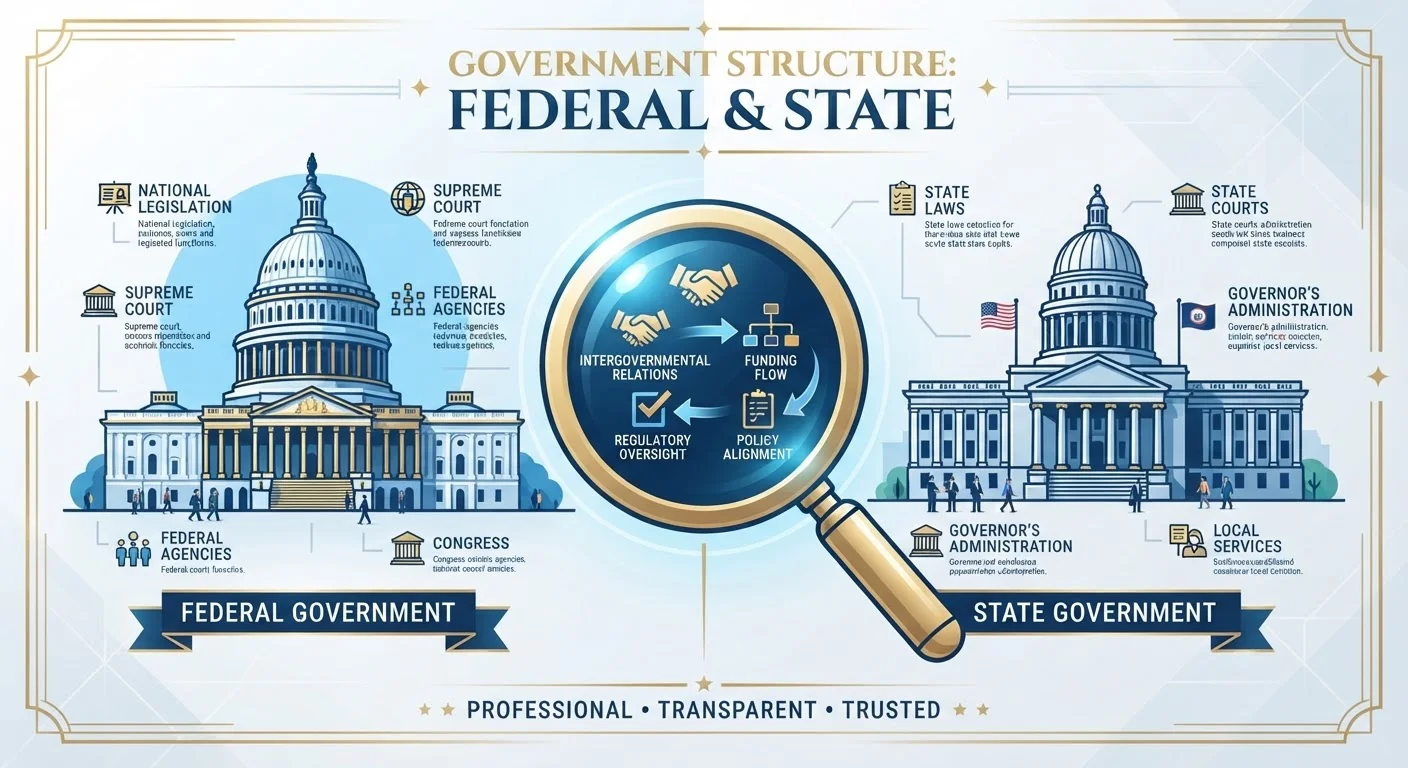
Photo: searchopenrecords editorial
—— In This Article
Key Takeaways
- Federal agencies hold certain unclaimed funds separately from state unclaimed property programs.
- State programs, governed by escheatment laws, cover the broadest categories of dormant financial accounts.
- Searching both systems requires visiting different, unrelated databases — no single portal covers everything.
- Tools like MissingMoney.com search multiple state databases simultaneously but do not cover federal holdings.
- Federal programs each have their own dedicated search portal — there is no unified federal unclaimed money database.
Two Separate Systems: Why the Distinction Matters
Many people assume there is one central government database where all unclaimed money resides. In reality, unclaimed property in the United States is managed through two fundamentally different systems: state-level escheatment programs and federal agency-specific programs. Understanding how these differ helps you search strategically rather than spinning your wheels in the wrong place.
State programs are governed by each state's escheatment laws — rules that require businesses (banks, insurers, utilities, and others) to hand over dormant accounts to the state after a set dormancy period, typically one to five years. Once transferred, the state holds the funds indefinitely and makes them searchable through public portals. You can learn more about this lifecycle in the How Unclaimed Money Works hub.
Federal programs, by contrast, exist outside the state escheatment framework entirely. Individual federal agencies each manage their own category of unclaimed funds — and there is no unified federal portal equivalent to a state treasurer's search tool. Knowing which agency to contact depends entirely on what type of payment or benefit you are looking for.
What State Programs Cover
State unclaimed property programs handle the broadest range of dormant assets. Common categories include:
- Forgotten bank and credit union accounts
- Uncashed payroll checks and money orders
- Dormant brokerage accounts and stock dividends
- Insurance policy proceeds and annuity payouts
- Security deposits from former landlords or utilities
- Contents of abandoned safe deposit boxes
Each state runs its own portal, and the rules — dormancy periods, reportable asset types, and claim procedures — vary considerably. The article How Unclaimed Property Laws Vary Across U.S. States explains those differences in detail.
For searching, the National Association of Unclaimed Property Administrators (NAUPA) sponsors MissingMoney.com, a free multi-state search tool that queries participating state databases simultaneously. Individual state treasurer websites remain authoritative and should be checked directly, especially for states that do not participate in MissingMoney.com. See Searching Unclaimed Property Across Multiple States at Once for a practical workflow.
Search All Name Variations
State databases index names exactly as reported by the original holder — which may reflect a maiden name, a middle name, or a hyphenated surname. Run searches using every name you have legally used, as well as common misspellings. This is especially important for funds that may have been reported decades ago.
What Federal Programs Cover
Federal agencies hold unclaimed funds that originate from federal programs — not from private-sector dormancy. The most significant sources include:
- IRS (Internal Revenue Service)
- Undelivered or uncashed federal tax refund checks. The IRS "Where's My Refund" tool and the "Get My Payment" portal can help locate missing refunds, but there is no searchable database of unclaimed refunds by name.
- Pension Benefit Guaranty Corporation (PBGC)
- The PBGC insures certain private-sector defined-benefit pension plans. When a plan terminates, the PBGC takes over and maintains a searchable database of participants owed benefits at pbgc.gov.
- TreasuryDirect / Bureau of the Fiscal Service
- Matured, unredeemed U.S. Savings Bonds are searchable via the Treasury Hunt tool at treasuryhunt.gov. This covers paper bonds that were never cashed.
- Federal Deposit Insurance Corporation (FDIC)
- When an FDIC-insured bank fails and uninsured funds remain after liquidation, the FDIC maintains records. However, most insured deposits are paid out promptly through the standard failure process.
- Department of Veterans Affairs (VA) and Office of Personnel Management (OPM)
- Unpaid federal employee or veteran benefits may be traceable through each agency's respective benefit administration offices.
Each of these requires a separate search. There is no single portal that aggregates all federal unclaimed funds in one place.
| State Unclaimed Property Programs | Federal Agency Programs | |
|---|---|---|
| Who manages it | State treasurer or comptroller | Individual federal agencies (IRS, PBGC, Treasury, etc.) |
| Legal framework | State escheatment laws | Federal agency-specific regulations |
| Asset types covered | Bank accounts, securities, insurance proceeds, checks | Tax refunds, pension benefits, savings bonds, VA benefits |
| Unified search portal? | Yes — MissingMoney.com covers most states | No — each agency has its own separate tool |
| Where to start | State treasurer website or MissingMoney.com | IRS.gov, pbgc.gov, treasuryhunt.gov (as applicable) |
| Claim filed with | State treasurer's office | The specific federal agency holding the funds |
Running a Complete, Efficient Search
Because the two systems operate independently, a thorough search requires a deliberate two-track approach. Here is a practical sequence:
- Start with your states of residence. Search each state where you have lived, worked, or held accounts using that state's official treasurer portal. Use MissingMoney.com to cover multiple states at once, then verify directly with any non-participating states. See A State-by-State Overview of Unclaimed Property Portals for portal links.
- Search relevant federal portals separately. If you or a family member held savings bonds, visit treasuryhunt.gov. If you participated in a pension plan that has terminated, check pbgc.gov. If you may have an uncashed tax refund, use IRS tools directly at irs.gov.
- Document your searches. Keep a record of the databases you searched, the names and variations you used, and the dates — this prevents duplication and creates a useful paper trail for any claims you file.
Once you identify funds, the claims process also differs between systems. State claims are filed through each state's treasurer portal. Federal claims are filed directly with the relevant agency. The Claiming Your Money hub walks through the general steps, and Claiming Funds Across Multiple States at Once addresses multi-state claim coordination.
This article is for general informational purposes only and does not constitute legal, financial, or tax advice. Consult a qualified professional regarding decisions specific to your circumstances.

Unclaimed Money Editorial Team
Unclaimed Money Editorial Team is the collective byline for our editorial team and contributor network. Articles published under this byline or an editorial pen name are researched, written, and reviewed according to our editorial standards for clarity, consistency, and independence before publication.
View author profile