
Accident Records on a Vehicle History Report: What the Data Really Means
Not all accident entries mean the same thing. Learn how to interpret collision data, damage severity, and airbag deployment records on a vehicle report.
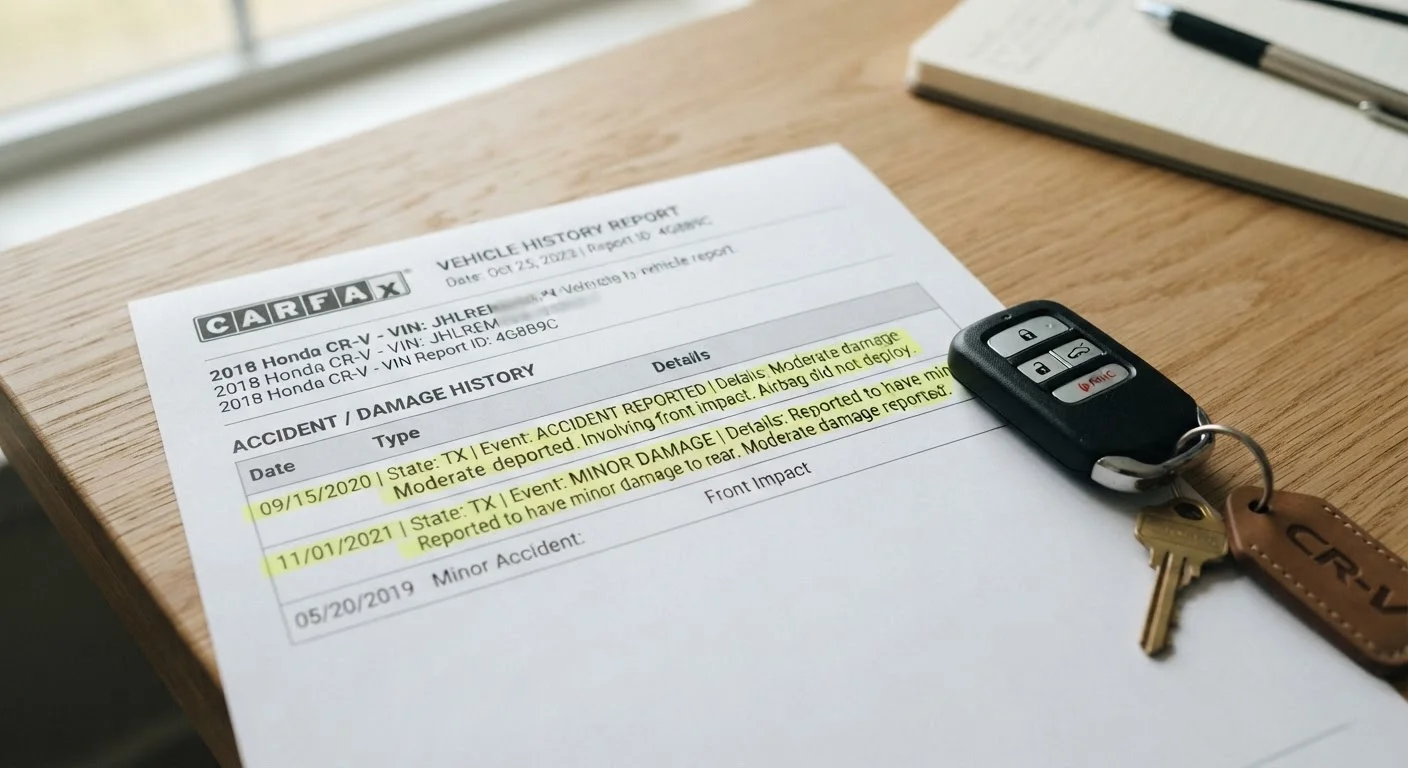
Photo: searchopenrecords editorial
—— In This Article
Key Takeaways
- An accident entry does not automatically mean a vehicle is unsafe or structurally compromised.
- The severity label, airbag deployment flag, and damage location are the most meaningful fields to examine.
- Reports only capture incidents that were actually reported — many minor collisions never appear.
- A title brand such as 'salvage' or 'rebuilt' is a separate, more serious flag than a basic accident entry.
- A pre-purchase inspection by a qualified mechanic is the most reliable way to validate what the report shows.
Where Accident Data Comes From
Vehicle history reports draw accident data from several distinct sources, and understanding those sources helps you weigh any entry you see. The three primary pipelines are insurance carrier claims data, state DMV title records, and law enforcement or government crash databases.
Insurance companies that voluntarily share claims data with aggregators contribute the largest share of accident entries. When a policyholder files a claim after a collision, the insurer logs the incident — including its date, reported damage area, and severity assessment — and that information may flow into the VIN history. State DMV records contribute title brand changes (such as salvage or rebuilt designations) when a vehicle is declared a total loss. Police report data, where available, adds another layer but coverage varies significantly by state.
Because each source operates independently, the same incident might generate one entry, multiple entries, or none at all. For a deeper look at what else appears alongside accident data, see what a vehicle history report actually contains.
Reading the Accident Entry: Key Fields Explained
When an accident record appears, it typically includes several data fields. Here is what each one actually tells you:
- Date of incident: The reported date of the collision or claim. Multiple entries on the same date from different sources usually represent the same event, not separate accidents.
- Damage severity: Labels like "minor," "moderate," or "severe" come from the reporting source's internal classification — usually the insurer. These are not standardized across all carriers, so "moderate" from one company may not be comparable to another's.
- Damage location: Front, rear, side, or rollover indicators tell you which area of the vehicle was affected. Frontal structural damage and rollover events carry more engineering significance than a rear bumper impact.
- Airbag deployment: A "yes" flag here confirms that impact forces were substantial enough to trigger the restraint system. It also means airbag components required replacement.
- Number of vehicles involved: Single-vehicle incidents (hitting a barrier or post) versus multi-vehicle collisions can provide context about the type of impact.
~1 in 5
Used vehicles with a reported accident history
Industry estimates from vehicle history data aggregators suggest roughly one in five used vehicles carries at least one reported accident or damage event in its history.
Varies by state
Total loss threshold triggering a salvage title
States set their own thresholds — commonly between 75% and 90% of a vehicle's actual cash value — to determine when an insurer must report a total loss and prompt a title brand change.
None of these fields alone tells the complete story. A rear-impact entry with no airbag deployment and a clean title reads very differently from a frontal severe-damage entry with airbag deployment and a subsequent rebuilt title. Always read the full record set, not just the first flag.
The Difference Between an Accident Entry and a Title Brand
One of the most common misreads of a vehicle history report is treating every accident entry as equivalent to a salvage designation. They are not the same thing.
A basic accident entry means an incident was reported. The vehicle may have been repaired fully and returned to service with a clean title. A title brand — such as salvage, rebuilt, or junk — is a legal designation issued by a state DMV, typically after an insurer declares the vehicle a total loss. That declaration triggers a formal title change that follows the VIN permanently, regardless of subsequent repairs.
If a vehicle carries a rebuilt title, it means it was once declared a total loss, repaired, and then re-inspected to meet state roadworthiness standards. The repair standards and inspection rigor vary by state. For a full explanation of this process, see total loss designations and what they mean.
Environmental damage — flooding, hail, or fire — can produce similar title brands but through a different pathway. That topic is covered in detail at how environmental damage shows up in vehicle records.
What the Report Cannot Tell You
Accident records in a VIN history are only as complete as what was reported. A collision handled entirely out-of-pocket — no insurance claim, no police report — leaves no data trail. Estimates suggest a meaningful share of minor vehicle damage is repaired without any formal report, meaning the history could appear clean while the vehicle carries unreported prior damage.
Even when an accident is reported, the record describes the event at the time of filing. It does not confirm whether repairs were made, who made them, what parts were used, or whether the work met manufacturer specifications. That gap is why cross-checking a report against physical records and inspections is an essential follow-up step.
Always Follow Up With a Physical Inspection
No matter what a vehicle history report shows, a pre-purchase inspection by an independent, qualified mechanic is the most reliable verification step available. A trained technician can assess frame integrity, paint consistency, and component condition in ways that no data report can replicate. Budget for this inspection as a standard part of any used vehicle evaluation.
For a broader discussion of data gaps, see the limits of what a VIN search can find.
This article is for informational and educational purposes only. It does not constitute legal, financial, or mechanical advice. Consult a qualified mechanic or licensed professional before making vehicle purchase decisions based on history report data.
Frequently Asked Questions

Vin Search Editorial Team
VIN Search Editorial Team is the collective byline for our editorial team and contributor network. Articles published under this byline or an editorial pen name are researched, written, and reviewed according to our editorial standards for clarity, consistency, and independence before publication.
View author profile