
VIN vs. License Plate: Which Identifier Tells You More About a Vehicle
VINs and license plates both identify vehicles, but they work very differently. See what each reveals and when each is most useful.
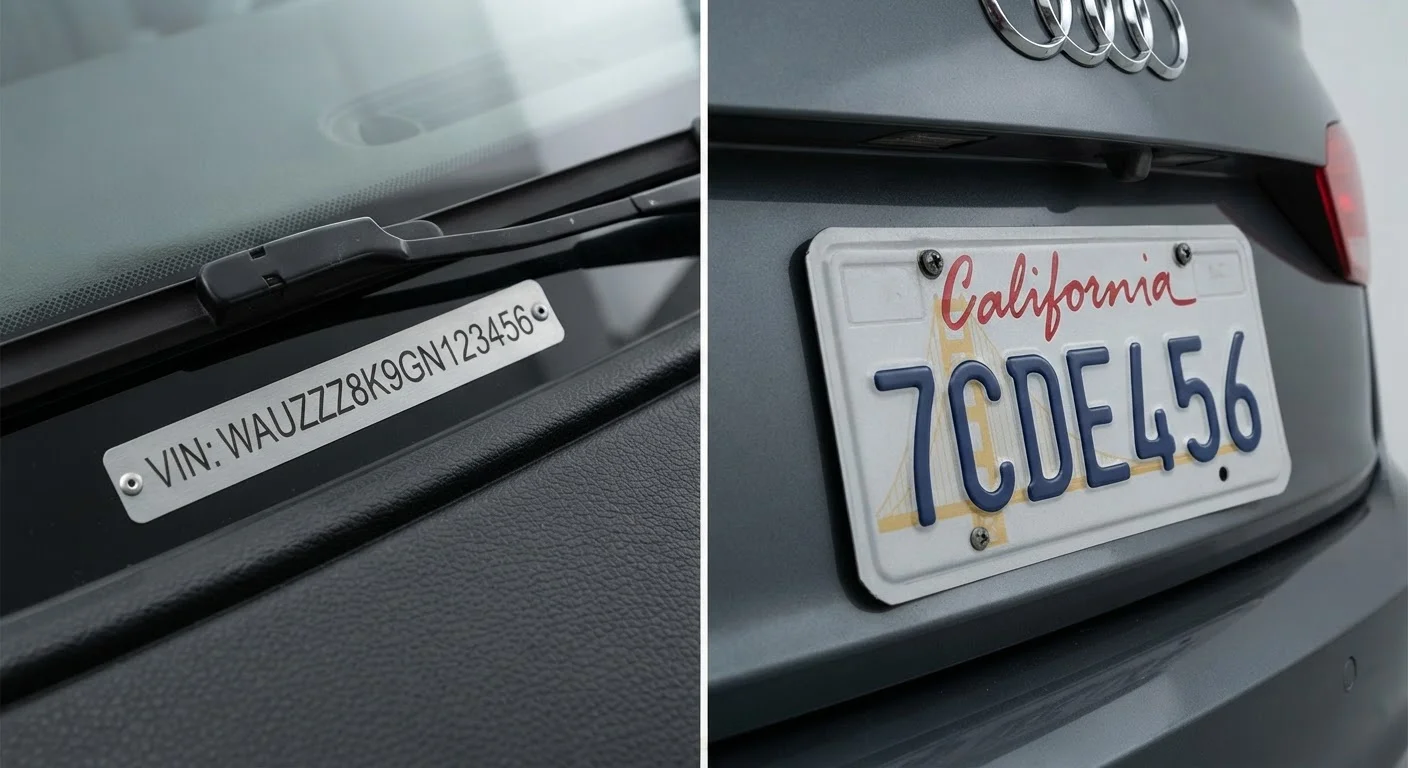
Photo: searchopenrecords editorial
—— In This Article
Key Takeaways
- A VIN is permanent and travels with the vehicle for its entire lifespan; a license plate can change with each owner or state.
- VINs encode manufacturer details, model specifications, and production data directly in their 17-character structure.
- License plates are administrative — they connect a vehicle to a registration record in a specific state at a specific time.
- VIN-based searches access national title, lien, recall, and history databases; plate searches are typically limited to state-level records.
- For any serious due-diligence check, the VIN is the more reliable and comprehensive identifier.
What Each Identifier Actually Is
Before comparing the two, it helps to understand what each identifier is designed to do — because they serve fundamentally different purposes.
A Vehicle Identification Number (VIN) is a 17-character alphanumeric code assigned by the manufacturer at the point of production. Standardized by the National Highway Traffic Safety Administration (NHTSA) in 1981, every road-legal vehicle sold in the U.S. carries one. The VIN is physically stamped or affixed to the vehicle itself — typically on the dashboard near the windshield, on the driver's door jamb, and on major components — and it never changes. Think of it as a vehicle's permanent fingerprint. As our position-by-position VIN guide explains, each character encodes specific data: the manufacturer, country of origin, vehicle type, engine, model year, and production sequence.
A license plate number, by contrast, is an administrative identifier issued by a state's Department of Motor Vehicles (DMV). It links a vehicle to a specific registration record within that state for a specific period. Plates change when a vehicle is sold across state lines, when an owner moves, or simply when a registration renewal involves a new plate series. The plate itself carries no inherent information about the vehicle — all meaning comes from the state database it references.
What Each Identifier Can Reveal
The depth of information accessible through each identifier differs significantly.
| Criterion | VIN | License Plate |
|---|---|---|
| Assigned by | Manufacturer at production | State DMV at registration |
| Permanence | Fixed for vehicle's lifetime | Changes with owner or state |
| Information encoded | Make, model, engine, plant, year | None — points to a database record |
| Geographic scope | National (all 50 states) | State-specific only |
| Title & lien history | Yes, via national databases | No |
| Safety recall lookups | Yes, via NHTSA database | No |
| Current registration check | Indirect (DMV cross-reference) | Yes, directly |
| Theft database checks | Yes, via NICB VINCheck | No |
A VIN search can surface national title records, branded titles (such as salvage, flood, or rebuilt), odometer readings at transfer, open safety recalls issued by NHTSA, lien holder data, and insurance total-loss events. Because the VIN is consistent across all 50 states, records follow the vehicle no matter how many times it has changed hands or jurisdictions. See our guide on what a VIN reveals about ownership history for a closer look at how title data connects to the VIN record.
A license plate search, on the other hand, is largely confined to the issuing state's registration database. It can confirm whether a vehicle's registration is current, identify the registered owner of record (subject to state privacy laws, particularly the Driver's Privacy Protection Act), and sometimes surface emissions or inspection status. It cannot, on its own, tell you about the vehicle's history in other states, whether the title is clean, or what the vehicle's factory specifications are.
For a broader look at what VIN-based lookups can and cannot do, our article on eight things a VIN can reveal sets realistic expectations.
Permanence and Reliability
One of the most practical differences between the two identifiers is permanence. A VIN is immutable by design — altering or removing it is a federal crime under 49 U.S.C. § 32910. When you run a VIN-based history check, you are querying records that have accumulated under that code since the vehicle rolled off the assembly line.
A license plate offers no such continuity. A vehicle sold three times across different states may have carried four different plate numbers. Records tied to earlier plates may be archived, incomplete, or inaccessible without the VIN as an anchor. This is why title transfer documentation — handled through state DMV processes — relies on the VIN, not the plate, as the primary vehicle identifier.
VIN Tampering Is a Federal Offense
Under U.S. federal law (49 U.S.C. § 32910), removing, altering, or defacing a VIN is a criminal offense. If you inspect a used vehicle and the VIN plate appears scratched, re-stamped, or mismatched with the VIN on the door jamb or title document, treat this as a serious red flag. A mismatched VIN can indicate a stolen vehicle or a rebuilt wreck. Always cross-check the VIN in multiple locations on the vehicle before completing any purchase.
If you are new to decoding what a VIN actually says, our first-time VIN lookup guide walks through the entire process from finding the number to interpreting results.
When to Use Each — and Why It Matters
Understanding which identifier to reach for in a given situation prevents wasted effort and missed red flags.
- Pre-purchase due diligence: Always use the VIN. A plate search will not reveal a flood title from a prior state or an open safety recall.
- Verifying registration before a road trip: A plate-based check through your state DMV is quick and sufficient for confirming current registration validity.
- Confirming a vehicle matches its advertised specs: The VIN is the only identifier that encodes manufacturer and model data. Our guide on reading a VIN without a decoder tool shows how to interpret that data manually.
- Checking for theft: The National Insurance Crime Bureau (NICB) VINCheck database is indexed by VIN, not plate number.
For most serious vehicle research tasks, the VIN is the more powerful tool. License plate data has its place in registration verification and jurisdictional lookups, but it lacks the cross-state, manufacturer-level depth that the VIN provides through systems like the VIN and title records infrastructure maintained across U.S. public records systems.
This article is for general informational purposes only. Public records availability varies by state, and access to certain registration data may be restricted under federal and state privacy laws. Consult the appropriate state DMV or a licensed professional for guidance specific to your situation.

Vin Search Editorial Team
VIN Search Editorial Team is the collective byline for our editorial team and contributor network. Articles published under this byline or an editorial pen name are researched, written, and reviewed according to our editorial standards for clarity, consistency, and independence before publication.
View author profile