
VIN Check Digit: Why Position 9 Exists and How It Catches Fraud
The ninth character of a VIN is a calculated check digit designed to detect forgeries. Here's the math behind it and why it matters.
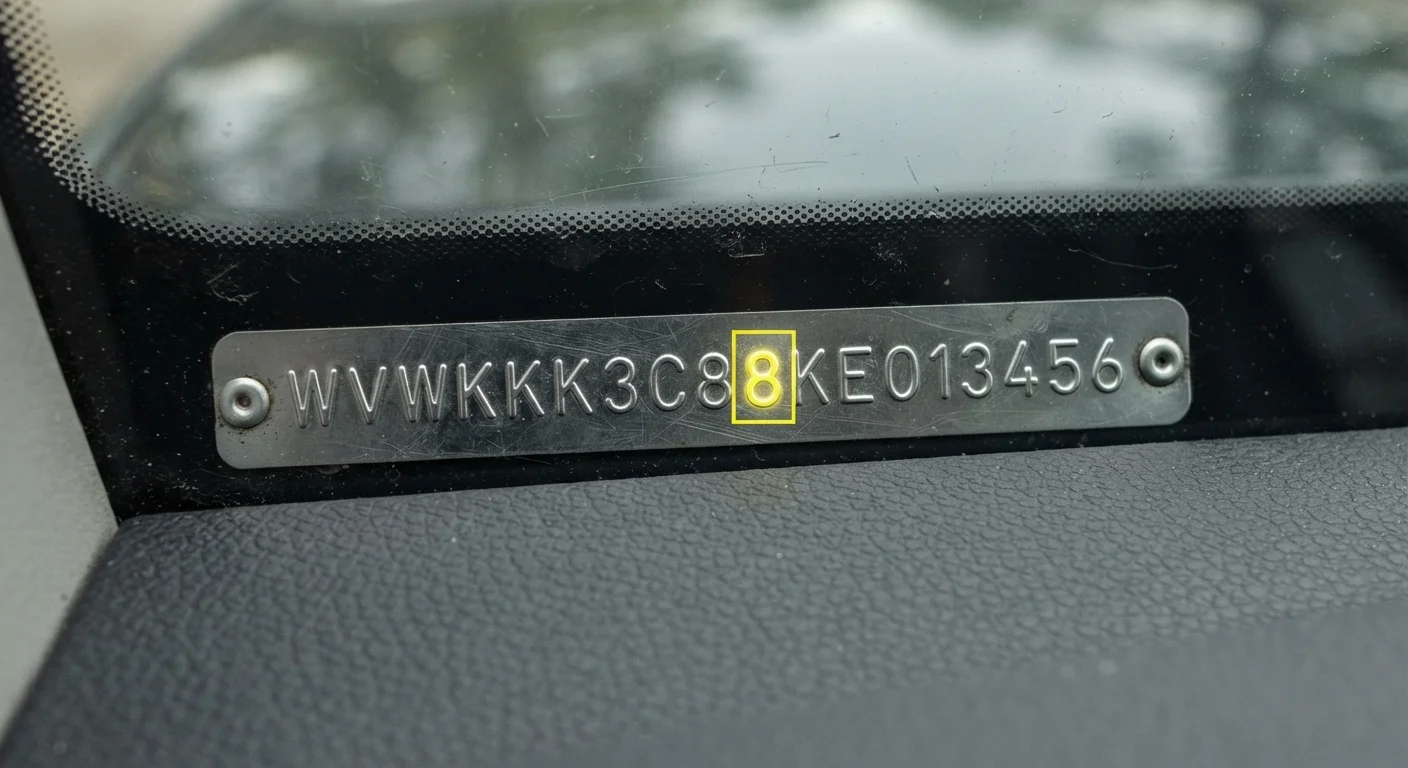
Photo: searchopenrecords editorial
—— In This Article
Key Takeaways
- Position 9 in every US VIN is a mathematically derived check digit, not an arbitrary character.
- The algorithm is defined by federal regulation (49 CFR Part 565) and standardized across all manufacturers.
- A VIN that fails the check digit test is a strong indicator of fabrication or tampering.
- The check digit cannot catch every type of VIN fraud — it only detects structurally invalid numbers.
- You can manually verify a VIN's check digit using publicly documented NHTSA math.
Why Position 9 Is Not Like the Other Characters
Every VIN character except one carries descriptive information about the vehicle — the manufacturer, vehicle type, model year, plant, and production sequence. The ninth character is different. It carries no descriptive information at all. Its only job is to prove that the rest of the VIN is mathematically coherent.
This design is deliberate. When NHTSA standardized the 17-character VIN format under 49 CFR Part 565, regulators built in a self-verification mechanism so that any observer — a dealer, an insurer, a law enforcement officer — could quickly test whether a VIN was plausible without contacting a manufacturer. The check digit is that mechanism.
For a full breakdown of what every other VIN position encodes, see our position-by-position VIN guide.
The Math Behind the Check Digit
The algorithm works in three steps. First, each of the 17 characters is converted to a numeric value. Digits 0–9 keep their face value. Letters are mapped to numbers using a fixed transliteration table — for example, A = 1, B = 2, up through a specific pattern that skips the letters I, O, and Q (which are excluded from VINs to avoid visual confusion with 1 and 0).
Second, each numeric value is multiplied by a positional weight. Positions 1 through 17 each carry a specific weight — for instance, position 1 has a weight of 8, position 2 has 7, and so on, with position 9 (the check digit itself) assigned a weight of 0 during verification so it does not influence the sum being tested.
Third, all the products are added together and the total is divided by 11. The remainder of that division — which can range from 0 to 10 — is the valid check digit. If the remainder is 10, the check digit is the letter X.
11
Divisor used in the check digit formula
NHTSA's 49 CFR Part 565 specifies that the weighted character sum is divided by 11 to produce a remainder between 0 and 10, which becomes the check digit.
17
Total characters in a standardized VIN
The 17-character VIN format has been required for all US passenger vehicles since the 1981 model year under federal motor vehicle regulations.
To verify a VIN, you simply recalculate the expected check digit and compare it to what appears in position 9. A mismatch means the VIN is structurally invalid.
What the Check Digit Can and Cannot Catch
The check digit is a blunt but effective first filter. Any VIN that has been randomly invented — say, typed out by someone guessing characters — will almost certainly fail the test. Likewise, if an existing VIN is altered by changing even one character carelessly, the check digit will no longer match and the VIN becomes invalid.
This matters in real fraud scenarios. A stolen vehicle with its original VIN plates ground off and replaced with plates from a salvage car is a practice sometimes called "VIN cloning." If the replacement VIN is carelessly fabricated rather than copied from a real vehicle, the check digit will immediately expose the inconsistency.
However, the check digit has clear limits. A fraudster who copies a genuine VIN from a similar vehicle — same make, model, and year — can produce a number that passes the formula perfectly, because the formula only tests internal consistency, not uniqueness or official assignment. For that reason, a passing check digit should be treated as a necessary condition for VIN validity, not a sufficient one. Always pair a check digit verification with a title records search to confirm the VIN's history against public records.
For a broader look at how VIN alteration is detected and what it signals about a vehicle, see our guide to VIN tampering.
Practical Takeaways for Buyers and Owners
Understanding the check digit gives you one more tool when evaluating a used vehicle. Before relying on any VIN-based history report, it is worth confirming that the VIN itself passes a basic structural check. Many free online VIN decoders perform this validation automatically and will flag an invalid check digit in their results.
If you are ever handed a handwritten VIN — from a seller, a listing, or a repair order — treat any discrepancy in position 9 as a reason to stop and ask questions. It does not automatically mean fraud, since transcription errors can also cause a mismatch, but it warrants verification against the physical plate on the vehicle.
Keep in mind that the check digit is just one layer of VIN integrity. Other red flags — mismatched title documents, odometer inconsistencies, or a VIN plate that shows signs of tampering — require separate investigation. Learn more about how mileage fraud surfaces in public records through our odometer rollback explainer, and review common VIN misconceptions to avoid over-relying on any single data point.
Frequently Asked Questions

Vin Search Editorial Team
VIN Search Editorial Team is the collective byline for our editorial team and contributor network. Articles published under this byline or an editorial pen name are researched, written, and reviewed according to our editorial standards for clarity, consistency, and independence before publication.
View author profile