
Digitised Archives vs. Physical Record Repositories: Weighing Your Research Options
Online databases are convenient but incomplete. Understand the trade-offs between digitised archives and in-person record searches.
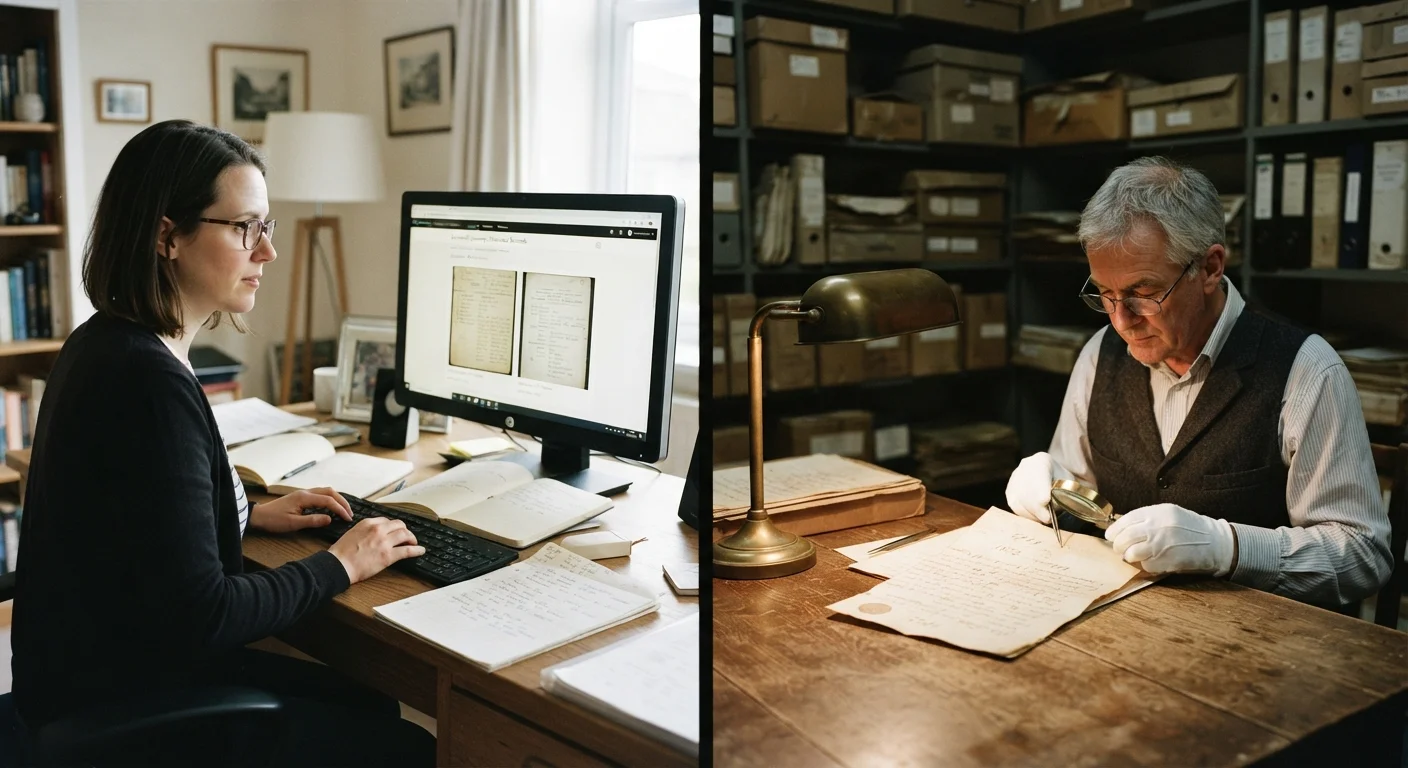
Photo: searchopenrecords editorial
—— In This Article
Key Takeaways
- Digitised archives offer convenient 24/7 access but cover only a fraction of existing historical records.
- Physical repositories hold irreplaceable original documents, handwritten annotations, and unscanned collections.
- The most thorough family tree research typically combines both digital and in-person research methods.
- Record type, geographic origin, and time period all affect which approach will yield the most results.
- Gaps in digitisation are uneven — some regions and record types remain almost entirely offline.
Why the Choice Matters for Your Family Tree
Building an accurate family tree depends heavily on which records you can actually access — and in what form. The decision between searching digitised archives and visiting physical record repositories isn't just about convenience; it shapes which ancestors you can find, how reliably you can verify details, and where your research will hit a wall.
Digitisation has dramatically expanded what's possible from a home computer. Millions of census pages, vital records, and military documents are now searchable online. Yet the trade-offs of relying solely on digital archives are real: indexing errors, incomplete scanning projects, and collections that were never digitised at all can quietly stall your research. Understanding both options helps you plan where to invest your time.
What Digitised Archives Do Well
Online databases have made genealogy research accessible to millions of people who could never have afforded archival travel. Key advantages include:
- Keyword and name searching across millions of records simultaneously
- Around-the-clock availability without geographic constraints
- Linked record sets that surface related documents automatically
- High-resolution scans of original handwriting in many cases
Government portals, university library collections, and volunteer-driven transcription projects have digitised significant portions of U.S. federal census records (1790–1940), Social Security Death Index entries, and many state-level vital records. For finding records online, these tools serve as an efficient first pass.
However, digitisation is uneven. The records most likely to be online are those that were already centralised, well-funded to preserve, or part of a major indexing project. Peripheral or local records — county deed books, church registers, township tax lists — often remain exclusively in physical form.
| Digitised Archives | Physical Repositories | |
|---|---|---|
| Access | 24/7 from any location | During staffed hours, in person or by mail |
| Record coverage | Broad but uneven; major collections prioritised | Comprehensive within their jurisdiction |
| Search capability | Full-text and name indexing available | Manual search through finding aids or microfilm |
| Original document context | Partial; scans may omit marginalia or loose papers | Full; original condition and adjacent records visible |
| Cost | Free to subscription-based; varies widely | Travel costs; many repositories charge per copy |
| Indexing accuracy | Transcription errors common in older records | No index layer; errors from original clerk only |
| Best era coverage | 20th century and select earlier federal records | Pre-20th century and local/county records |
What Physical Repositories Offer That Digital Cannot
Walking into a county courthouse, state archive, or historical society reading room provides access to a layer of documentation that simply does not exist online. Original documents carry context that scans frequently lose: marginal notations by clerks, physical condition clues about an era, accompanying loose papers filed with the main record, and adjacent entries that weren't indexed but may name your ancestor.
Physical repositories are especially valuable when researching:
- Records from before the 20th century, particularly in rural counties
- Ethnic and religious community records (church registers, fraternal lodge minutes)
- Probate files, which often include inventories, witness lists, and family correspondence
- Land survey maps and plat books that establish geographic context
For a deeper look at which record types have no online equivalent, see records that still require in-person or mail requests. Archivists at physical repositories are also an underrated resource — they know their collections intimately and can point researchers toward finding aids that aren't publicly listed.
Practical Strategy: Layering Both Approaches
The most effective family tree methodology treats digitised archives and physical repositories as complementary layers, not competing alternatives. A structured approach might look like this:
- Start online to establish the broad outline of a family line, identifying names, approximate dates, and locations using digitised census, vital, and military records.
- Note every gap — missing births, unclear migration paths, or conflicting record details — these are your physical research targets.
- Identify the relevant repositories for each gap. County clerks, state archives, and local historical societies each hold distinct record types. Contact them before visiting to confirm holdings and hours.
- Request records by mail or in person for documents that were never scanned. Many repositories accept written requests for specific record lookups.
- Reconcile findings from both sources. A digitised index entry that conflicts with a physical original should favour the original document.
For researchers navigating this process with court-related records, the same layered logic applies — see weighing courthouse visits against online portals for a parallel breakdown. Digitisation timelines also vary significantly by jurisdiction — the broader history of public records digitisation explains why some counties are decades ahead of others.

Genealogy Search Editorial Team
Genealogy Search Editorial Team is the collective byline for our editorial team and contributor network. Articles published under this byline or an editorial pen name are researched, written, and reviewed according to our editorial standards for clarity, consistency, and independence before publication.
View author profile