
Census Records Through the Decades: A Genealogist's Roadmap
Each national census captured different details. Discover what each era of census records contains and how to extract the most useful family data.
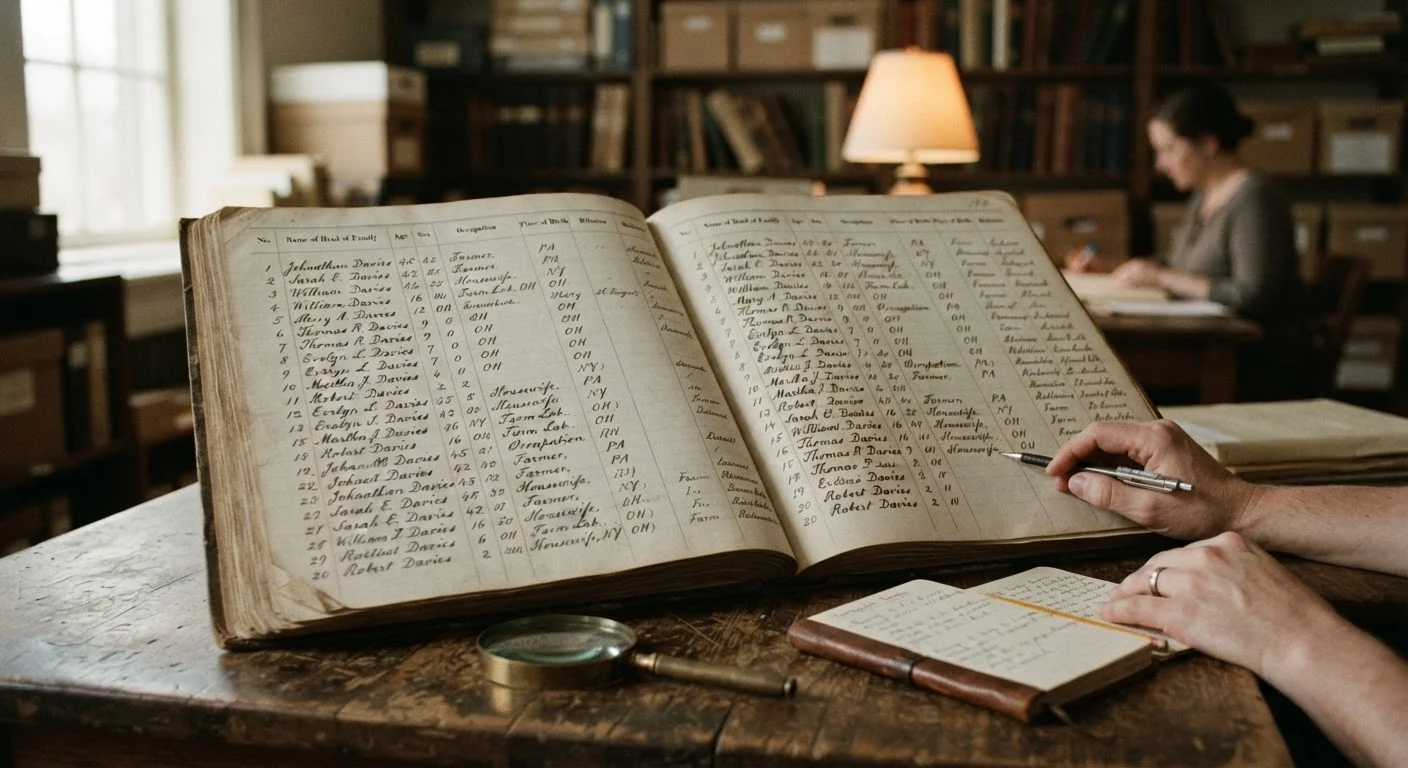
Photo: searchopenrecords editorial
—— In This Article
Why Census Records Are a Genealogist's Backbone
Every ten years, the U.S. federal government conducted a systematic count of the population — and in doing so, preserved detailed snapshots of ordinary households that no other record type replicates at scale. Census records place named individuals within specific families, at specific addresses, at a fixed point in time. For genealogists, that combination is invaluable.
Unlike birth or marriage certificates, which document singular events, a census record can reveal an entire household in a single document: parents, children, boarders, in-laws, and servants. Comparing a family across multiple census years lets you track migration patterns, occupational shifts, and generational change. See our guide to the public records that matter most in genealogy for how census data fits within a broader research strategy.
| First federal census | 1790 (U.S. Census Bureau) |
| First census to name all free persons | 1850 (U.S. Census Bureau) |
| First census to record household relationships | 1880 (U.S. Census Bureau) |
| Privacy seal on census records | 72 years (U.S. Census Bureau policy) |
| Most recently released federal census | 1950 (released 2022) (National Archives) |
| Census frequency | Every 10 years (U.S. Constitution, Article I) |
Decade-by-Decade: What Each Census Captured
The scope of census questions expanded significantly over time. Understanding what each era recorded — and what it omitted — helps you set realistic expectations before you search.
1790–1840: Heads of Household Only
The earliest federal censuses listed only the head of household by name. All other household members were tallied in age-and-sex columns with no individual names. These records confirm a surname was present in a location but rarely identify wives or children directly.
1850–1860: Every Free Person Named
The 1850 census was transformative: every free household member was listed by name, age, sex, birthplace, and occupation. The 1860 census added a column for the value of personal estate. Note that enslaved individuals were enumerated separately on the Slave Schedules, recorded by age and sex under the enslaver's name — a painful limitation that complicates African American genealogy for this period.
1870–1880: Expanded Detail, First Relationship Data
The 1870 census was the first to include African Americans by name following emancipation. By 1880, the census added each person's relationship to the head of household — a critical field that lets researchers confirm family structures rather than infer them. The 1880 census also recorded parents' birthplaces, opening doors to immigrant origins.
1900–1930: The Rich Middle Decades
These decades are among the most information-dense. The 1900 census recorded month and year of birth, years married, number of children born, and number still living. The 1910 and 1920 censuses captured immigration year and naturalization status — crucial for immigrant families. The 1930 census added questions about home ownership and radio ownership, offering economic context. For a deeper look at how to read these records accurately, see our article on tracing your lineage through census records.
1940: The Last Fully Available Federal Census
The 1940 census, released to the public in 2012 after the standard 72-year privacy restriction, is particularly rich. It recorded highest grade of school completed, income from wages, and whether the person had worked the previous week. It also asked where each person lived five years prior — a direct migration indicator. The 1950 census became publicly available in 2022 and is now searchable, though indexing is still maturing.
1950 and Beyond: The 72-Year Rule
Federal census records remain sealed for 72 years to protect individual privacy. This means records from 1960 onward are not yet publicly accessible. State censuses, city directories, and other substitute records can help bridge this gap for recent generations.
Common Pitfalls and How to Navigate Them
Census records reward careful interpretation, but several recurring issues trip up researchers:
- Name variations: Enumerators wrote what they heard. A surname like Wojciechowski might appear as Voicheck or Woychek. Search phonetically and use wildcard searches on digital platforms.
- Age discrepancies: Ages reported in census years often differ by two to five years from birth records. Cross-check against multiple censuses rather than relying on a single entry.
- Missing or skipped households: Enumerators occasionally missed households, especially in rural or transient communities. If a family disappears from one census, check neighboring townships or state-level census records if available.
- Digitization gaps: Not every census page has been fully indexed. Image-only browsing may be necessary for some years and counties.
For a structured comparison of what census records can and cannot do relative to vital records, visit our article on census records vs. vital records. Understanding each source's strengths helps you triangulate more confidently. You may also find the major types of genealogy records useful for locating supplementary documents when census data falls short.

Genealogy Search Editorial Team
Genealogy Search Editorial Team is the collective byline for our editorial team and contributor network. Articles published under this byline or an editorial pen name are researched, written, and reviewed according to our editorial standards for clarity, consistency, and independence before publication.
View author profile