
Landline, Mobile, and VoIP Numbers: How Reverse Lookup Handles Each Differently
Not all phone numbers yield the same lookup results. Learn why landlines, mobile numbers, and VoIP lines behave differently in reverse phone lookup tools.
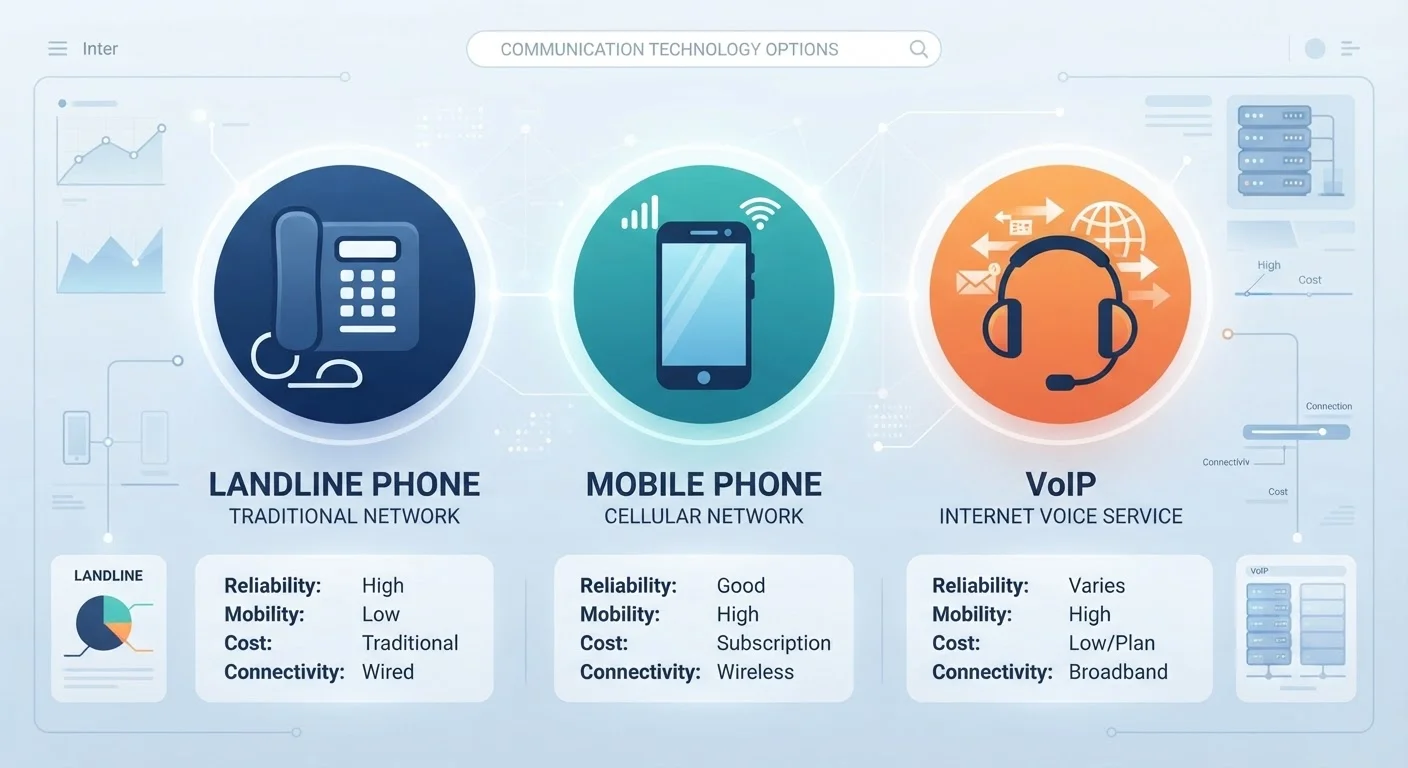
Photo: searchopenrecords editorial
—— In This Article
Key Takeaways
- Landline numbers offer the most reliable lookup data due to mandatory carrier registration tied to a physical address.
- Mobile numbers are traceable but yield less structured address data; porting history can further complicate results.
- VoIP numbers are the hardest to trace — registration requirements are minimal and identity verification is often absent.
- The type of number determines what a reverse lookup can realistically return, not just the quality of the lookup tool.
- Spoofed numbers can impersonate any of the three types, making number-type identification a useful first step.
Why Number Type Is the Starting Point for Any Reverse Lookup
When you run a reverse phone lookup, the tool's first job is to classify the number — determining whether it's a landline, a mobile line, or a Voice over Internet Protocol (VoIP) number. That classification shapes everything that follows. Different number types are governed by different registration rules, stored in different carrier databases, and leave very different trails in public records.
Understanding what each number type actually tells you is a prerequisite to interpreting lookup results accurately. A result that looks thin or incomplete isn't necessarily a failure of the lookup tool — it may simply reflect the inherent traceability limits of the number type in question.
Lookup services query sources such as carrier CNAM (Calling Name) databases, local number portability (LNP) registries, and aggregated public records. Each of those sources contains richer data for some number types than others. The sections below break down how that plays out for landlines, mobile numbers, and VoIP lines respectively.
Landline Numbers: The Highest Data Fidelity
Traditional landline numbers — formally called wireline or plain old telephone service (POTS) numbers — have the longest history of mandatory, address-tied registration. When a landline is provisioned, the carrier is required to associate it with a verifiable service address for emergency (E911) purposes. That binding between number and physical location is the foundation for why landline lookups tend to return the most reliable results.
Reverse lookup tools querying a landline typically surface the subscriber name, service address, and carrier. Because landlines are also frequently listed in historical directory databases, cross-referencing against prior address records is often straightforward. The public records footprint of landlines vs. mobile numbers reflects this difference clearly.
The main limitation: landline penetration has declined significantly as households migrate to mobile-only plans. A number that was once a landline may have been ported to mobile service, which can create stale records in older databases.
| Landline | Mobile | VoIP | |
|---|---|---|---|
| Registration requirement | Mandatory, address-tied | Billing name and address | Minimal; often self-reported |
| E911 address accuracy | High — updated by carrier | Moderate — may lag location | Low — may be fictitious |
| Typical lookup data returned | Name, address, carrier | Name, carrier; partial address | Carrier only or generic label |
| CNAM database coverage | Strong and well-maintained | Moderate; varies by carrier | Sparse or absent |
| Spoofing risk | Lower | Moderate | High — easily configured |
| Impact of number porting | Can create stale records | Common; area code misleading | Frequent number changes |
Mobile Numbers: Useful but Structurally Incomplete
Mobile numbers are registered to a carrier account, and that account requires a billing name and address — but the address on file is a billing address, not necessarily a current residential location. Unlike landlines, mobile numbers are not required to update their associated address in real time, which means the geographic data attached to a mobile number in carrier records can lag well behind a subscriber's actual location.
Additionally, the widespread use of number portability means a mobile number's area code may no longer correspond to its user's region. Number portability significantly affects lookup accuracy, particularly for users who have moved across states while keeping the same number.
Despite these limitations, mobile lookups can still return a subscriber name and carrier, and when combined with aggregated public records — voter registration, property records, court filings — can provide a reasonably complete profile. The quality depends heavily on how recently those public records were indexed.
VoIP Numbers: The Hardest to Trace
VoIP numbers present the greatest challenge for reverse lookup tools. Because VoIP services are delivered over the internet rather than through traditional telephone infrastructure, providers face considerably lighter registration requirements. Many consumer and business VoIP services allow numbers to be provisioned with minimal identity verification, and the address submitted during sign-up need not correspond to any physical location.
The CNAM database entries for VoIP numbers are frequently absent, generic (e.g., showing only the provider's name), or populated with whatever label the account holder chose to submit. This is why a reverse lookup on a VoIP number might return only the originating carrier — such as a well-known VoIP provider — without any subscriber-level detail.
VoIP flexibility also enables spoofing at scale. Anyone controlling a VoIP account can often configure an outbound caller ID to display a number they don't own. Caller ID spoofing directly undermines reverse lookup reliability, especially when the spoofed number is itself a VoIP line. For more on how the same lookup tool returns different results by number type, the underlying registration architecture explains most of the variance.
Readers interested in the regulatory context behind these differences can find additional background in our overview of how registration rules vary across number types.
Practical Implications for Anyone Running a Reverse Lookup
Knowing the number type before interpreting results is the single most useful habit to develop. Most lookup tools will indicate whether a number is classified as wireline, wireless, or VoIP — treat that label as context for everything else the result shows.
If a lookup returns limited information on a VoIP number, that's often an accurate reflection of what exists in carrier databases — not an error. Conversely, if a landline lookup returns a name and address, that data has a relatively high probability of being current and correct, especially if the number hasn't been ported.
For unknown numbers that exhibit signs of spoofing or scam behavior, consulting tools that specialize in spam pattern detection may complement a standard reverse lookup. See how reverse lookup tools and caller ID apps approach unknown numbers differently for a clearer picture of which tool fits which scenario.
Explore the broader context of number classification in the Phone Number Types hub, which covers how each category affects data availability across a range of lookup scenarios.

Phone Lookup Editorial Team
Phone Lookup Editorial Team is the collective byline for our editorial team and contributor network. Articles published under this byline or an editorial pen name are researched, written, and reviewed according to our editorial standards for clarity, consistency, and independence before publication.
View author profile