
How Public Records Are Created, Stored, and Maintained
From paper filings to digital databases, understand the lifecycle of a government record and which agencies are responsible for keeping them.
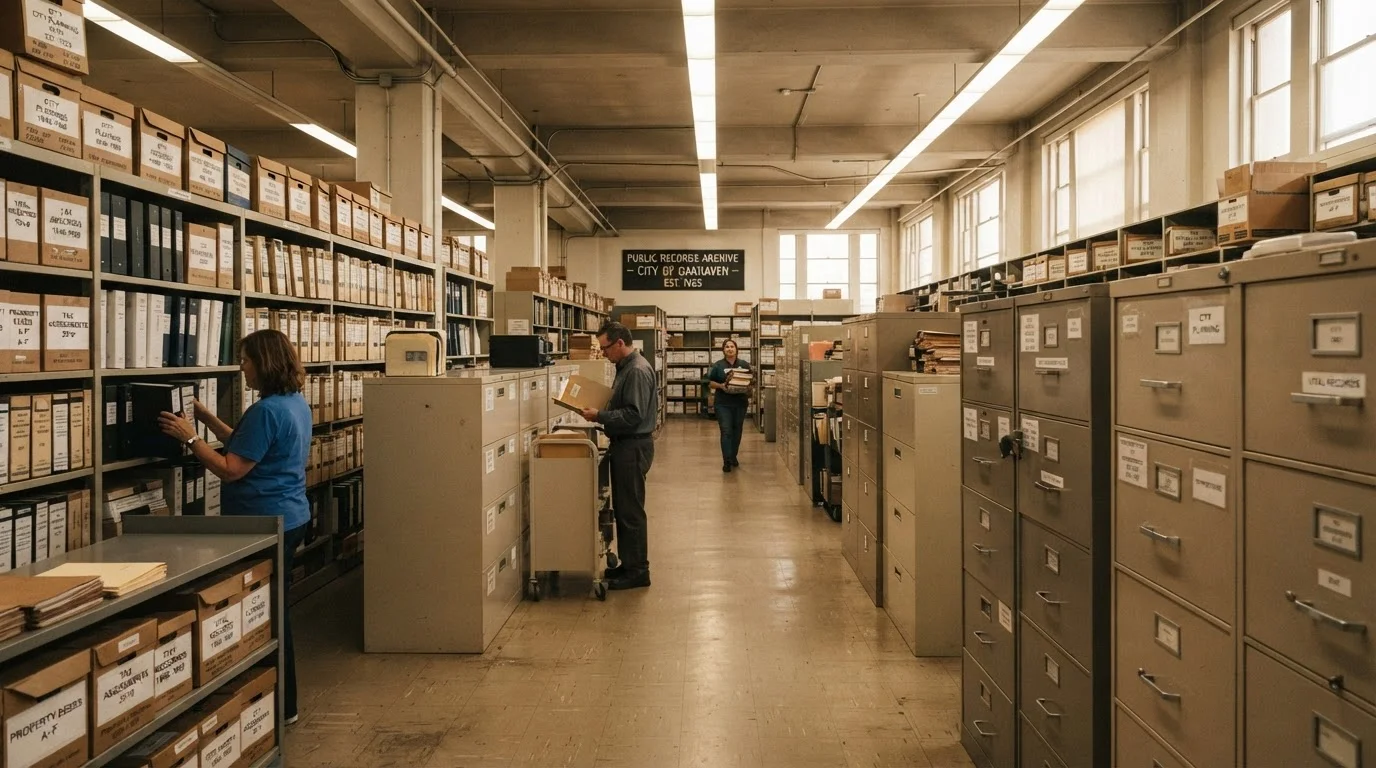
Photo: searchopenrecords editorial
—— In This Article
Key Takeaways
- Public records are created whenever a government body documents an official transaction or decision.
- Designated custodian agencies — not a single central database — are responsible for storing and maintaining records.
- Federal, state, and local levels each hold different types of records under separate legal frameworks.
- Retention schedules determine how long a record must be kept before it can be archived or destroyed.
- Most public records are accessible under open-records laws, though specific exemptions apply.
How a Public Record Is Born
A public record comes into existence the moment a government body creates or receives a document in the course of conducting official business. This is not a passive process — it is triggered by a concrete governmental act. A county clerk records a property deed transfer; a court enters a judgment; a health department registers a birth; a city council adopts a resolution. Each of these actions generates a record that, by law, belongs to the public trust.
The legal foundation for this principle at the federal level is the Federal Records Act, which broadly defines a federal record as any documentary material made or received by a federal agency in connection with the transaction of public business. State statutes apply analogous definitions to state and local agencies. The practical implication: if a government employee creates a document while performing an official function, that document is very likely a record subject to retention and disclosure rules — regardless of whether it ever sees public release.
Court records illustrate this clearly: every filing, motion, and judgment entered into the court docket becomes an official record the moment the clerk processes it.
Who Stores and Maintains Records — and Where
There is no single national vault of U.S. public records. Instead, records are held by the specific agency that created or received them — a principle called custodial responsibility. The agency custodian is legally accountable for safeguarding the record, ensuring its integrity, and responding to access requests.
3
Government tiers holding distinct public records
Federal, state, and county/municipal agencies each serve as independent custodians of different record categories under separate legal frameworks.
1966
Year FOIA was enacted at the federal level
The Freedom of Information Act established the federal presumption of government transparency; all 50 states have since passed equivalent open-records statutes.
Permanent
Retention period for many property and court records
Certain record types — including property deeds and final court judgments — are designated for permanent retention under most state and federal retention schedules.
Records are distributed across three main tiers of government:
- Federal agencies — such as the Social Security Administration, the Department of Veterans Affairs, and the federal courts — maintain records under NARA oversight.
- State agencies — vital records offices, state archives, and licensing boards — hold birth certificates, professional licenses, and legislative documents.
- County and municipal offices — clerks, recorders, and registrars — are custodians of property records, local court filings, and business licenses.
Understanding which tier holds the record you need is a prerequisite for any successful records search. Our reference guide on which government level holds the record you need breaks this down by document type.
From Paper Filing to Digital Database
For most of U.S. history, public records were physical documents — handwritten ledgers, carbon-copy forms, typed pages stored in fireproof vaults. Many of these paper archives still exist in county courthouses and state repositories, some dating back centuries. Genealogy researchers regularly rely on them, as explained in our overview of public records used in genealogy research.
Modern records are increasingly born digital: electronic court filing systems, online property transfer portals, and digital vital records platforms create records that never exist on paper. Agencies managing the transition from paper to digital face digitization — the process of scanning and indexing historical documents — alongside building new electronic systems for ongoing filings.
Storage formats also affect accessibility. A scanned PDF uploaded to a county recorder's public portal is instantly searchable. A box of microfilmed records from the 1970s requires a trip to a reading room. The degree of public access often depends as much on an agency's technological capacity as on the law itself.
Open Records Laws and the Presumption of Transparency
The governing principle behind U.S. public records law is a presumption of openness: government documents are public unless a specific statutory exemption justifies withholding them. At the federal level, the Freedom of Information Act (FOIA), enacted in 1966, codified this presumption for executive branch agencies. Every U.S. state has enacted a parallel statute — often called a sunshine law, open-records law, or public records act — that applies the same logic to state and local government.
Common exemptions across most jurisdictions include:
- National security and law enforcement investigation records
- Personal medical and financial information protected by privacy statutes
- Personnel files and internal deliberative documents
- Records sealed by a court order
When an agency denies access to a record, it must typically cite the applicable exemption. Requesters generally have the right to appeal that denial — either administratively within the agency or through the courts. This framework is what makes address data, property ownership, and court outcomes available for legitimate public inquiry, as described in our guide on address lookup and public records.
Retention, Archiving, and Eventual Destruction
Agencies do not keep every record indefinitely. Formal retention schedules — approved by records management authorities — specify exactly how long each record type must be preserved. A routine administrative memo might be scheduled for disposal after three years; a property deed may be retained permanently. These schedules exist both to protect important historical information and to prevent unmanageable accumulation of low-value documents.
Once a record reaches the end of its retention period, one of three things happens: it is transferred to an archive for long-term historical preservation, it is destroyed according to approved procedures, or — in the case of records with enduring legal or historical significance — it is designated permanent. NARA manages permanent federal records; state archives perform the equivalent function at the state level.
For the public, retention schedules have a direct practical consequence: a record that was once accessible may no longer exist if its retention period has expired. Our dedicated explainer on government record retention schedules covers how to find out whether a record should still be on file. For a broader orientation on finding records digitally, the Finding Records Online hub is a useful starting point.
Frequently Asked Questions

Public Records 101 Editorial Team
Public Records 101 Editorial Team is the collective byline for our editorial team and contributor network. Articles published under this byline or an editorial pen name are researched, written, and reviewed according to our editorial standards for clarity, consistency, and independence before publication.
View author profile