
Public Records vs. Private Data: Understanding the Difference
Not all information about a person is public record. This guide clarifies where the public domain ends and private data begins.
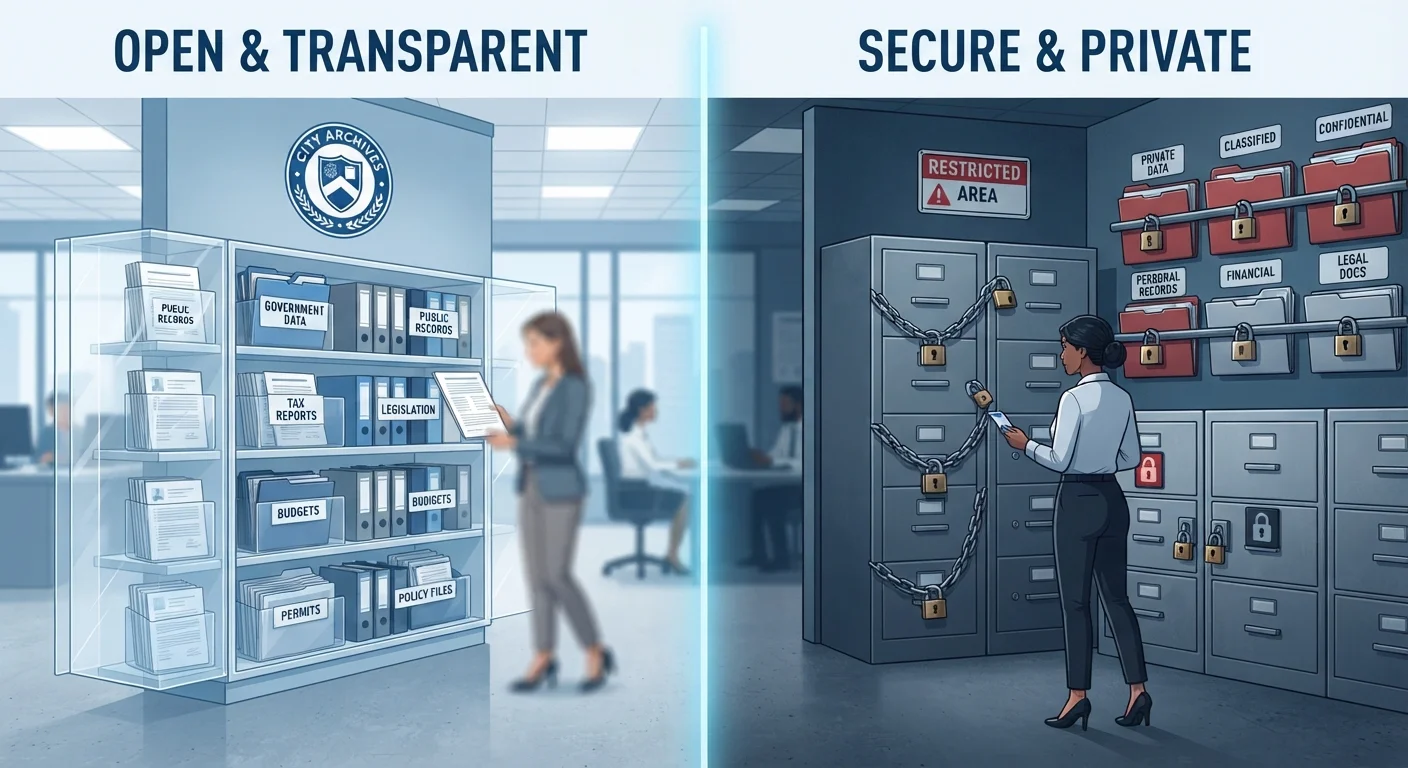
Photo: searchopenrecords editorial
—— In This Article
Key Takeaways
- Public records are created or held by government agencies and are legally accessible to the general public.
- Private data is protected by statute, contract, or reasonable expectation of privacy — it cannot be freely accessed.
- The boundary between public and private is set by federal and state law, not by common assumption.
- Even within public records, certain fields are routinely redacted to protect sensitive personal details.
- Misunderstanding this boundary can lead to legal liability or reliance on inaccurate information.
Defining Public Records: Government Accountability in Writing
A public record is any document, file, or data set created, received, or maintained by a government body in the course of official business. The underlying principle is democratic accountability: citizens fund government, so government activity should be transparent to them.
Federal access rights flow primarily from the FOIA, enacted in 1966, which gives any person the right to request records held by federal agencies. Each state has its own parallel statute — commonly called sunshine laws or open-records acts — governing access to state and local documents. These laws vary considerably; some states are notably more open than others. For a clear breakdown of how those frameworks diverge, see federal vs. state public records laws.
Common categories of public records include: property deeds and tax assessments, court filings and judgments, vital records (birth, death, and marriage certificates with some restrictions), business registrations, professional licenses, and voter registration rolls. To understand the legal criteria that determine whether a specific government document qualifies as public, see what makes a government record public.
What Counts as Private Data — and Why It's Protected
Private data is information that an individual or organization generates, controls, or receives under a reasonable expectation of confidentiality. Unlike public records, private data is not created by government in its official capacity — or if it is, it is specifically exempted from public access by statute.
Several federal frameworks define and protect specific categories of private data:
- HIPAA (Health Insurance Portability and Accountability Act) — protects medical and health records held by covered entities such as hospitals and insurers.
- FCRA (Fair Credit Reporting Act) — governs how consumer credit information can be collected, shared, and used.
- FERPA (Family Educational Rights and Privacy Act) — restricts access to student education records.
- GLBA (Gramm-Leach-Bliley Act) — requires financial institutions to safeguard customers' nonpublic personal information.
Beyond these statutory shields, state constitutionality and common law recognize a broader right to privacy covering communications, personal correspondence, and data shared in confidence. Private individuals — as opposed to public officials — enjoy considerably stronger protections. For a deeper look at how this plays out with financial information specifically, see financial records and the limits of public disclosure.
Side-by-Side: Where Each Type of Information Falls
The distinction is often clearest when you examine specific data points. The table below places common information types into context.
| Criterion | Public Records | Private Data |
|---|---|---|
| Created by | Government agencies | Individuals, companies, or healthcare providers |
| Default access | Open to any requestor | Restricted; requires consent or legal process |
| Governing framework | FOIA, state open-records laws | HIPAA, FCRA, FERPA, GLBA, state privacy laws |
| Examples | Deeds, court filings, business licenses | Medical records, credit reports, bank statements |
| Redaction possible? | Yes — certain fields routinely redacted | N/A — not released at all without authorization |
| Can be used in background checks? | Yes, with applicable legal constraints | Only under strict FCRA permissible purpose rules |
It is worth noting that even genuinely public records frequently contain redacted fields. A court filing, for example, is public, but Social Security numbers, financial account numbers, and the names of minor victims are routinely removed before release. That redacted content does not become private data — it was simply never made publicly accessible in the first place. For more on what gets omitted, see what public records actually leave out.
Why the Boundary Matters in Practice
Confusing public records with private data creates real problems in two directions. First, people sometimes assume information is public when it is not — then attempt to obtain or distribute it in ways that violate privacy law. Second, people sometimes assume everything about them is shielded when, in fact, significant government-held data about their property, legal history, and business activity is lawfully open.
Background checks are a common flashpoint. A consumer background check typically draws from court records (public) but may also incorporate data from commercial aggregators that blend in non-public sources. Understanding which layer you're looking at matters for accuracy and legal compliance. The article public records vs. private data in a background check addresses this distinction in detail.
Court records deserve special mention because they are often misunderstood. Filings, dockets, and judgments are public by design — the judiciary operates on the principle of open proceedings. The article court records explained provides a full breakdown of that access structure. For broader context on how the U.S. records system is organized, the How Records Work hub is a useful starting point.
This article is for general informational purposes only and does not constitute legal advice. Consult a qualified attorney for questions about your specific rights or obligations under public records or privacy law.

Public Records 101 Editorial Team
Public Records 101 Editorial Team is the collective byline for our editorial team and contributor network. Articles published under this byline or an editorial pen name are researched, written, and reviewed according to our editorial standards for clarity, consistency, and independence before publication.
View author profile