
Reading a VIN: How a 17-Character Code Unlocks a Car's Past
Each segment of a VIN encodes specific information. Here's how to decode a Vehicle Identification Number and understand what it reveals.
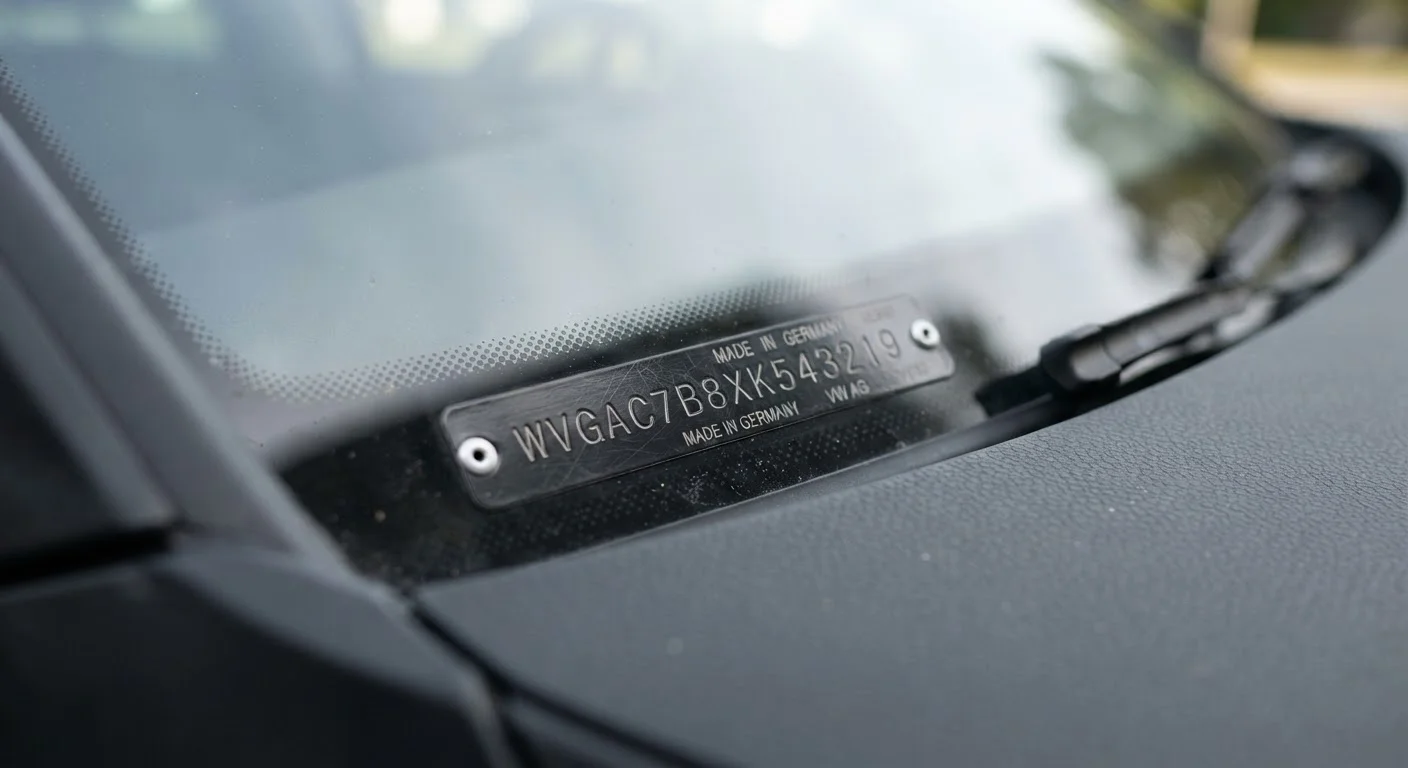
Photo: searchopenrecords editorial
—— In This Article
What a VIN Is and Where to Find It
A Vehicle Identification Number (VIN) is a standardized 17-character code assigned to every motor vehicle manufactured for sale in the United States since 1981. The format is governed by NHTSA standards and the ISO 3779 specification, meaning every character occupies a fixed position with a defined meaning — regardless of manufacturer or model year.
You can locate a VIN in several places on a vehicle:
- Dashboard, visible through the lower-left corner of the windshield (most common)
- Driver-side door jamb sticker
- Engine block or firewall
- Vehicle title, registration documents, and insurance cards
Before using any VIN for a history lookup, always verify that the number matches across at least two physical locations on the vehicle. Mismatches can be a red flag worth investigating further. For a deeper look at how VINs connect to public records, see VIN & Title Records.
| VIN Length | 17 characters (NHTSA / ISO 3779 standard, mandatory since 1981) |
| Prohibited Characters | I, O, Q (avoids confusion with 1 and 0) (NHTSA VIN decoding standard) |
| Model Year Encoding | Position 10 (alphanumeric, defined table) (NHTSA standardized model year chart) |
| Check Digit Position | Position 9 (Federal Motor Vehicle Safety Standard No. 115) |
| Free Recall Lookup | Available via NHTSA at nhtsa.gov (National Highway Traffic Safety Administration) |
| Primary Linked Databases | State DMV title records, NHTSA recall database, insurance total-loss reports |
Breaking Down the 17 Positions
The 17 characters of a VIN divide into three logical segments. Understanding each segment tells you what the vehicle is, who built it, and which specific unit it is.
Characters 1–3: World Manufacturer Identifier (WMI)
The first character identifies the country of manufacture (e.g., 1, 4, or 5 = United States; J = Japan; W = Germany). The second character identifies the manufacturer, and the third narrows to the vehicle type or division. Together, these three form the World Manufacturer Identifier, assigned by the Society of Automotive Engineers (SAE).
Characters 4–8: Vehicle Descriptor Section (VDS)
These five characters are manufacturer-defined and encode attributes such as body style, engine type, restraint system, and vehicle line. Decoding this segment requires the specific manufacturer's key — there is no single universal legend for VDS characters.
Character 9: Check Digit
Position 9 is a mathematically derived check digit, calculated using a weighted formula applied to the other 16 characters. Its sole purpose is to detect transcription errors or fraudulent VINs. A number or the letter X appears here. If you run the standard algorithm and get a different result, the VIN may have been altered.
Character 10: Model Year
This single character encodes the model year using a standardized alphanumeric table maintained by NHTSA (letters I, O, Q, U, and Z are never used to avoid confusion). For example, K = 1989, Y = 2000, A = 2010, N = 2022.
Character 11: Plant of Assembly
Assigned by the manufacturer, this character identifies the specific assembly facility where the vehicle was built.
Characters 12–17: Vehicle Identifier Section (VIS)
These six digits form the sequential production number — effectively the vehicle's serial number within that plant and model year. For manufacturers producing more than 500 vehicles per year, the last four characters must be numeric. This segment is what makes every VIN unique. For a position-by-position reference, see our full character-by-character guide.
What Public Records a VIN Can Unlock
Once you understand the structure of a VIN, the more valuable question becomes: what does running a VIN through public records systems actually reveal? The VIN serves as the primary key that links a vehicle across multiple state and federal databases.
Branded Title
A vehicle title that carries a designation indicating significant damage or legal history — common brands include Salvage, Rebuilt, Flood, and Lemon Law Buyback. Branded titles are recorded by state DMVs and are tied to the VIN.
World Manufacturer Identifier (WMI)
The first three characters of a VIN, assigned by SAE International, that identify the country of manufacture and the vehicle manufacturer.
Check Digit
The ninth character of a VIN, calculated using a NHTSA-specified mathematical formula applied to the other 16 characters. It is used to detect transcription errors and fraudulent VINs.
Vehicle Descriptor Section (VDS)
Characters 4 through 8 of a VIN, defined by the manufacturer, that encode vehicle-specific attributes such as body style, engine type, and restraint system.
Odometer Disclosure
A legally required record of a vehicle's mileage at the time of each title transfer, mandated by the federal Truth in Mileage Act and recorded against the VIN.
Vehicle Identifier Section (VIS)
Characters 12 through 17 of a VIN — the sequential production number that, combined with the rest of the VIN, makes each vehicle uniquely identifiable.
Public record systems connected to a VIN typically include:
- Title history: State DMVs issue and track titles by VIN. A title search can reveal the number of previous owners, whether the title was ever branded (e.g., salvage, rebuilt, flood, lemon law buyback), and lien records.
- Odometer disclosures: Federal law (the Truth in Mileage Act) requires odometer readings to be recorded at each title transfer. These disclosures are tied to the VIN and can help identify odometer rollback.
- Accident and total-loss records: Insurance companies and salvage yards report major incidents to databases that aggregate by VIN. State agencies also record branded titles when a vehicle is declared a total loss.
- Registration records: Some states make registration data accessible, revealing the state of registration and, in some cases, registration gaps that may indicate storage, export, or other usage patterns.
- Recall status: NHTSA maintains a publicly searchable recall database indexed by VIN, showing open or completed safety recalls.
For a balanced view of what these lookups can and cannot confirm, see what a VIN can and cannot reveal. To understand the ownership dimension specifically, see what a VIN tells you about ownership history.
Practical Takeaways for Buyers and Sellers
Whether you are buying a used vehicle, selling one, or simply verifying a car in your possession, the VIN is your primary tool for grounding a transaction in documented public record. Here is how to use that knowledge effectively:
- Record the VIN before negotiating. Obtain the VIN from the physical vehicle — not just the listing — and confirm it matches across the dashboard plate and door jamb sticker.
- Check the check digit manually. NHTSA's weighted formula is publicly documented. Running it takes a few minutes and can immediately flag a VIN that has been tampered with.
- Look up recall status for free. NHTSA's public recall search (accessible at nhtsa.gov) requires only the VIN and returns open recall status at no cost.
- Understand what a branded title means. A salvage or rebuilt title does not automatically disqualify a vehicle, but it affects insurability, resale value, and financing options. Know the implications before proceeding.
- Use public records as a baseline, not a guarantee. Not all accidents are reported to insurance; not all title events are recorded immediately. Public records reflect what was officially reported, not necessarily everything that happened.
If you prefer to decode a VIN without relying on an online tool, see how to read a VIN plate without a decoder tool. For context on how VINs compare to license plates as identifiers, see VIN vs. license plate.
This article is for general informational purposes only and does not constitute legal or financial advice. Consult qualified professionals for decisions specific to your situation.

Vin Search Editorial Team
VIN Search Editorial Team is the collective byline for our editorial team and contributor network. Articles published under this byline or an editorial pen name are researched, written, and reviewed according to our editorial standards for clarity, consistency, and independence before publication.
View author profile