
Title vs. Registration: Two Records, One Vehicle
Title and registration are often confused. Here's how each document differs, what it proves, and which agencies hold them.
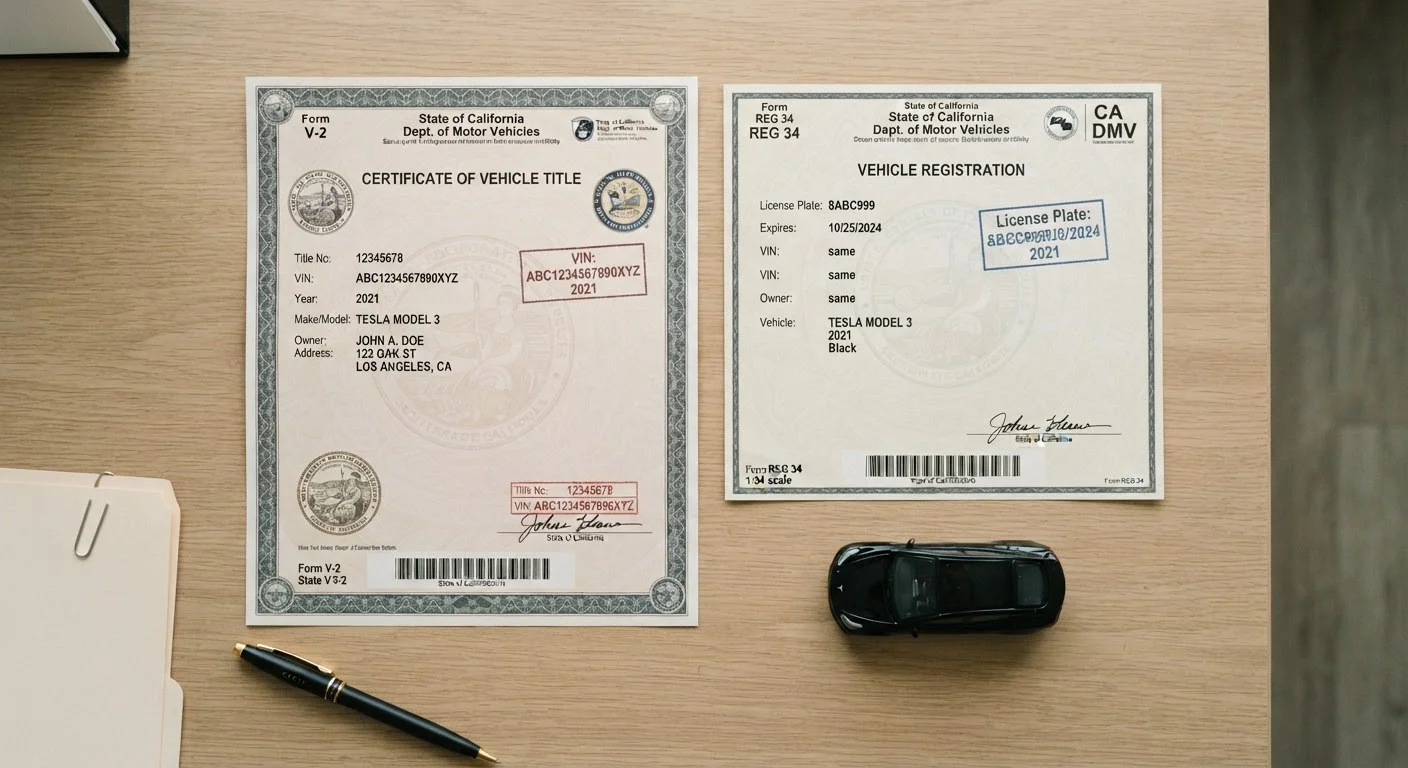
Photo: searchopenrecords editorial
—— In This Article
Key Takeaways
- A vehicle title proves ownership; registration proves the vehicle is legally authorized to operate on public roads.
- Titles are permanent records that transfer with ownership; registrations expire and must be renewed periodically.
- Both documents are issued by state DMVs, but they serve distinct legal and administrative functions.
- A lien on a title indicates a lender has a financial interest; registration records do not capture this.
- Gaps or discrepancies between title and registration records can signal fraud, clerical error, or an incomplete transfer.
What Each Document Actually Proves
Despite being issued by the same agency — your state's Department of Motor Vehicles (DMV) or equivalent — a vehicle title and a vehicle registration answer two completely different legal questions.
A title (formally called a Certificate of Title) is a legal instrument that identifies the owner of a vehicle. It records the vehicle's identification number (VIN), make, model, year, and the name of the person or entity holding ownership. It also shows whether a lender holds a lien — a legal claim against the vehicle as collateral for a loan. Titles do not expire; they transfer when ownership changes.
A registration, by contrast, answers the question: Is this vehicle currently authorized to be operated on public roads in this state? It confirms that the owner has paid applicable state and local fees, and in many states, that the vehicle has passed required emissions or safety inspections. Unlike a title, registration expires on a set schedule — typically annually — and must be renewed to remain valid.
Both documents are part of the public record trail that follows every vehicle. To understand how they connect within a broader ownership history, see our guide to the public record trail behind a vehicle title.
Side-by-Side: Key Differences at a Glance
The table below captures the core distinctions between the two documents across the dimensions that matter most when reviewing or verifying vehicle records.
| Criterion | Vehicle Title | Vehicle Registration |
|---|---|---|
| Primary purpose | Proves legal ownership | Authorizes road operation |
| Issued by | State DMV | State DMV |
| Expiration | Does not expire | Expires periodically (typically annually) |
| Transfers with ownership? | Yes — signed over at sale | No — new owner re-registers separately |
| Records lien status? | Yes | No |
| Can carry branded flags? | Yes (salvage, flood, rebuilt, etc.) | No |
| Required to keep in vehicle? | Not typically | Yes — must be accessible during stops |
| Relevant to VIN history search? | Central data source | Secondary, access varies by state |
One practical point worth noting: a vehicle can have a valid title but an expired registration — meaning ownership is legally established but the vehicle is not currently street-legal. The reverse can also technically occur during processing delays, though it is far less common. Neither condition is inherently fraudulent, but both warrant follow-up when you encounter them during a vehicle search.
How Titles and Registrations Create Public Records
Every title transaction — whether a new purchase, a private sale, or a lender releasing a lien — generates a public record at the state DMV. These records are what make it possible to trace a vehicle's full ownership history using its VIN. Our complete walkthrough of VIN and title records explains how these stages connect from first registration to resale.
Registration records create a separate, parallel data trail. Each renewal reflects a snapshot of the vehicle's status — registered owner at that moment, the jurisdiction, and fee compliance — but registration data is generally less central to ownership verification than title records. Some states make registration data available through public records requests; others restrict access to protect owner privacy.
When a vehicle is sold privately, both records must be updated, but the process differs. The seller must sign over the title, and the buyer must file for a new title in their name. Registration, meanwhile, typically cannot transfer directly — the new owner must register the vehicle separately. These gaps are a common source of title record complications; our article on what happens to the title record when a car is sold privately covers what can go wrong.
Out-of-State Titles and Registration Gaps
When a vehicle has been registered across multiple states, title records may reflect transfers through different DMV systems, each with its own data format and public access rules. A registration gap between states — the period after a title transfers but before re-registration is complete — does not automatically indicate fraud. However, it is worth investigating if a VIN search reveals an unexplained lapse. Some states also have differing requirements for how quickly new owners must apply for a local title, which can create legitimate but confusing record gaps.
For a practical guide to following the chain of ownership through these records, see our article on tracing an ownership transfer through public records.
Why the Distinction Matters for Vehicle Research
When you run a VIN lookup, the data returned draws heavily on title records — not registration records. That means you will typically see ownership transfers, lien history, and title brands (such as salvage, flood, or rebuilt designations) rather than a year-by-year registration log.
Title brands in particular are crucial. A branded title is a permanent notation recorded on the title document indicating that the vehicle sustained significant damage or was declared a total loss. Registration records carry no equivalent flag. This is why a clean-looking, currently registered vehicle can still carry a problematic history — the registration tells you it is street-legal today; only the title tells you what happened before.
If your title record search surfaces inconsistencies — such as gaps in ownership, mismatched VINs, or out-of-state transfer records — our article on things that can complicate a title record search outlines the most common causes. You can also explore what a full vehicle history report can reveal beyond what the title alone shows.
Understanding the difference between these two documents is not a technical detail — it is the foundation of reading vehicle public records accurately. A title establishes who owns a vehicle and what claims exist against it. A registration confirms it is legally on the road. Both matter, but they are not interchangeable.

Vin Search Editorial Team
VIN Search Editorial Team is the collective byline for our editorial team and contributor network. Articles published under this byline or an editorial pen name are researched, written, and reviewed according to our editorial standards for clarity, consistency, and independence before publication.
View author profile