
Tracing an Ownership Transfer Through Public Records
Each time a vehicle changes hands, a public record is created. Here's how to follow that chain using title and registration data.
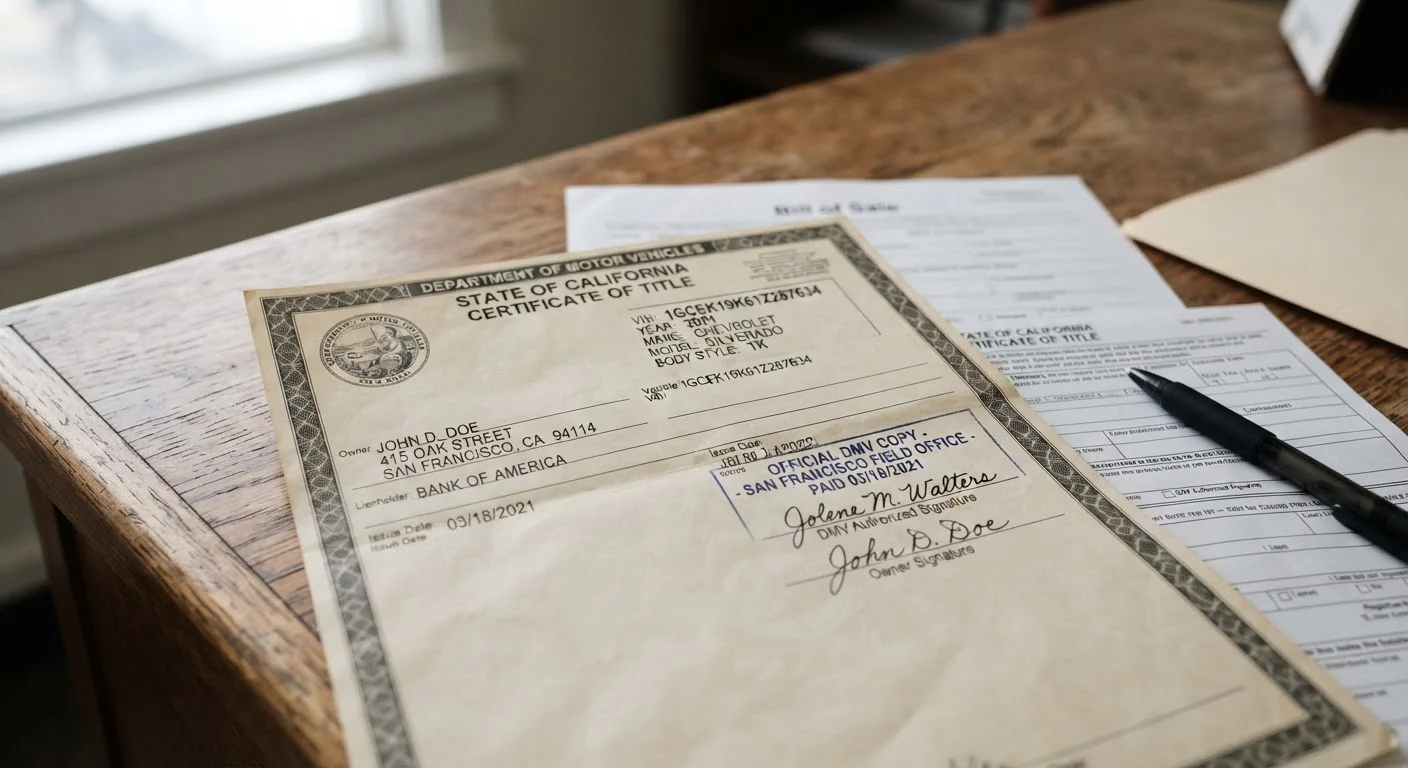
Photo: searchopenrecords editorial
—— In This Article
Key Takeaways
- Every vehicle ownership transfer generates a public title record filed with a state DMV.
- The VIN is the consistent identifier linking every title, registration, and lien record across owners.
- Gaps in the ownership chain can signal undisclosed private sales, title washing, or filing delays.
- You can reconstruct a transfer chain using DMV title history requests and VIN-based record searches.
- State-to-state transfers sometimes create gaps because states don't always share data in real time.
How Ownership Transfers Become Public Records
When a vehicle changes hands in the United States, the transaction is not simply a private agreement between buyer and seller. It triggers a formal public record process administered by each state's Department of Motor Vehicles (DMV) or equivalent title agency. The seller endorses the existing title, the buyer applies for a new one, and the DMV issues a fresh title document listing the new owner — creating a timestamped entry in the state's title database.
The thread that connects every one of these entries is the Vehicle Identification Number (VIN) — a standardized 17-character code assigned to the vehicle at manufacture under NHTSA guidelines. Every title, lien, and registration record generated during the vehicle's life is indexed to that same VIN. This is what makes it possible to reconstruct an ownership chain across multiple decades and multiple states.
To understand the full shape of that chain — including what the title document itself proves — see our overview of the public record trail behind a vehicle title.
Title Records Are State-Specific by Design
No single federal database holds the complete ownership history of every vehicle. Each state maintains its own title records, and data-sharing between states is inconsistent and sometimes delayed. This means a search limited to one state will almost always be incomplete if the vehicle has crossed state lines during its lifetime. Always combine official DMV requests with multi-state VIN data sources to build the most accurate picture possible.
What You'll Need Before You Start
Tracing an ownership transfer chain requires a small set of inputs and access to the right record sources. Gather the following before you begin.
What you will need
With these in hand, you're positioned to submit accurate requests and interpret the records you receive. For a broader orientation to how title and registration records work together, the VIN and title records walkthrough provides useful background.
Steps to Trace the Ownership Transfer Chain
Follow these steps in order. Each builds on the previous, progressively filling in the ownership timeline.
Decode the VIN to establish the vehicle's origin
Before requesting any records, use a free NHTSA VIN decoder (available at vpic.nhtsa.dot.gov) to confirm the vehicle's make, model, model year, country of manufacture, and plant of assembly. This baseline confirms you have a valid VIN and surfaces any discrepancy between what the seller claims and what the manufacturer encoded.
Request a title history from the state DMV
Contact the DMV of the state where the vehicle is currently or was most recently titled. Most states offer a title history record — sometimes called a title transcript or ownership history — that lists each titled owner in sequence with transfer dates. Request this document using the VIN. Some states process requests online; others require a mail-in form or in-person visit.
Run a VIN-based search through a compiled history database
State DMV records reflect only that state's entries. To capture transfers that occurred in other states, run a VIN search through a service that aggregates multi-state title and registration data. These databases draw from DMV feeds, insurance total-loss reports, auction records, and inspection data. Cross-reference results against the DMV title history you already obtained.
Map each transfer onto a timeline
List every owner entry — name or entity type (individual, dealer, fleet), state of title, and transfer date — in chronological order. Mark any period where no titled owner appears. Note whether gaps align with dealer inventory, state-to-state moves, or unexplained lapses. This visual timeline makes anomalies easier to spot and forms the basis for any follow-up requests.
Verify the current title status and any active liens
The final step is confirming that the most recent title is clear — meaning no active lien (a legal claim by a lender) is recorded against it. A lien appears when a vehicle is financed; it must be released by the lender before a clean title can be issued to a new buyer. Request the current title status from the issuing state's DMV, or check lien records through that state's UCC (Uniform Commercial Code) filing system if applicable.
Understanding the difference between a title and a registration document is important here — the two are often confused. See title vs. registration: two records, one vehicle for a clear breakdown of each document's role.
Private sales deserve particular attention — they frequently produce incomplete or delayed records. Our article on what happens to the title record in a private sale explains exactly what records are generated and where gaps commonly appear.
Interpreting Gaps and Anomalies in the Chain
A complete ownership chain will show a continuous sequence of titled owners, each linked to the next by dated transfer records. In practice, gaps appear for several legitimate and illegitimate reasons.
- Dealer inventory periods: A vehicle held by a licensed dealer may not be retitled until sold to a retail buyer, producing a gap in private-owner records.
- Filing delays: Some states allow 30 to 60 days to submit a title transfer application, so a gap does not always mean a hidden owner.
- State-to-state moves: When a vehicle crosses state lines, the receiving state issues a new title but may not receive complete history from the originating state. This is explored in detail in our piece on state-to-state title transfers and how records follow the VIN.
- Title washing: In some cases, a vehicle with a salvage or branded title is moved across states specifically to obscure its history. A gap coinciding with a state change warrants closer scrutiny.
For a deeper look at what missing ownership entries can signal, see how ownership history is recorded and why gaps matter. You can also explore vehicle history reports broadly to understand what compiled reports include beyond title data.

Vin Search Editorial Team
VIN Search Editorial Team is the collective byline for our editorial team and contributor network. Articles published under this byline or an editorial pen name are researched, written, and reviewed according to our editorial standards for clarity, consistency, and independence before publication.
View author profile