
Title Washing: How It Distorts the Public Record Trail
Title washing moves a branded vehicle through states to obscure its history. Learn how this happens, what records it exploits, and its limits.
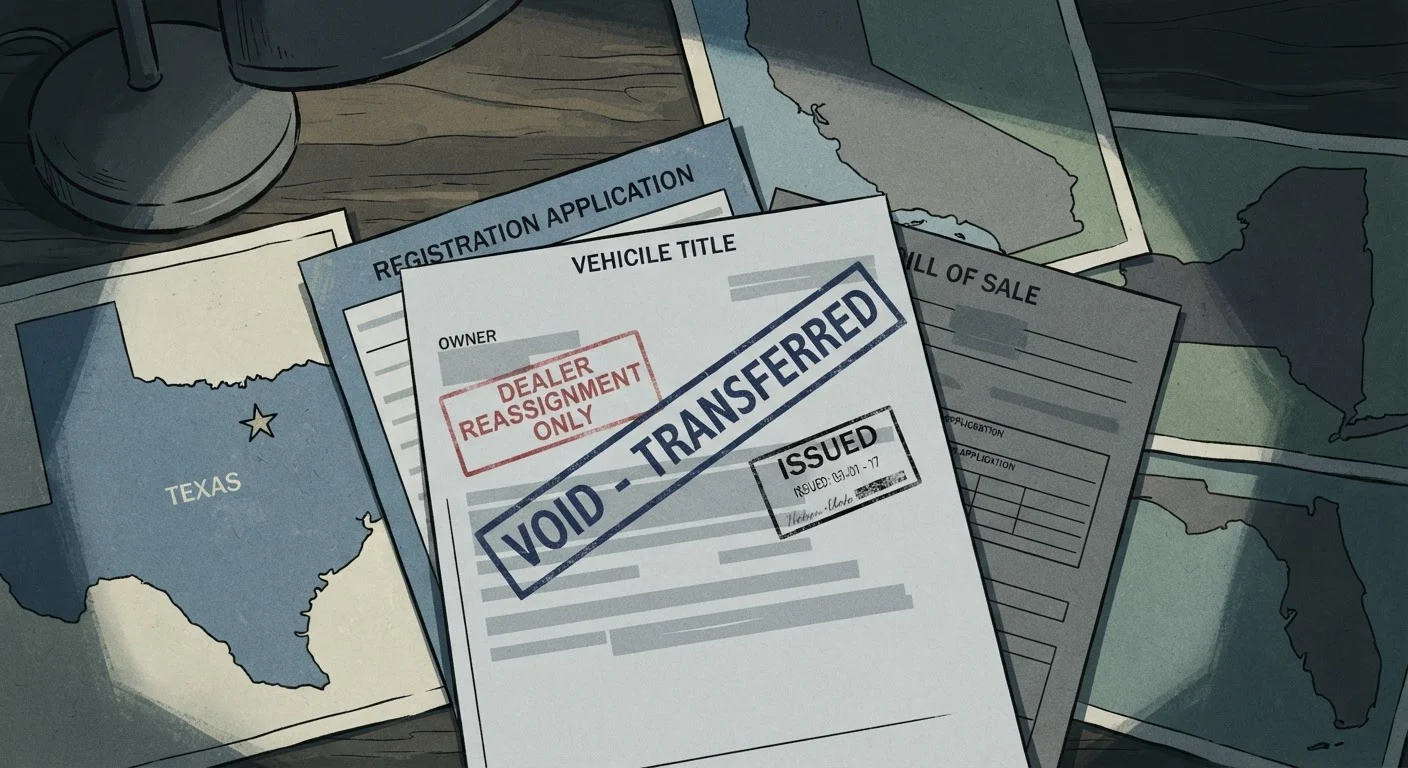
Photo: searchopenrecords editorial
—— In This Article
Key Takeaways
- Title washing moves a branded vehicle through states to erase its salvage, flood, or lemon law designation.
- State title systems are not fully harmonized, creating gaps that title washers exploit.
- NMVTIS was created to share brand data across states, but coverage is not universal.
- A VIN search can surface historical brands even when a current title appears clean.
- No title document alone can guarantee a complete vehicle history — cross-referencing records matters.
How State Title Systems Create the Gap
Every time a vehicle sustains major damage and is declared a total loss, the insurer typically notifies the state DMV, which then brands the title — adding a permanent designation such as salvage, flood, or rebuilt. That brand travels with the title document within that state. The problem arises at state lines.
Each state maintains its own title database with its own rules about which brands to recognize from other jurisdictions and which to carry forward automatically. Historically, these systems did not communicate in real time. A bad actor could transfer a salvage-branded vehicle to a state with looser reciprocal brand recognition, apply for a new title there, and receive a document that omits the original designation entirely. The public record trail behind a vehicle title — liens, registrations, and ownership transfers — should theoretically preserve this history, but gaps between databases interrupt that chain.
The number of states a vehicle passes through before a clean title is issued varies. In some documented fraud cases, a single out-of-state transfer is sufficient; in others, multiple hops are used to further obscure the paper trail.
Brand Terminology Varies by State
Different states use different terminology for the same type of damage history. What one state calls 'salvage' another may call 'total loss' or 'junk.' When reviewing a title or history report, look for the underlying event — insurer total-loss declaration or major structural damage — rather than relying solely on the label used.
The Role of NMVTIS — and Its Limits
The National Motor Vehicle Title Information System (NMVTIS) was authorized under the Anti Car Theft Act and is administered by the U.S. Department of Justice. Its purpose is to give state DMVs, law enforcement, and consumers a centralized reference point for title brands, odometer readings, and total-loss reports from insurers and salvage yards.
When functioning as intended, NMVTIS closes the inter-state gap: a state DMV processing a new title application can query NMVTIS and see that the vehicle carries a prior brand, then apply that brand to the new title. This is a meaningful safeguard. However, NMVTIS depends on participating entities reporting data accurately and promptly. Not all states update at the same frequency, and not all insurers or salvage yards meet reporting deadlines consistently. The result is a system that catches a large proportion of title washing attempts but is not airtight.
50+
Separate state title databases in the US
Each US state and territory maintains its own DMV title system, and inter-state data sharing relies on voluntary NMVTIS participation rather than a single federal mandate.
~1 in 4
Rebuilt or salvage vehicles sold without disclosure
Industry estimates, including analyses by vehicle data researchers, suggest a significant share of salvage-history vehicles reach consumers without clear brand disclosure on the face of the title.
For consumers, this means a current clean title is not a guarantee of a clean history. Cross-referencing NMVTIS-based vehicle history data with insurance total-loss databases and factors that complicate a title record search provides a more complete picture than any single document.
What Title Washing Does to the Ownership Chain
Beyond the brand itself, title washing disrupts the ownership chain — the sequential record of every transfer from one owner to the next. Tracing an ownership transfer through public records relies on each state filing a consistent record when a vehicle changes hands. When a vehicle is moved specifically to launder its history, the transfers involved may be rapid, involve unfamiliar out-of-state entities, or show unusually short ownership durations — all of which are anomalies worth investigating.
Odometer disclosures are another casualty. Federal law requires odometer readings to be disclosed at each transfer, but when a chain of transfers is engineered to obscure history, those disclosures may be falsified or incomplete. The odometer record is one of the data points that a clean title doesn't reveal on its own.
Private sales add further complexity. Private vehicle sales create unique gaps in the title record trail, and title washers frequently use private transactions as one link in the chain precisely because the paperwork burden is lower and scrutiny is reduced.
Practical Steps for Spotting a Washed Title
No single check eliminates all risk, but combining several sources meaningfully reduces it. Start with a VIN-based search that draws on NMVTIS data — this surfaces any brands reported by prior-state DMVs or insurance carriers. Compare the number of states listed in the title history against the ownership timeline: many states in a short period with no clear geographic rationale is a red flag.
Next, look at the odometer progression. Readings should increase consistently over time; a reset or a jump that doesn't align with reported mileage is a disclosure problem. Have a licensed mechanic perform a pre-purchase inspection, paying particular attention to structural repairs, mismatched paint, and water-damage indicators inside the cabin and under carpet.
Finally, review the vehicle history report alongside the physical title. If the history report shows a prior salvage entry but the title in hand shows clean, that discrepancy alone warrants serious scrutiny before any transaction proceeds. The legal framework behind US public records systems gives these documents their authority — but only when the chain of reporting is intact.
This article is for general informational and educational purposes only. It does not constitute legal or financial advice. If you suspect title fraud, consult a qualified attorney or contact your state's DMV and law enforcement.
Frequently Asked Questions

Vin Search Editorial Team
VIN Search Editorial Team is the collective byline for our editorial team and contributor network. Articles published under this byline or an editorial pen name are researched, written, and reviewed according to our editorial standards for clarity, consistency, and independence before publication.
View author profile