
How Ownership History Is Recorded — and Why Gaps Matter
A vehicle history report traces registered owners over time. Understand how ownership records are compiled and what missing entries can signal.
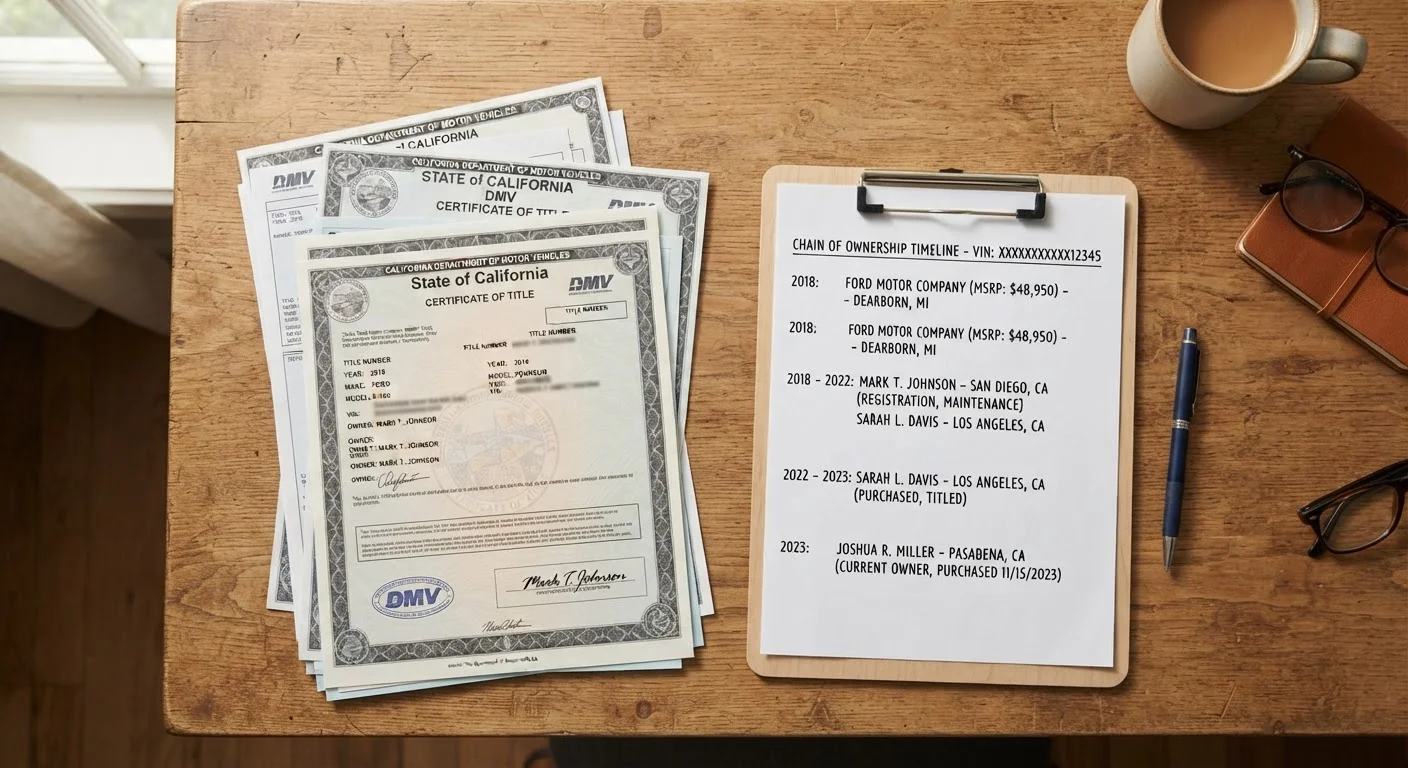
Photo: searchopenrecords editorial
—— In This Article
Key Takeaways
- Each ownership transfer creates a title record filed with the state DMV, linked to the vehicle's VIN.
- Gaps in ownership history can result from cross-state transfers, private sales, or delayed title filings.
- A high number of previous owners in a short time span can indicate underlying problems with the vehicle.
- Ownership records alone don't confirm how a vehicle was used — fleet, rental, or lease histories add important context.
- Incomplete ownership chains don't automatically disqualify a vehicle, but they warrant closer scrutiny.
How Title Records Build the Ownership Chain
Every time a vehicle changes hands in the United States, state law requires the buyer to apply for a new title through their state's Department of Motor Vehicles (DMV). That application — recording the buyer's name, the date of transfer, and the vehicle's identifying information — becomes a public record. Repeated across every sale, these records form a chain of ownership that can be traced back, in many cases, to the original retail purchase.
The vehicle's VIN serves as the through-line. Because the VIN is a unique, standardized 17-character code assigned to every vehicle built for the US market under NHTSA guidelines, every title, registration, and lien document filed across any state gets anchored to that same identifier. This is what makes cross-state ownership tracing possible at all. See how a vehicle title connects to liens, registrations, and ownership history for a deeper look at this record trail.
History report providers aggregate this state-reported data into a single timeline. That timeline is what you see when you run a vehicle history report — a compiled view of ownership entries, title dates, and registration states over the vehicle's recorded life.
Why Gaps Appear — and What They Signal
A gap in ownership history means the public record shows no filed title or registration activity for a period of time. Several legitimate factors can produce these gaps, but each deserves investigation.
Ask About the Gap Period Directly
When a history report shows a gap, the most direct step is to ask the seller to account for that time in writing. A legitimate explanation — dealer holding, out-of-state registration, inheritance processing — should come with supporting paperwork. If the seller cannot explain the gap or becomes evasive, treat that as a significant caution signal.
- Cross-state transfers: Data-sharing agreements between state DMVs are not uniform. A vehicle that moved from one state to another may show a break in the record if the receiving state did not report its title data to the aggregator in a compatible format.
- Delayed title filings: Private-party buyers sometimes drive a vehicle for weeks before completing a title transfer. During that window, no ownership record exists for that period.
- Dealer holding periods: When a dealer acquires a vehicle at auction or trade-in, it may not appear as a registered owner because dealers typically hold titles rather than register vehicles in their name.
- Older records: DMV digitization is incomplete. Titles issued before the widespread adoption of electronic records may simply not exist in any database.
The concern is not a gap itself, but what it might obscure. An unrecorded ownership period could coincide with unreported damage, an odometer rollback, or use in a context — such as a rental fleet or commercial operation — that affects the vehicle's wear. Tracing each ownership transfer through public records can help you identify where the chain breaks and what questions to ask the seller.
Reading Owner Count and Tenure as Signals
Beyond gaps, the pattern of ownership itself carries meaning. A vehicle with many short-tenure owners — several different registered names within a few years — can suggest the vehicle presented problems that successive buyers eventually gave up on. Conversely, a single long-term owner followed by a recent sale may indicate stable care prior to a lifestyle change, such as a relocation or fleet disposal.
50
Separate state DMV systems feeding ownership data
Because each US state maintains its own title and registration database, data completeness in compiled history reports depends on the reporting practices of individual state agencies.
17
Characters in a standardized VIN
NHTSA standardized the 17-character VIN format in 1981; all vehicles manufactured for the US market since then carry a VIN that serves as the anchor for ownership and title records.
Fleet, rental, and lease vehicles add another layer of interpretation. These vehicles often appear with a corporate entity as the registered owner, followed by transfer to a dealer and then retail sale. That pattern is not inherently negative, but it tells you the vehicle was operated under commercial conditions, which affects expected wear. Fleet history is one of the data points explained in what a vehicle history report actually contains.
Pay attention also to any lien entries that appear alongside ownership records. An open lien at the time of a title transfer can complicate ownership — or in serious cases, mean the vehicle was sold without the lienholder's knowledge. Our overview of lien records in vehicle histories explains what those entries actually mean.
What to Do When the Record Is Incomplete
An incomplete ownership chain does not automatically disqualify a vehicle, but it does shift the burden of verification to you as the buyer. Several practical steps can fill the informational gaps a history report cannot.
- Request supporting documents from the seller. Ask for prior titles, service records, or any paperwork covering the missing period. A seller with nothing to hide will generally produce these readily.
- Check for odometer disclosures. Federal law requires odometer disclosure on title transfers. Comparing mileage figures across the ownership chain can surface inconsistencies that suggest tampering, even when full ownership records are absent. Several factors can obscure a vehicle's title history — including missing odometer data.
- Commission a pre-purchase inspection. A qualified mechanic can assess the vehicle's physical condition independently of what the paper record shows. This is especially important when documentation is thin.
- Run the VIN through NHTSA's database. NHTSA maintains a publicly accessible recall database linked to VINs. Outstanding safety recalls should be resolved before purchase regardless of what ownership history shows.
Understanding what a VIN actually tells you about ownership history helps set realistic expectations: a VIN search surfaces what has been officially recorded, not everything that has ever happened to a vehicle. Used alongside direct documentation and a physical inspection, it becomes one part of a sound due-diligence process.
Frequently Asked Questions

Vin Search Editorial Team
VIN Search Editorial Team is the collective byline for our editorial team and contributor network. Articles published under this byline or an editorial pen name are researched, written, and reviewed according to our editorial standards for clarity, consistency, and independence before publication.
View author profile