
How Court Record Information Flows Into Background Check Reports
Understand the path court data takes from courthouse filings to the background check report you or an employer receives.
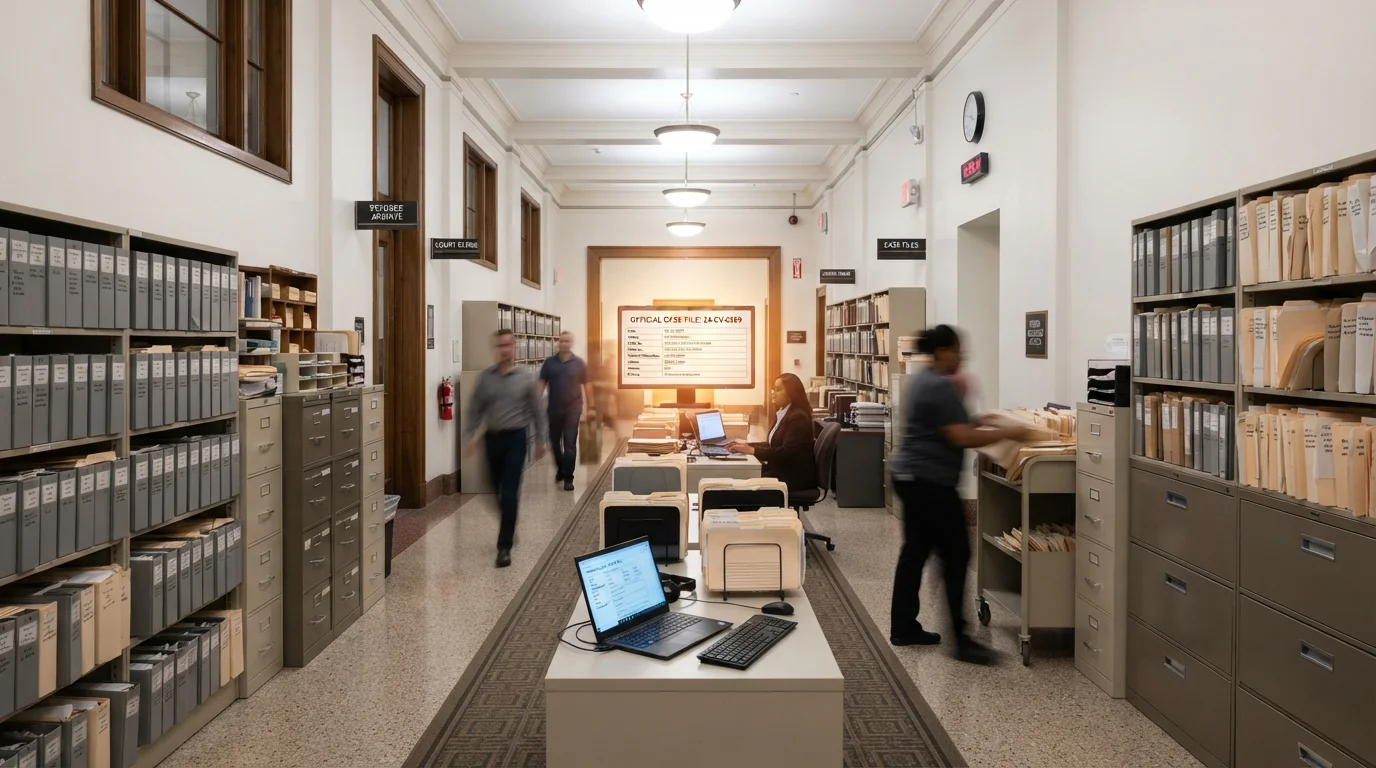
Photo: searchopenrecords editorial
—— In This Article
Key Takeaways
- Court data does not flow automatically from courthouses into background check reports.
- Multiple intermediaries — including data aggregators and consumer reporting agencies — handle records between the courthouse and the final report.
- Gaps, delays, and errors can occur at each stage of the data pipeline.
- The FCRA governs how court data may be used in employment and tenancy background checks.
- Consumers have the right to dispute inaccurate court record information appearing in reports covered by the FCRA.
Where Court Records Originate
Every court record begins with a filing — a charging document, a civil complaint, a plea, or a judgment entered by a clerk into an official case management system. Federal courts use the PACER (Public Access to Court Electronic Records) system, while state and local courts rely on their own case management platforms, many of which vary significantly in format and accessibility.
Different types of court records — from arrest records and indictments to civil judgments and appellate opinions — are stored in separate dockets and do not automatically consolidate into a single, searchable file. A criminal conviction in a county court, for example, exists only in that county's system unless additional steps move it into a broader repository.
State-level repositories, sometimes called statewide criminal history databases, aggregate records from local courts and law enforcement agencies. However, participation by individual courts is inconsistent, meaning statewide databases often contain gaps.
The Intermediary Layer: Aggregators and Consumer Reporting Agencies
Between a courthouse filing and a finished background check report sit two key types of intermediaries: data aggregators and consumer reporting agencies (CRAs).
Data aggregators systematically collect court records from public sources — courthouse portals, state repositories, and federal systems — and compile them into searchable databases. They may update these databases on varying schedules: daily, weekly, or monthly. This lag is a primary reason a recent court record may not appear in a report.
CRAs, regulated under the Fair Credit Reporting Act (FCRA), purchase or license aggregator data and then produce the formatted reports delivered to employers, landlords, or individuals. For employment and tenancy purposes, CRAs are legally required to maintain reasonable accuracy procedures and to investigate consumer disputes. For a fuller look at the entire reporting process, see what actually happens after you submit a background check request.
FCRA vs. Non-FCRA Background Check Products
Not all background check products are FCRA-governed. Some services marketed to the general public operate outside FCRA requirements and carry different — often weaker — accuracy obligations. Understanding which type of report you are dealing with affects what rights you hold to dispute inaccurate information or request disclosure of your file.
Not all background check products are FCRA-governed. Some services marketed to the general public operate outside FCRA requirements and carry different — often weaker — accuracy obligations. Understanding which type of report you are dealing with affects what rights you have.
Database Search vs. Direct Courthouse Search
Most commercially run background checks begin with a database search — fast and broad, but dependent on how recently the aggregator refreshed its data. If a record was entered after the last update cycle, it will not appear.
A direct courthouse search, by contrast, queries the specific court where a case was filed. This method retrieves current records and captures information that has not yet reached aggregator databases. It is also better suited to catching case dispositions — final outcomes such as dismissals or acquittals — that may not be reflected in a database showing only the initial charge.
The public records trail behind background check data illustrates why neither method is universally complete. Many thorough background check processes combine both approaches to reduce the risk of missing or outdated information.
Why Records May Be Missing, Delayed, or Inaccurate
Several structural factors create gaps in court record reporting:
- Inconsistent court participation: Not every jurisdiction submits records to state or national repositories on a consistent schedule.
- Name and identifier mismatches: Court records are often indexed by name rather than a unique identifier, making it possible for records to be missed if a name is spelled differently across systems.
- Disposition lag: An arrest may be recorded promptly while the final case outcome — dismissal, acquittal, or conviction — takes months to be entered and propagated through data systems.
- Expungement delays: Even after a court orders a record sealed or expunged, commercial databases may continue displaying that record until their data is refreshed or a dispute is filed.
Consumers who believe a report contains inaccurate court record information have the right under the FCRA to dispute that information directly with the CRA. The agency must investigate and correct confirmed errors. For context on how fraud-related court records specifically enter these pipelines, see how courts and agencies generate fraud records.
50+
Separate state criminal repository systems in the U.S.
Each U.S. state maintains its own criminal history repository with varying participation rates from local courts, contributing to significant data inconsistencies across jurisdictions.
~30%
FBI records estimated to lack final disposition data
The U.S. Government Accountability Office has reported that a substantial share of arrest records in the FBI's Interstate Identification Index lack recorded case dispositions, limiting report accuracy.
Varies widely
Database refresh frequency among aggregators
Commercial data aggregators update their court record databases on schedules ranging from daily to monthly, creating variable lags between courthouse filings and report availability.
Reading Court Record Data in a Report
When court record information appears in a background check report, it is typically formatted into fields: case number, jurisdiction, charge description, disposition, and disposition date. Understanding each field helps readers evaluate what a record actually reflects.
A charge description alone does not indicate guilt — it reflects what was alleged at filing. The disposition field is the critical data point: it shows whether the case resulted in a conviction, a dismissal, an acquittal, or another outcome. Reports that display charges without dispositions can be misleading and, in some employment contexts, may violate FCRA obligations if they imply culpability where none was established.
For a plain-language breakdown of how these fields appear alongside other report sections, the inside a background check report guide explains each component in detail. Separately, how court records get into a background check report addresses the collection and verification steps that precede the final formatted output.
This article is for general informational purposes only and does not constitute legal advice. Readers with questions about their specific background check rights or dispute options should consult a qualified attorney familiar with FCRA matters.
Frequently Asked Questions

Background Checks Editorial Team
Background Checks Editorial Team is the collective byline for our editorial team and contributor network. Articles published under this byline or an editorial pen name are researched, written, and reviewed according to our editorial standards for clarity, consistency, and independence before publication.
View author profile